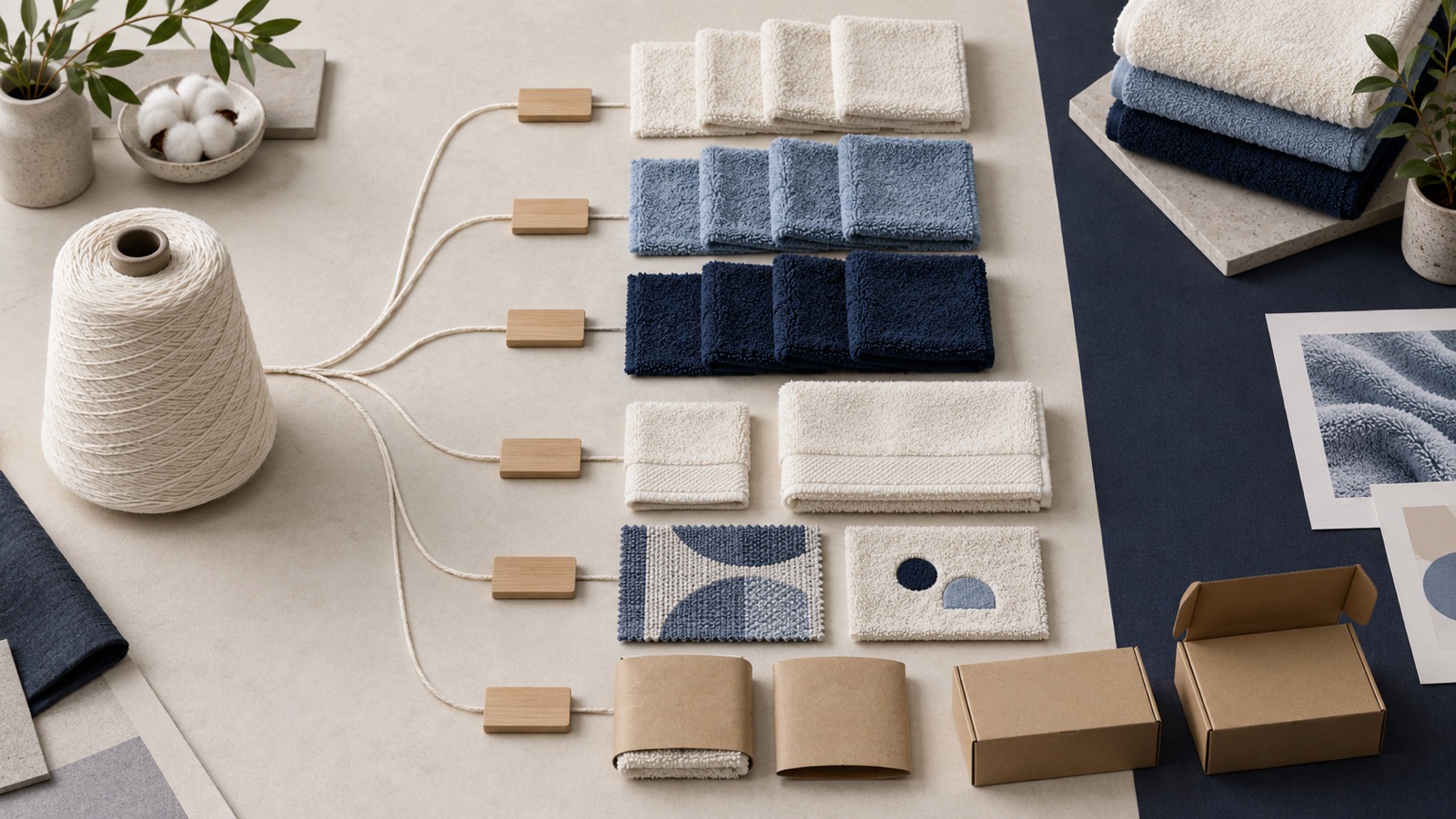
A custom towel MOQ is usually driven by the smallest workable production batch for the requested combination of yarn, construction, colour, weave or logo, size mix and packaging. It may apply to the whole order, but it may also apply separately per construction, colour, design, size or market pack.
There is no single industry minimum that fits every towel. Ask the manufacturer to show which component or process sets the minimum, what quantities can be combined, and which specification change would alter it. Son Ha Textile should confirm any MOQ only after reviewing the actual brief; this article does not publish or imply a standard Son Ha minimum.
MOQ is a batch-planning result, not a quality grade
MOQ means minimum order quantity: the lowest quantity a supplier is prepared to accept under a defined specification and commercial basis. It is different from the buyer’s economic order quantity, which balances demand, inventory and ordering cost. It is also different from a testing lot or shipment lot.
Start by asking, “minimum of what?” A quotation might state a total programme MOQ while hiding smaller requirements per colour, design or SKU. Put the answer beside the specification revision and delivery basis. The towel specification-sheet guide defines the product fields, while the custom towel RFQ checklist helps make suppliers quote them on the same basis.
The seven main MOQ drivers
| Driver | Why a batch forms | What the buyer should ask |
|---|---|---|
| Yarn and fibre | Required yarn count, blend, twist or preparation may need to be committed as a material batch. | Is the yarn standard, stocked, reserved or made for this order? |
| Dyeing and colour | Each shade normally needs its own recipe, approval and production batch. | Is the minimum per shade, and can the same shade serve multiple sizes? |
| Weave and construction | Terry structure, border, jacquard and loom setup define compatible production groups. | Which SKUs can run under one construction setup? |
| Logo method | Jacquard, dobby, embroidery and print have different setup and run requirements. | Is the minimum per artwork, position, colourway or method? |
| Size mix | Changing width, length, border or weight may create separate planning and finishing steps. | Can sizes share yarn, colour and construction batches? |
| Labels and accessories | Woven labels, care labels, tags, barcodes and trims may have supplier batch requirements. | Which item has its own minimum and who owns surplus stock? |
| Packaging | Printed sleeves, bags, inserts, assortments and cartons can form separate order units. | Is the minimum per artwork, language, pack count or destination? |
1. Yarn and base construction come first
A towel may use a standard factory yarn or a less common count, blend, twist or preparation. Material sourced or prepared specifically can set a batch floor before weaving. Ask whether the quote assumes available stock, newly purchased yarn or a proposed substitute.
Then identify which SKUs share the same base. Towels with the same fibre, yarn and terry construction may sometimes be planned together even when dimensions differ; a change in width, pile, border, weight or ground structure may prevent that. Do not assume aggregation. Ask the technical team to group the range by compatible yarn and loom setup.
2. More colours usually create more separate batches
Colour is rarely one order-level field. A range with several shades normally requires separate colour references, lab dips or other approvals and production control for each shade. A pale blue used across bath, hand and face towels may offer more opportunity to combine than three different blues across the same total quantity, provided the yarn, construction and process are compatible.
State how colour will be approved and tolerated. ISO 105-J03:2009 provides a method for calculating colour difference between two specimens measured under the same conditions and permits a maximum tolerance suited to the end use. The standard does not set a towel MOQ; it illustrates why a named reference, measurement conditions and acceptance rule matter when a colour batch is planned.
3. Weave, border and logo method change the setup
A plain terry towel with a standard border, a custom dobby border, an all-over jacquard design and a separately embroidered logo are not equivalent production requests. Each may require different artwork preparation, yarn or thread colours, machine setup, sampling and finishing. Ask for MOQ and setup charges by method rather than asking only for “a logo towel price”.
A different logo size, position or thread palette can turn one programme into several production groups. Request a manufacturability review and price alternative branding methods separately.
4. Size mix can either consolidate or fragment the order
Buyers often describe one collection total, while the factory has to schedule individual widths, lengths and finished weights. A coordinated bath sheet, bath towel, hand towel and face towel may share colour and yarn but still require different loom widths, border placements, cutting or sewing operations. The minimum can therefore be expressed per size as well as per colour.
Ask for a range matrix with rows for sizes and columns for colours. The factory should mark which cells can share material and colour batches and which need their own run. This is more useful than one headline MOQ because it shows where adding a size or colour causes a new setup.
5. Packaging and destination variants can set their own minimums
Retail and private-label orders may include sewn labels, swing tags, barcode stickers, printed sleeves, individual bags, inserts and destination-specific cartons. These components are often sourced separately from weaving, so their supplier batch, printing method and artwork count can become the limiting factor. A buyer may be able to manufacture one towel base yet still need several label or packaging versions.
Resolve label content before committing accessory quantities. The US FTC Textile Fiber Rule requires covered products to disclose fibre names and percentages, responsible company identity and country of manufacture. In the EU, Regulation (EU) No 1007/2011 governs fibre-composition labelling and relevant market language. These are examples, not a global template.
Pack-count changes can also create new trade-item identification. GS1’s GTIN management rule for pack or case quantity states that a unique GTIN is assigned at each existing packaging hierarchy above the base trade item. Confirm identifier ownership, pack levels and artwork before asking a packaging supplier to print.
A hypothetical range shows why totals can mislead
This example describes variant structure only; it does not state any manufacturing minimum. A buyer requests three towel sizes, four colours and two destination-market packs. That creates 24 commercial variants. Manufacturing may be organised around four colour groups sharing a base construction, while labels and packaging split into two market versions. If one size changes yarn or border, it may become another production group.
The RFQ should request the minimum and price basis for every group: base construction, colour, size, artwork and pack. It should also assign any unused yarn, labels or packaging.
Ways to make a small programme more workable
- Use one base yarn and construction across several sizes where technically compatible.
- Reduce the initial colour count, then add proven colours in a later order.
- Choose a standard yarn, size or border when it still meets the product need.
- Use common packaging with controlled market-specific stickers or inserts where legally and commercially appropriate.
- Separate an optional branding method instead of forcing every SKU into a specialised setup.
- Ask for a phased launch, sample route or separately priced alternative rather than asking the factory to hide setup costs.
Do not remove a required fibre, test, label or performance criterion simply to reach a lower quantity. Record alternatives as a new specification revision and approve the representative sample using the towel sample approval checklist.
Questions to put beside every MOQ quote
- Does the minimum apply to the total order, construction, colour, design, size, label or pack?
- Which items can be combined, and what technical condition makes them compatible?
- Which material or process is currently setting the minimum?
- Does the price assume stock material, a custom purchase or surplus ownership?
- What changes at the next quantity break?
- Are sampling, artwork, setup, testing and packaging charged separately?
- What quantity variance or overrun must the purchase order address?
MOQ should be treated as a documented output of the agreed specification, not a number copied from another towel. Reconfirm it when colour count, construction, artwork, size mix, packing or destination changes.
Frequently asked questions
What is Son Ha Textile’s MOQ for custom towels?
There is no MOQ stated in this article. Son Ha Textile should confirm a minimum only after reviewing the product specification, quantities by variant, colour, branding, packaging and destination requirements.
Can different towel sizes share one MOQ?
Sometimes, if they share compatible yarn, colour, construction and production planning. Different widths, borders, weights or finishing steps may create separate runs, so the factory must confirm the grouping.
Does a higher GSM always mean a higher MOQ?
No. GSM changes material use and may affect construction or pricing, but the binding minimum could instead come from yarn, dyeing, loom setup, logo method or packaging. Ask which driver controls the quoted minimum.
Is the sample quantity the same as the bulk MOQ?
No. Sampling is a development stage and may use different material availability, setup or charges. A sample approval does not confirm bulk MOQ unless the factory states the production basis in writing.
Sources
- ISO 105-J03:2009 — Textiles — Tests for colour fastness — Part J03: Calculation of colour differences — International Organization for StandardizationAccessed 5 October 2026
- Textile Fiber Rule — United States Federal Trade CommissionAccessed 5 October 2026
- Regulation (EU) No 1007/2011 on textile fibre names and related labelling and marking — European UnionAccessed 5 October 2026
- GTIN Management Standard — Pack/case quantity — GS1Accessed 5 October 2026
A note on specifications
Product performance, minimum order quantities, lead times, pricing and compliance requirements depend on the final specification, testing standard, order volume and destination market. This article provides general manufacturing information; confirm requirements with the factory and appropriately qualified testing, compliance and logistics advisers before ordering.