
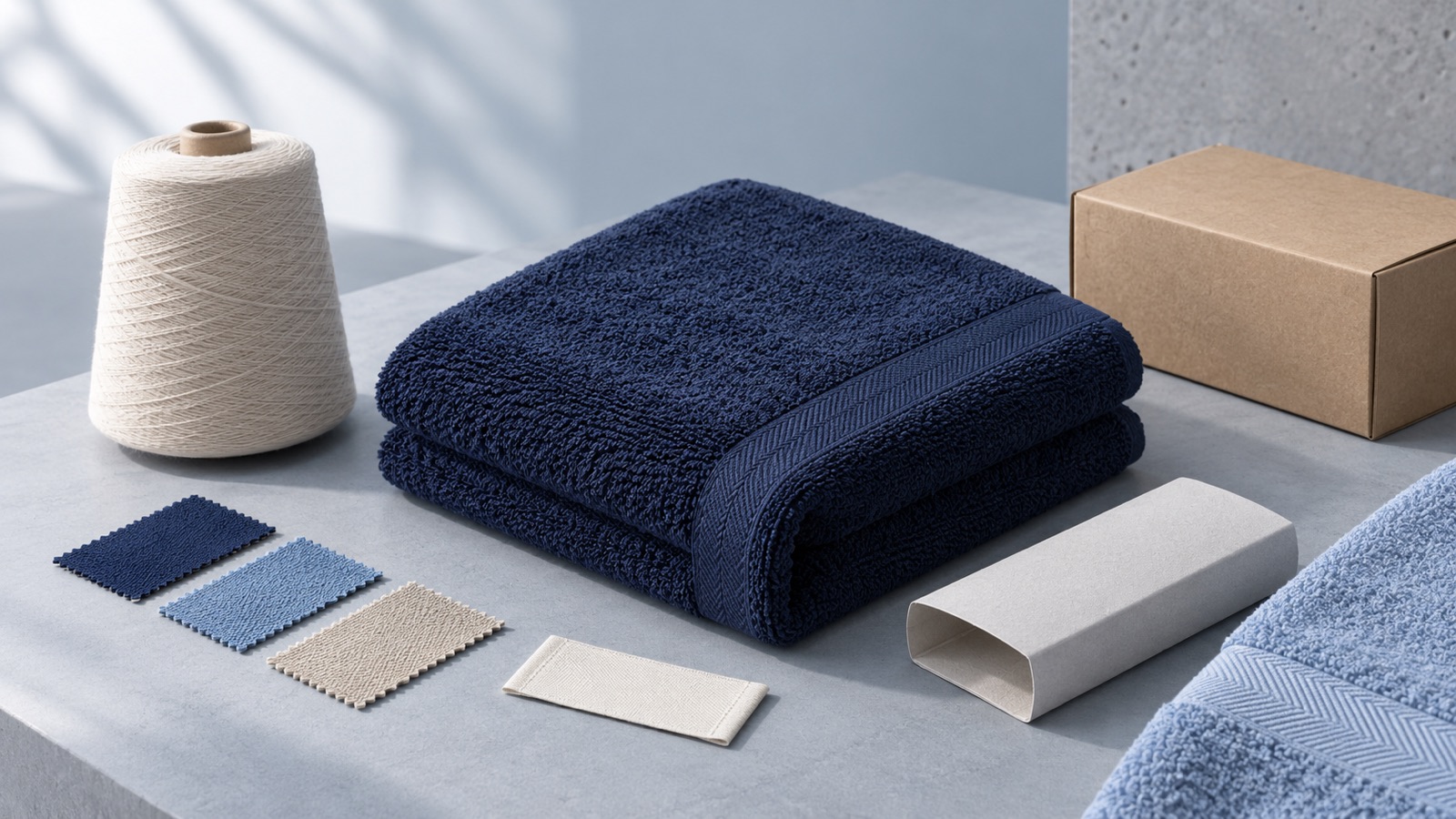
A custom towel request for quotation (RFQ) should identify each product, intended use, quantity by SKU, finished size, fibre and construction target, GSM or piece weight, colour, branding, labels, packaging, required tests, destination, requested timing and delivery basis. Attach controlled artwork, reference images or samples, and state which details are fixed, preferred or open for the manufacturer to propose.
The goal is not to make the longest document. It is to make every invited manufacturer price the same scope and show assumptions separately. Missing quantity, product definition, branding, packing or delivery information can turn apparently similar prices into different products or incomplete commercial offers.
The concise custom towel RFQ checklist
- Project: buyer entity and contact, intended use, destination market, quote currency and required response date.
- Line items: unique SKU, towel type, colour/design, finished dimensions and quantity for every size and colour combination.
- Construction: fibre composition, yarn or pile requirements, target GSM and/or finished piece weight, borders, hems and tolerances.
- Colour and branding: colour references, logo method, artwork revision, dimensions, position and number of colours.
- Labels and packaging: label content, fold, individual pack, assortment, barcode or sticker, units per carton and carton marks.
- Performance and compliance: named tests, methods, pre-treatment and pass limits; buyer-supplied destination requirements.
- Development: required sample stages, approval responsibilities and any reference sample supplied.
- Commercial response: unit-price basis, minimums by relevant line, setup or development charges, tooling ownership, payment proposal, quote validity, production assumptions and exclusions.
- Delivery: requested window, chosen Incoterms® rule with named place, and whether freight, duties or insurance are included.
Use the companion towel specification-sheet guide to define the technical fields in detail. The RFQ is the commercial wrapper around that controlled specification: it tells the supplier what to price, how to respond and where alternatives must be shown.
Separate fixed requirements from proposal fields
Mark every important input as required, target or manufacturer to propose. A required field is not to be changed in the base quotation. A target gives the desired direction and asks the supplier to state the offered value. A proposal field invites manufacturing input while preserving the performance, appearance or commercial outcome the buyer needs.
For example, a buyer may fix the finished size, fibre declaration and embroidered artwork, set GSM as a target within an agreed range, and ask the factory to propose the detailed pile-yarn construction. That produces a useful alternative. By contrast, allowing a supplier to change size, GSM and pack count without highlighting those changes creates a price that cannot be compared directly.
Which missing inputs prevent a like-for-like quote?
| Missing input | What the supplier cannot establish | RFQ remedy |
|---|---|---|
| Quantity by SKU, colour and size | Material, dyeing, branding, packing and production basis for each line | Give a line-level quantity table; label forecasts or optional volumes clearly |
| Finished size and mass target | How much textile is in one saleable unit | State finished dimensions plus GSM and/or piece weight with tolerance |
| Branding artwork and method | Design preparation, stitch or weave complexity, colour count and sampling work | Attach vector artwork and dimensions, or ask for separately priced methods |
| Pack configuration | Accessories, labour, carton count, volume and unit presentation | Specify fold, individual pack, assortment and units per carton |
| Destination and label responsibility | Which label, language, testing and documentation inputs are in scope | Name the market and assign who supplies and approves compliance content |
| Delivery basis | Which logistics costs and responsibilities belong in the price | State the Incoterms® rule, named place and 2020 edition |
Some missing details do not block an indicative price if assumptions are acceptable. A factory may offer a construction option or a standard carton proposal. The response should label those assumptions and avoid presenting an estimate as a confirmed production quote.
Define the product enough to price it
GSM is mass per unit area, covered for woven fabrics by ISO 3801; it is not a complete towel grade. An RFQ should pair the target and tolerance with finished dimensions, fibre composition, yarn and pile direction where controlled, borders, hems, finish and piece-weight expectations. Two same-GSM products can use different constructions and therefore should not be treated as automatic equivalents.
Translate broad performance language into testable requirements. “Absorbent” may need a named method, product state and pass limit: AATCC TM79-2025 determines water absorbency for textiles, while ASTM D4772-26 addresses rapid surface-water absorption and retention specifically for terry fabrics. These methods answer different questions. If the buyer has not selected a method, ask suppliers to identify what they have included rather than assuming every quote covers the same testing.
Destination, labels and delivery belong in the RFQ
Label requirements are market-specific. For covered products in the United States, the FTC Textile Fiber Rule requires disclosures including generic fibre names and percentages, responsible business identity and country of processing or manufacture. In the European Union, Regulation (EU) No 1007/2011 governs textile fibre names and fibre-composition labelling. These examples are not a universal label template. State the destination and sales channel, then identify who will supply and approve the final content.
Care instructions need the same precision. ISO 3758:2023 establishes care symbols for specified textile-care processes and excludes industrial laundering from its symbol system. Attach approved artwork only after the intended care process and applicable market rules have been confirmed.
For international quotations, the ICC explains that Incoterms® 2020 allocates costs, risk and obligations between buyer and seller. The RFQ should state the chosen rule with a precise named place and the edition—for example, not simply “FOB price” with no named port. Incoterms® does not replace product specifications, payment terms or the wider sales contract.
Require a structured supplier response
Ask every supplier to return the same line-item table. For each SKU, request:
- offered construction and any deviation from the base specification;
- unit price, currency, quantity tier and price basis;
- minimum quantity or batch condition and what drives it;
- sample, artwork, setup, tooling, test and packaging charges shown separately;
- sample and production timing as a proposal, with its stated assumptions;
- pack count, carton assumptions and delivery basis;
- quote validity, payment proposal, exclusions and buyer actions required.
Do not infer that one universal minimum order quantity or lead time applies to custom towels. Ask the manufacturer to state the relevant minimum by design, colour, size or pack and to confirm timing after the construction, materials, approvals and order scope are settled.
Move from quotation to controlled sampling
An RFQ starts commercial comparison; it does not approve production. Once a route is selected, update the technical sheet with the offered construction and record each sample stage, approval authority and open deviation. The towel sample approval checklist covers dimensions, mass, GSM, colour, construction, branding, workmanship, packaging and agreed tests before bulk production.
Son Ha Textile’s factory team in Phùng Xá, Hanoi can review a custom towel RFQ against the company’s manufacturing capabilities and factory-direct partnership approach. Commercial terms, minimums, sample scope and timing remain specific to the final brief and should be confirmed in the quotation and order documents.
Questions buyers often ask
Is an RFQ the same as a towel specification sheet?
No. The specification defines the product and acceptance requirements. The RFQ adds quantities, timing, delivery basis, requested commercial response and the rules for pricing alternatives. Use them together.
Can I ask the manufacturer to propose the construction?
Yes. Fix the intended use, appearance, dimensions, fibre or label constraints, performance needs and commercial limits, then identify construction as “manufacturer to propose”. Require the offered details and deviations to be stated.
Should an RFQ include a target price?
It can, if the target is realistic and clearly labelled. A target helps guide alternatives, but suppliers should not silently change size, material, performance or packaging to reach it. Ask them to show the base offer and any value-engineered option separately.
Do I need final packaging artwork before requesting a quote?
Not always. You do need enough information to define the pack type, materials, dimensions, print scope, labels, assortment and carton quantity. Mark provisional artwork as such and ask the supplier to list its pricing assumptions.
Sources
- ISO 3801:1977 — Textiles — Woven fabrics — Determination of mass per unit length and mass per unit area — International Organization for StandardizationAccessed 5 October 2026
- AATCC TM79-2025 — Test Method for Absorbency of Textiles — AATCCAccessed 5 October 2026
- ASTM D4772-26 — Standard Test Method for Surface Water Absorption of Terry Fabrics (Water Flow) — ASTM InternationalAccessed 5 October 2026
- Incoterms® 2020 — International Chamber of CommerceAccessed 5 October 2026
- Textile Fiber Rule — United States Federal Trade CommissionAccessed 5 October 2026
- Regulation (EU) No 1007/2011 on textile fibre names and related labelling and marking — European UnionAccessed 5 October 2026
- ISO 3758:2023 — Textiles — Care labelling code using symbols — International Organization for StandardizationAccessed 5 October 2026
A note on specifications
Product performance, minimum order quantities, lead times, pricing and compliance requirements depend on the final specification, testing standard, order volume and destination market. This article provides general manufacturing information; confirm requirements with the factory and appropriately qualified testing, compliance and logistics advisers before ordering.