
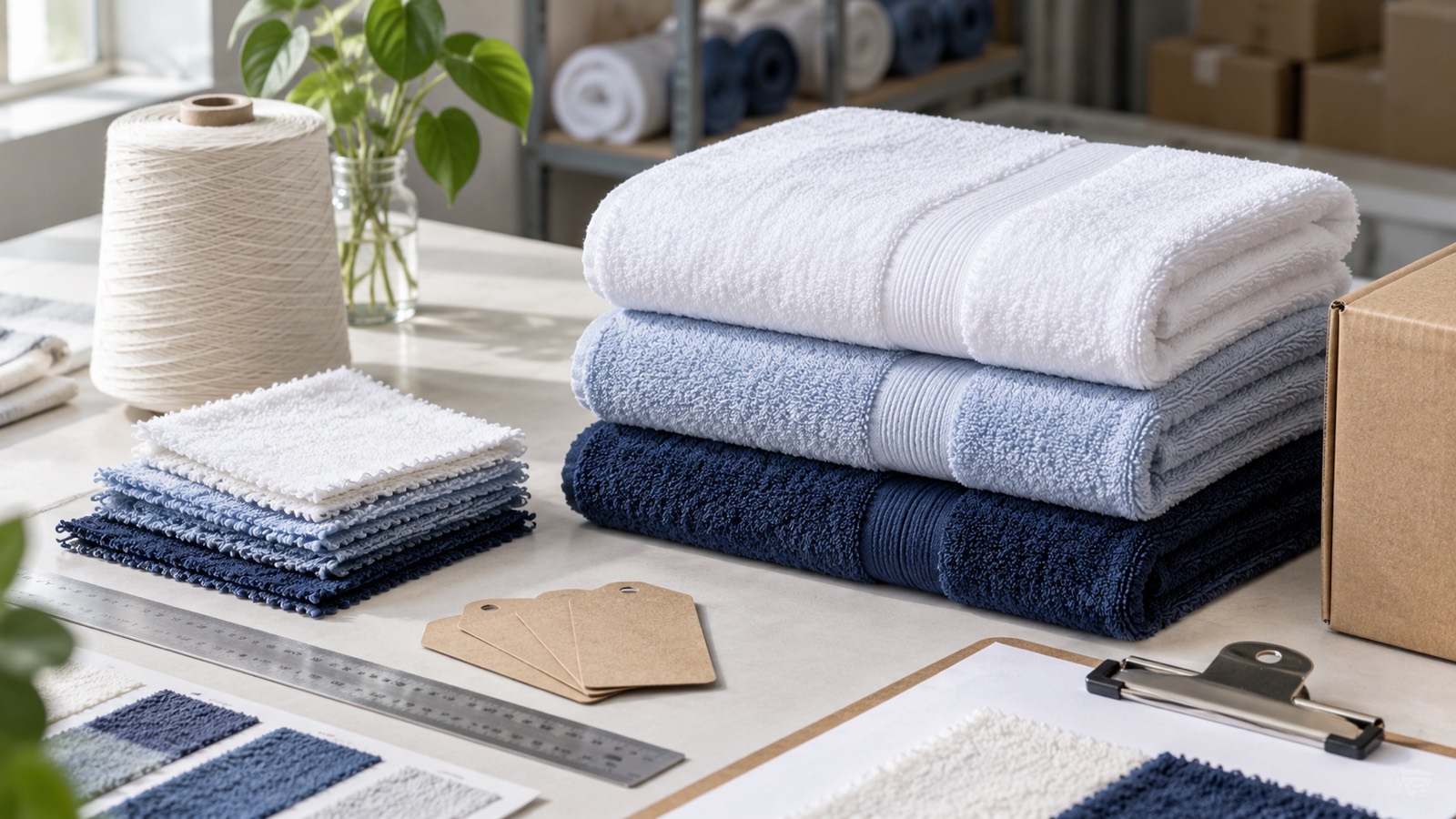
Sourcing towels from Vietnam works best as a controlled product-development process, not a search for the lowest unit price. Give each factory the same measurable brief, verify the organisation and relevant capability, approve a documented sample, agree quality and commercial controls, then align packing and export records before production begins.
Vietnam is the manufacturing origin, but the destination market still determines many import, labelling and product requirements. The buyer, manufacturer, testing provider, customs broker and freight partners should therefore agree who owns each decision and document rather than assume the factory handles every obligation.
1. Convert the buying need into a factory-ready brief
Start with what the towel must do. State the product type, intended user, destination market, sales or operating channel, target quantities by size and colour, and desired launch or delivery window. Then define finished dimensions, GSM or piece weight, fibre composition, yarn and terry construction, border and hem details, colour references, branding, labels, packing and test requirements.
Separate mandatory requirements from targets and items the factory may propose. A reference towel or photograph helps communicate appearance, but it does not replace measurable instructions. Use the towel specification-sheet guide to create one controlled RFQ revision, and the GSM guide to avoid treating weight as a complete quality grade.
2. Build a short list and verify each manufacturer
Before comparing samples or prices, confirm who will manufacture the goods and who will sign the contract. Request the legal company name, registered address, business registration details, factory location and the name of the entity that will invoice and export. Check that bank-account and contract details align; independently verify any change to payment instructions.
Evaluate capability against the actual brief rather than a general claim to make towels. Useful questions include:
- Which requested processes are performed at the named factory, and which are subcontracted?
- Can the proposed equipment and construction make the required sizes, borders, jacquard or branding?
- How are yarn, colour, production lots, inspections and packing records identified?
- Which tests can be performed internally, and which require an external laboratory?
- Can the factory provide current evidence for any certification or audit that your programme specifically requires?
Do not infer certification, capacity or destination-market approval from a website or sales deck. Ask for evidence, check its scope, facility name and validity, and decide whether an on-site or remote assessment is proportionate to the order. Son Ha Textile’s capabilities and partnership approach provide a starting point for a factory-direct discussion in Phùng Xá, Hanoi; the final programme still needs its own confirmed specification and evidence.
3. Compare quotations on the same basis
A useful quotation repeats the specification revision and identifies assumptions, exclusions, order quantity by SKU, sample charges, tooling or artwork costs, packing, payment stages, expected timing and quotation validity. Ask suppliers to show alternatives separately so a lower price is not created by an unnoticed change in size, GSM, fibre, construction or pack.
| Control point | What to record | Why it matters |
|---|---|---|
| Product basis | Specification revision, artwork and reference sample | Keeps every quote tied to the same product. |
| Commercial basis | Currency, quantity breaks, payment stages and validity | Makes offers comparable beyond unit price. |
| Delivery rule | Named place or port and Incoterms® 2020 rule | Allocates defined transport tasks, costs and risk points. |
| Timing basis | Dependencies, sample approval point and planned readiness window | Shows what must happen before production timing starts. |
The ICC explains that Incoterms® rules allocate specified obligations, costs and transfer of risk, but they are not a substitute for the sale contract. Write the chosen rule, version and exact named place—for example, “FCA [named place], Incoterms® 2020”—then have qualified trade and logistics advisers check that it suits the transport plan.
4. Develop and approve a representative sample
Treat sampling as a decision gate. Record the sample’s fibre, yarn, construction, finished size, mass, colour, branding, labels and pack, then compare them with the RFQ. Test the characteristics that matter for the intended use, which may include absorbency, dimensional change, colourfastness, lint, seam security and appearance after a defined laundering process.
Approval should identify both the physical sample and the updated specification revision. A signed sample with vague comments leaves room for disagreement; a photograph alone cannot preserve handle, pile or weight. The sample approval checklist provides a repeatable record. If a sample is conditionally approved, list each required correction and decide how it will be confirmed before bulk production.
5. Put the commercial and quality agreement in writing
The purchase contract or purchase order should identify the parties, goods, quantities, prices, payment arrangement, approved specification and artwork, inspection and test plan, packing, delivery terms, document requirements, change-control process and an agreed route for resolving non-conformity. Obtain appropriate professional advice for legal, payment, tax, insurance and sanctions questions; they vary by parties and markets.
Define production checkpoints before work starts. Depending on risk, these may cover incoming materials, lab dips, pre-production confirmation, in-line checks and a pre-shipment inspection. If acceptance sampling is used, specify the standard, inspection level, lot definition and defect classes rather than writing “AQL inspection” alone. ISO 2859-1:2026 defines AQL-indexed sampling schemes for lot-by-lot inspection by attributes; the parties still need to select and document the plan that applies.
6. Lock labels, packing and destination requirements
The importer or brand owner should identify applicable rules before production labels and packaging are ordered. Requirements differ by destination and channel. For example, the US FTC Textile Fiber Rule requires covered textiles to disclose generic fibre names and percentages, the manufacturer or marketer identity, and the country of processing or manufacture. In the EU, official guidance states that textile products marketed to consumers generally require fibre-composition labelling and relevant destination-language text under its rules. See the EU textile-labelling guidance.
These examples are not a universal checklist. Confirm fibre naming, country-of-origin marking, care information, language, product safety, chemical restrictions, packaging, barcodes and importer details for the exact market and use. Approve artwork, placement, attachment method, fold, assortment, carton count, carton strength and shipping marks as controlled files.
7. Align export documents and origin evidence before shipment
Vietnam’s official trade repository lists a customs declaration and, where the buyer must pay the seller, a commercial invoice among the documents for exported goods; permits, specialised inspection records or other evidence apply where the goods are subject to those controls. The same procedure describes electronic declaration and customs-routing steps. Check the current Vietnam export customs procedure with the exporter and broker for the actual shipment rather than treating an article checklist as filing instructions.
Also reconcile the commercial invoice, packing list, transport booking, product description, quantities, net and gross weights, carton marks, HS classification approach and any required origin evidence. Vietnam’s National Trade Repository lists the country’s trade agreements, but a listed agreement does not make a towel shipment automatically eligible for preferential tariff treatment. The repository’s FTA explainer describes tariff preference in relation to goods that originate as defined in the relevant agreement. Eligibility therefore depends on the applicable product-specific rule of origin, supporting records and the importing country’s procedures. Confirm classification, origin and duty treatment with qualified customs advisers.
8. Close the order with records, not assumptions
Before release, match the inspection result, approved deviations, packing data and shipment documents to the latest order revision. Record who accepted any change. After delivery, review shortages, damage, test results, customer feedback and laundering performance against the agreed criteria, then feed verified findings into the next specification.
A well-run sourcing programme creates traceability from the initial brief through the sample, production lot, cartons and documents. That discipline matters more than the country name alone: it lets the buyer and the Vietnam factory solve concrete product and shipment questions against one shared record.
Frequently asked questions
Should I source directly from a towel factory or through an intermediary?
Either model can work. Direct sourcing gives the buyer direct access to manufacturing decisions, while an intermediary may provide local coordination or consolidated services. Compare responsibilities, technical access, commercial transparency and quality controls—not only the quoted price.
Does buying from Vietnam automatically reduce import duty?
No. Duty depends on the destination, HS classification, customs value and any valid preferential origin claim. A trade agreement only helps when the product and evidence satisfy its applicable rules and the importer follows the required procedure.
What should I send before asking for a price?
Send the intended use, destination, quantities by SKU, dimensions, GSM or piece weight, fibre and construction, colour, branding, labels, packing, tests and delivery basis. Mark open points clearly so the factory can price its proposal separately.
When should a pre-shipment inspection happen?
Agree the timing in the quality plan. It should be late enough that a defined portion of the lot is finished and packed, but early enough to investigate and address a non-conformity before the agreed release or shipment date.
Who is responsible for destination-market compliance?
Responsibility depends on the law, contract and role of each party; importers and brand owners commonly hold obligations that cannot simply be assumed by the factory. Assign each compliance task in writing and obtain qualified advice for the target market.
Sources
- Procedure and Requirements on Customs Documents for Exported Goods — Vietnam National Trade Repository, Ministry of Industry and TradeAccessed 4 October 2026
- Free Trade Agreements — Vietnam National Trade Repository, Ministry of Industry and TradeAccessed 4 October 2026
- What Are Free Trade Agreements? — Vietnam National Trade Repository, Ministry of Industry and TradeAccessed 4 October 2026
- Incoterms® and Commercial Contracts — International Chamber of CommerceAccessed 4 October 2026
- ISO 2859-1:2026 — Sampling Procedures for Inspection by Attributes — International Organization for StandardizationAccessed 4 October 2026
- Textile Fiber Rule — United States Federal Trade CommissionAccessed 4 October 2026
- Textile Label — Your Europe, European UnionAccessed 4 October 2026
A note on specifications
Product performance, minimum order quantities, lead times, pricing and compliance requirements depend on the final specification, testing standard, order volume and destination market. This article provides general manufacturing information; confirm requirements with the factory and appropriately qualified testing, compliance and logistics advisers before ordering.