
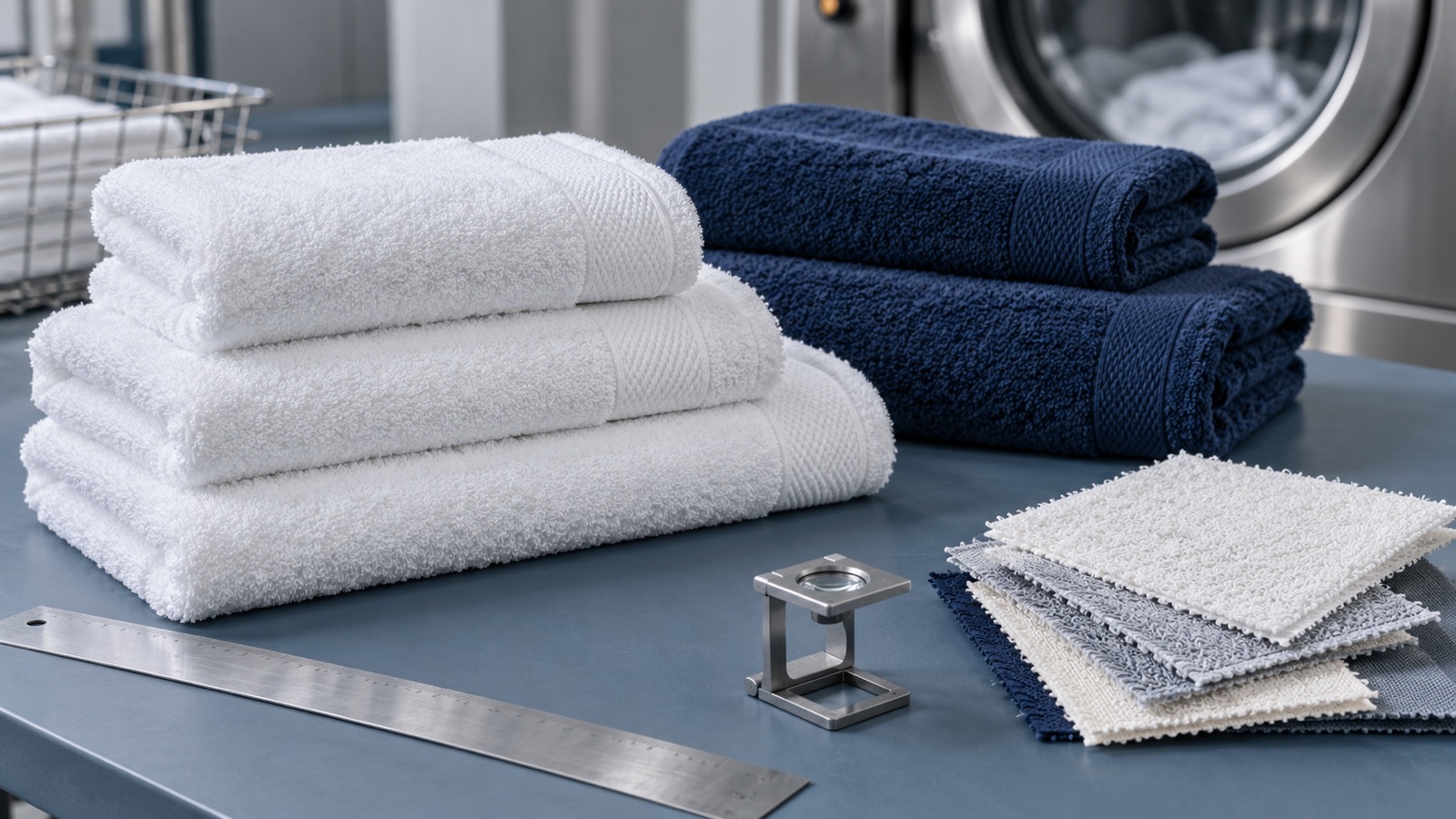
Specify a hotel towel around the laundry process it will actually face, not around a hotel-star label or a single GSM number. Define the product role, finished construction, wash chemistry and temperature, drying method, expected appearance and performance, test methods, tolerances and replacement criteria.
The most useful brief is built jointly by procurement, housekeeping, the laundry operator and the towel manufacturer. It gives the factory a repeatable target and gives the hotel a practical way to approve samples before bulk production.
Start with the laundry operation, not a generic towel grade
“Commercial laundering” is not one universal cycle. An on-premise washer-extractor, a tunnel washer at an outsourced laundry and a smaller professional machine can apply different chemistry, temperature, mechanical action, load size, extraction and drying conditions. Industry training from the Textile Rental Services Association treats sorting, washing, drying, finishing and pack-out as connected parts of textile processing. Your towel brief should do the same.
Ask the operator to document the intended process before requesting samples:
- Flow: on-premise or outsourced; batch washer or tunnel; sorting rules; typical load mix.
- Wash: programme name, temperature range, cycle stages, detergent system, bleaching or oxidising agents, neutralisation and water conditions.
- Dry: tumble-dryer type, target endpoint or moisture control, heat setting, cool-down and whether items are pressed or folded directly.
- Soil: ordinary guest use plus recurring makeup, spa oil, pool chemical or food-and-beverage exposure relevant to the product.
- Service: turnaround, inventory level, visual presentation, stain-reclaim policy and reasons for removing a towel from circulation.
Record ranges where the process varies. Do not turn an unverified operating assumption into a factory requirement; confirm it with the laundry provider and chemical supplier responsible for the actual programme.
Translate the operating brief into product decisions
| Decision | What to specify | Why operations need it |
|---|---|---|
| Product role | Bath, hand, face, pool or spa towel; finished dimensions and permitted tolerance | Prevents similar-looking items from being approved against the wrong use |
| Construction | Fibre content, yarn system, pile on each face, ground construction, GSM target and tolerance | Defines the article more completely than weight alone |
| Edges and branding | Hem, selvage, border, label and any jacquard or embroidery detail | Creates inspection points for distortion, loose stitching and appearance |
| Colour | Approved standard, instrumental or visual tolerance, shade grouping and bleach exposure | Connects brand presentation with the chemicals used in service |
| After-laundry result | Dimensions, mass, absorbency, colour change, staining, lint, seams, pile and overall appearance after a defined protocol | Turns “laundry suitable” into measurable acceptance criteria |
There is no universal GSM for every hotel or hotel category. GSM measures mass per area; it does not independently predict absorbency, drying time or durability. Use the towel GSM guide to set a controlled weight target, then compare constructions under the intended wash and dry process.
White and coloured towels both require a deliberate laundry plan. For coloured goods, align the shade and dye-performance requirement with the expected detergent and bleach system. For white goods, define the desired white appearance and how it will be assessed rather than assuming every white towel or brightening system behaves alike. Branding details must also be sampled: dense embroidery, decorative borders and labels may respond differently from the terry field.
Write a test plan that matches the claim
A test name is not enough. State the edition, selected procedure, number of cycles, specimen condition, measurement points and pass/fail limit. The method must match the property and the laundry environment.
| Property | Useful evidence | Important boundary |
|---|---|---|
| Dimensional change | ISO 5077 provides a method for determining dimensional change after specified washing and drying procedures. | The wash and dry procedure still has to be named; the result is not a universal shrinkage promise. |
| Colour in industrial laundering | ISO 105-C12:2024 addresses resistance of textile colour to industrial laundering. | Choose the relevant industrial procedure and acceptance grade; colourfastness is not inferred from fibre or GSM. |
| Colour in domestic or normal commercial laundering | ISO 105-C06 covers specified domestic or commercial procedures for normal household articles. | ISO notes that industrial articles can face special, sometimes more severe procedures; C06 should not automatically substitute for C12. |
| Water absorbency | AATCC TM79-2025 determines water absorbency for textiles of different fibre contents and constructions. | Specify when in the wash sequence absorbency is checked and the criterion to be met. |
Domestic procedures can be useful when they answer the intended question, but they must be labelled accurately. ISO 6330:2021 defines domestic washing and drying procedures and warns that machine, detergent and dryer parameters can affect results. Likewise, consumer-facing care symbols under ISO 3758:2023 exclude industrial laundering. A retail care label therefore does not replace the hotel’s commercial-laundry specification.
Approve a laundered sample, not only a new towel
Begin with an unwashed reference sample and record the details in the sample approval checklist. Then run a documented pilot using representative loads and the intended wash chemistry, drying process and number of cycles agreed for development. Keep the reference and laundered samples identified so appearance, dimensions, mass, handle, absorbency, hems and decoration can be compared consistently.
A development trial is not a universal wash-life claim. Actual service life also depends on operating control, stains, misuse, loss, reclaim decisions and the property’s rejection threshold. Instead of asking the factory to guarantee an unsupported number of washes, define the conditions of the pilot and the point at which the hotel would consider the result unacceptable.
For a bulk order, carry the approved construction and test plan into production inspection. The full towel specification sheet should identify sample status, tolerances, test reports, packaging and change-control responsibilities so the approval does not depend on memory or a vague “same quality” instruction.
A procurement checklist for hotel towel programmes
- Define each towel’s use, finished dimensions, colour and presentation requirement.
- Document the real wash, chemical, bleach, extraction and drying conditions with the laundry operator.
- Specify fibre, yarn, pile, ground, GSM, borders, hems, branding and tolerances.
- Select tests that match the actual property and process; write procedure, cycles and acceptance limits.
- Approve both new and laundered samples, with identification and measured results.
- Define rejection and replacement reasons that housekeeping and laundry teams can apply consistently.
- Freeze the approved record before production and control any later material or process change.
Son Ha Textile’s factory team in Phùng Xá, Hanoi can develop towel constructions against a buyer’s documented product and laundry brief. Review the relevant manufacturing capabilities and partnership approach, then confirm product-specific tests, commercial terms and destination requirements before ordering.
Questions hospitality buyers often ask
What GSM is best for hotel towels?
There is no universal best figure. Set a target around guest feel, towel size, storage, laundry throughput and drying constraints, then validate the complete construction in the actual or representative laundry process.
Are white towels always better for commercial laundry?
No. White and coloured programmes have different appearance, chemistry and shade-management considerations. The correct choice depends on the property’s brand standard, soil profile, wash system and replacement practice.
Is a care label enough to tell a laundry how to process hotel towels?
No. ISO 3758 care symbols are intended for end users and exclude industrial laundering. Give the laundry a separate, documented process specification and confirm any industrial-laundry marking required for the programme.
How many washes should a hotel towel last?
A responsible specification should not promise one number for every towel and laundry. Agree a representative trial, measure defined properties and track service removals by reason; use that operating evidence to improve the next purchase.
Sources
- ISO 105-C12:2024 — Textiles — Tests for colour fastness — Part C12: Colour fastness to industrial laundering — International Organization for StandardizationAccessed 4 October 2026
- ISO 105-C06:2010 — Textiles — Tests for colour fastness — Part C06: Colour fastness to domestic and commercial laundering — International Organization for StandardizationAccessed 4 October 2026
- ISO 5077:2007 — Textiles — Determination of dimensional change in washing and drying — International Organization for StandardizationAccessed 4 October 2026
- ISO 6330:2021 — Textiles — Domestic washing and drying procedures for textile testing — International Organization for StandardizationAccessed 4 October 2026
- ISO 3758:2023 — Textiles — Care labelling code using symbols — International Organization for StandardizationAccessed 4 October 2026
- AATCC TM79-2025 — Test Method for Absorbency of Textiles — AATCCAccessed 4 October 2026
- Laundry Operations and Management — Textile Rental Services AssociationAccessed 4 October 2026
A note on specifications
Product performance, minimum order quantities, lead times, pricing and compliance requirements depend on the final specification, testing standard, order volume and destination market. This article provides general manufacturing information; confirm requirements with the factory and appropriately qualified testing, compliance and logistics advisers before ordering.