
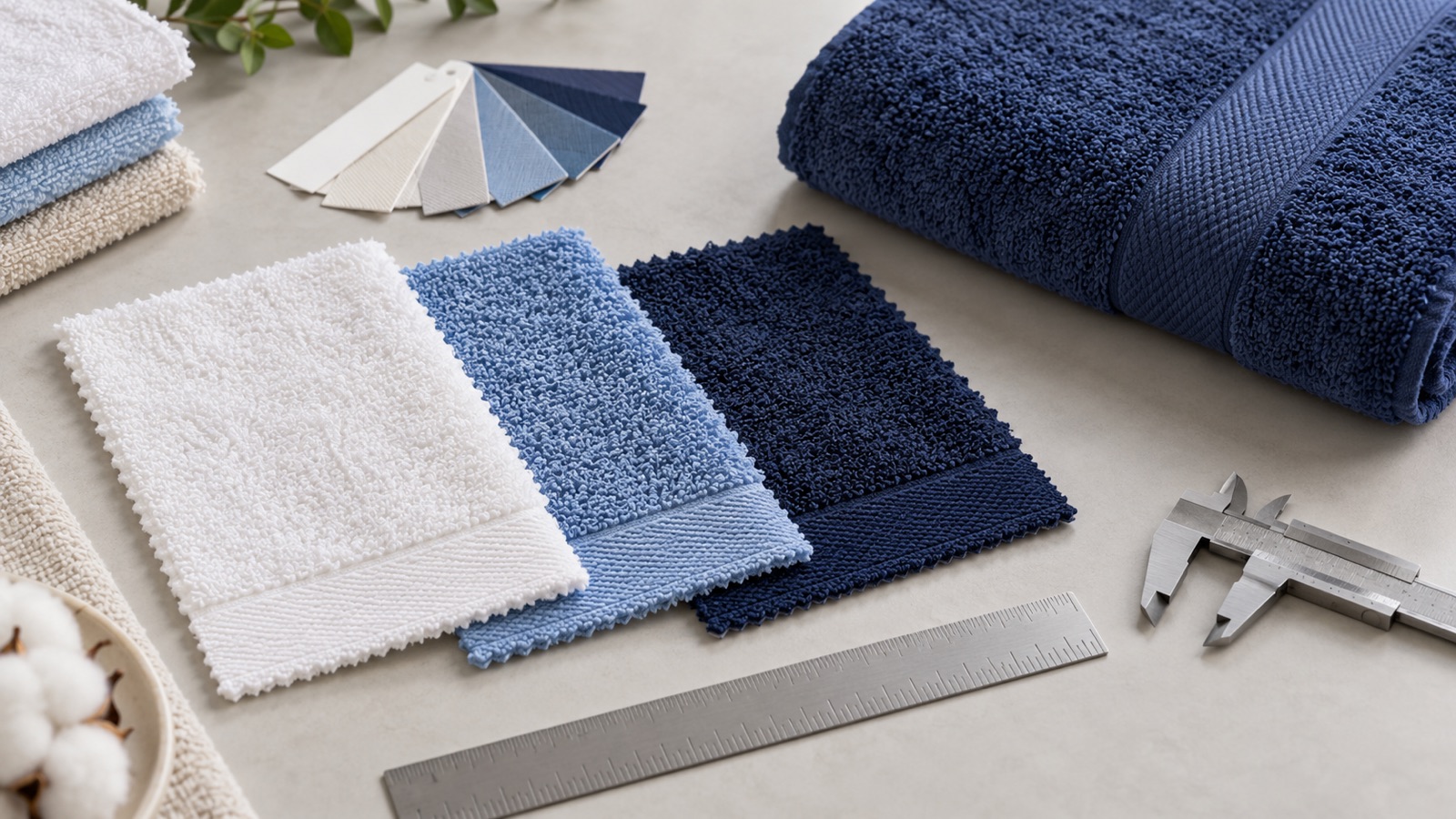
Approve a towel sample against a written, measurable record—not the instruction “same as sample”. Record the conditioned dimensions and mass, calculated GSM, colour reference and tolerance, construction, branding, workmanship, labels, packaging and every agreed performance test before bulk production begins.
The approved sample is a physical reference, but the approval sheet is what makes the decision repeatable. It should state how each characteristic is measured, the permitted tolerance and what happens when a result falls outside the agreed range.
Why a signed sample is not enough
A towel can feel right yet still leave important questions unanswered. Was it measured before or after washing? Was the weight recorded at the moisture condition in which it arrived? Which lighting was used to judge the colour? Does approval include the label, barcode and carton, or only the towel?
Resolve those questions before authorising bulk production. Start from a clear towel specification sheet, then use the sample to confirm that the proposed construction and finish express that specification correctly. Keep one sealed reference with the buyer and, where practical, one with the manufacturer. Photographs are useful for communication, but they do not replace a physical sample or measured data.
Set the measurement conditions first
Textiles exchange moisture with the surrounding air, so mass and dimensions can shift with conditioning. ISO 139 defines standard atmospheres for conditioning textiles and determining physical and mechanical properties. If a formal laboratory result is required, name the method and conditioning protocol rather than relying on an office measurement (ISO 139:2005).
For an operational approval, record at least the sample date, sample stage, sample identification, measuring equipment, location and condition, and whether the piece has been washed. Use the same approach when checking retained samples or bulk goods. This turns “approximately” into a result another person can reproduce.
The towel sample approval checklist
| Checkpoint | What to record | Approval question |
|---|---|---|
| Identity | Style/SKU, size, colour, sample stage, revision and date | Is everyone approving the same version? |
| Dimensions | Finished length and width, measurement points, condition and tolerance | Does it fit the specified size before and after the agreed care test? |
| Mass and GSM | Conditioned piece mass, measured area, calculated GSM and tolerance | Do the figures agree with the specification and with each other? |
| Colour | Shade reference, viewing conditions, visual or instrumental tolerance | Is the shade acceptable, including after the agreed wash test? |
| Construction | Fibre claim, yarn/pile description, border, hem, selvage and weave details | Are the visible and structural details correct? |
| Branding | Logo method, artwork revision, size, position, orientation and colours | Is the mark legible and correctly placed without harming use? |
| Workmanship | Agreed defect examples and limits for stitching, stains, holes, loose threads and distortion | What is acceptable, repairable or rejectable? |
| Labels and packing | Label copy, placement, barcode, fold, pack quantity and carton identification | Does the presentation match the approved order and destination requirements? |
| Performance | Named test method, laboratory or in-house status, pre-treatment, cycles and pass criteria | Has each result been accepted against a defined limit? |
1. Measure dimensions, mass and GSM separately
Lay the towel without stretching it and define exactly where length and width are taken, including how borders or fringes are treated. Record the actual figures, not just “pass”. For dimensional-change work, ISO 3759 covers preparation, marking and measurement before and after a specified treatment, while ISO 5077 covers calculating dimensional change after the chosen washing and drying procedures (ISO 3759:2011; ISO 5077:2007).
Weigh the complete towel and calculate GSM from the agreed measured area. Mass per unit area is a defined textile property—ISO 3801 is one reference for woven fabrics—but a towel's finished piece weight and its GSM are not interchangeable when dimensions vary (ISO 3801:1977). Use the same conditioning and calculation convention for approval and later inspection. The companion guide, Towel GSM Explained, covers why weight per area is not a complete quality grade.
2. Make colour approval reproducible
Name the approved colour reference, the face or area to compare, the illuminant or viewing cabinet, and the maximum permitted difference. An approved cut swatch or lab dip should be identified and protected from light, dirt and handling. If instrumental colour control is required, agree the instrument conditions and colour-difference formula; ISO 105-J03 provides a method for calculating colour difference between textile specimens measured under the same conditions and allows a maximum tolerance to be specified (ISO 105-J03:2009).
Colour match and colourfastness are different decisions. A shade can match initially and still change or stain adjacent material in laundering. ISO 105-C06 addresses resistance to domestic and commercial laundering with defined detergent systems, and notes that special industrial or hospital procedures may be more severe (ISO 105-C06:2010). Match the test exposure to the intended care process.
3. Inspect construction, branding and workmanship
Review pile coverage and direction, woven borders, hems, selvages, seams and any decorative construction on both faces. For jacquard, embroidery or other branding, verify the correct artwork revision, dimensions, position, orientation, thread or yarn colours and reverse-side appearance. Also check whether the branding creates stiffness, exposed threads or distortion that affects the product's intended use.
Replace broad terms such as “good workmanship” with illustrated defect categories. Agree how to classify holes, stains, skipped stitches, open seams, loose threads, pulled loops, uneven hems, bowing, skew and incorrect labels. The approval sample may show the desired appearance; the written record defines the acceptance boundary for bulk inspection.
4. Approve performance tests, not assumptions
Select tests from intended use and care conditions. A typical programme may consider dimensional change, colourfastness, absorbency, lint or fibre shedding, seam performance and appearance after laundering, but not every towel needs the same plan. Record the exact method edition, pre-treatment, number of cycles, acceptance limit and whether testing is by an independent laboratory or an agreed in-house procedure.
Do not use one measure as a proxy for another. ASTM D4772-26, for example, evaluates surface water absorption of terry fabrics and explicitly treats it as only one characteristic relevant to acceptance; it does not turn GSM into an absorbency result (ASTM D4772-26). If commercial laundering matters, align the sample test with the real chemistry, temperature, mechanical action and drying process; the hotel-towel specification guide develops that operational brief.
5. Close the approval with controlled records
- Assign the sample a unique style, colour, revision and date.
- Record every result, tolerance, deviation and agreed corrective action.
- Mark which components are approved: towel, branding, label, individual pack and export carton.
- Attach artwork, colour references, test reports and dated photographs to the same approval record.
- Obtain named approval from the authorised buyer and factory contacts.
- State whether production may begin or whether a revised sample is required.
If a deviation is accepted for the sample, write it into the order record. An unrecorded exception can later be mistaken for the bulk standard. Buyers working factory-direct with Son Ha Textile in Phùng Xá, Hanoi can share the completed approval record with the factory team as part of the production handover; see the site's manufacturing capabilities and partnership approach for context.
Frequently asked questions
Is a pre-production sample the same as an approved sample?
Not automatically. Sample-stage names vary between suppliers. Define what the sample represents, which materials and processes are production-intent, and who has authority to release bulk production.
Should a towel be washed before approval?
Approve both the as-received product and results after the specified care procedure when wash performance matters. Record the procedure, cycles and drying method so the result can be repeated.
How many measurements should be taken?
The sampling plan depends on the characteristic, method and order risk. A single development piece can support design review, but it does not establish production variation. Agree a separate bulk inspection plan.
Can photographs replace a retained approval sample?
No. Photographs help document layout and visible defects, but camera, screen and lighting differences limit colour and texture comparison. Retain identified physical samples where practical.
What should happen if the sample misses one tolerance?
Record the deviation and decide explicitly whether to reject it, request correction or accept a revised limit. Do not allow an informal exception to become the production specification.
Sources
- ISO 139:2005 — Textiles — Standard atmospheres for conditioning and testing — International Organization for StandardizationAccessed 4 October 2026
- ISO 3759:2011 — Textiles — Preparation, marking and measuring of fabric specimens and garments in tests for determination of dimensional change — International Organization for StandardizationAccessed 4 October 2026
- ISO 5077:2007 — Textiles — Determination of dimensional change in washing and drying — International Organization for StandardizationAccessed 4 October 2026
- ISO 3801:1977 — Textiles — Woven fabrics — Determination of mass per unit length and mass per unit area — International Organization for StandardizationAccessed 4 October 2026
- ISO 105-J03:2009 — Textiles — Tests for colour fastness — Part J03: Calculation of colour differences — International Organization for StandardizationAccessed 4 October 2026
- ISO 105-C06:2010 — Textiles — Tests for colour fastness — Part C06: Colour fastness to domestic and commercial laundering — International Organization for StandardizationAccessed 4 October 2026
- ASTM D4772-26 — Standard Test Method for Surface Water Absorption of Terry Fabrics (Water Flow) — ASTM InternationalAccessed 4 October 2026
A note on specifications
Product performance, minimum order quantities, lead times, pricing and compliance requirements depend on the final specification, testing standard, order volume and destination market. This article provides general manufacturing information; confirm requirements with the factory and appropriately qualified testing, compliance and logistics advisers before ordering.