
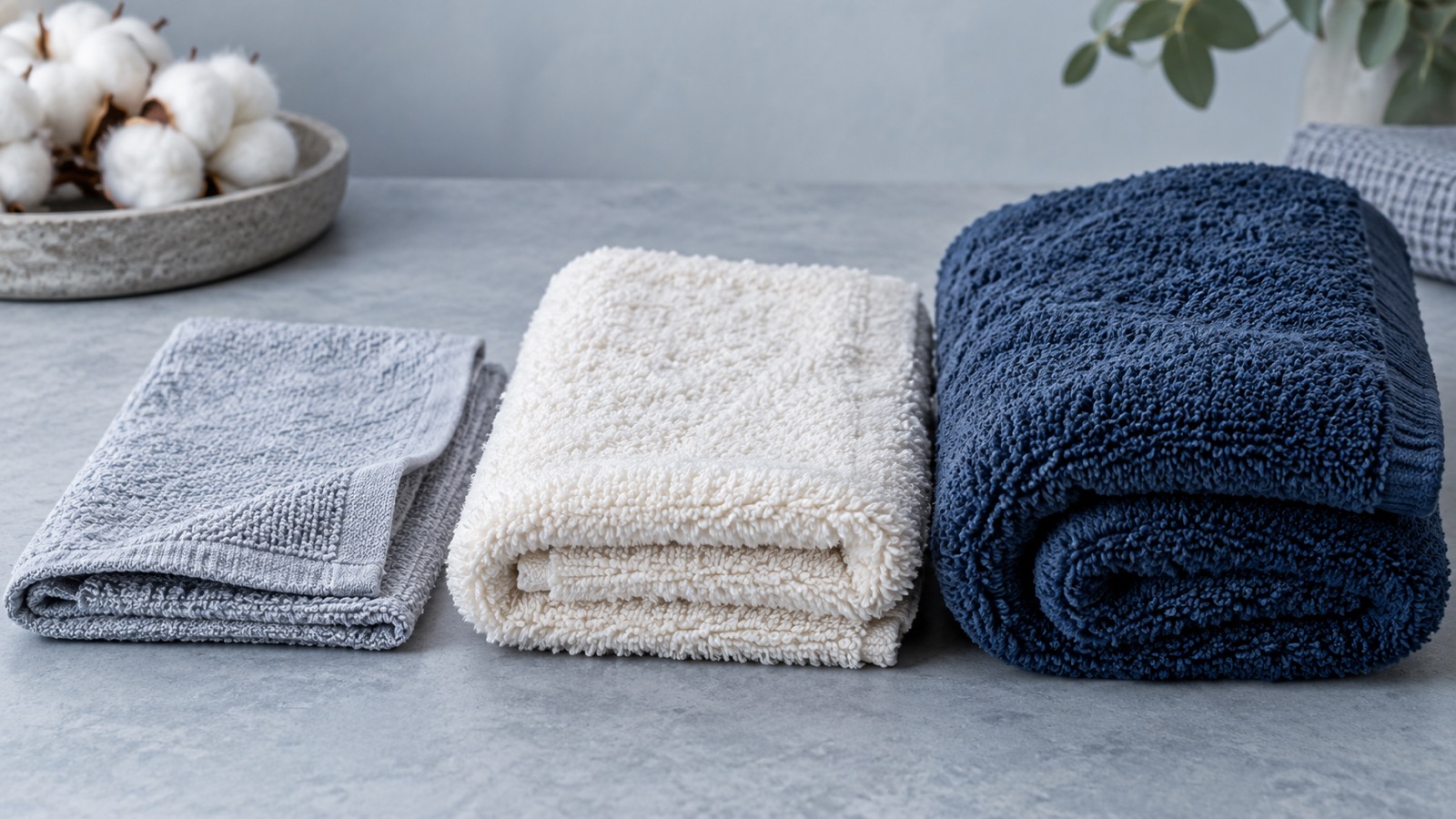
GSM means grams per square metre. For a towel, it states how much the fabric weighs over a defined area; it does not by itself grade quality, softness, absorbency, drying speed or durability.
Treat GSM as one controlled construction variable. A useful buying specification pairs it with fibre and yarn details, pile construction, finished dimensions, tolerances, wash conditions and the performance tests relevant to the towel’s intended use.
What towel GSM actually measures
GSM is mass per unit area: grams divided by square metres. That is the same underlying measurement addressed by ISO 3801 for woven fabrics. It is a physical quantity, not a marketing grade.
The calculation is straightforward: GSM = sample mass in grams ÷ sample area in square metres. A properly cut 0.10 m² specimen that weighs 50 g therefore measures 500 GSM. In formal evaluation, the agreed conditioning, specimen preparation, number of specimens and reporting method matter; a small informal cutting can be useful for screening, but it should not quietly replace the method written into the purchase specification.
GSM can also give a planning estimate of finished towel mass. A hypothetical 70 × 140 cm towel has an area of 0.98 m². At 500 GSM, its simple area-based estimate is 490 g. The delivered piece may not equal that number exactly because hems, borders, labels, dimensional tolerance and local variation affect total mass. If piece weight matters for freight, laundry loads or shelf presentation, specify and verify it separately.
What GSM tells a buyer
When the rest of the construction is held constant, GSM is a useful control for three practical decisions:
- Material quantity per area. It distinguishes a lighter construction from a heavier one without confusing towel size with fabric mass.
- Sampling consistency. The approved sample and production lots can be checked against the same nominal target, tolerance and method.
- Range architecture. A buyer can set different weight targets for a face towel, bath towel and bath sheet while keeping the visual programme coordinated.
GSM works best as a comparator only when like is compared with like. Two towels at the same GSM may distribute their mass differently between ground yarns, pile yarns and decorative borders. A different fibre, yarn count, twist, pile height or weave can change the handle and behaviour while the scale still reports the same mass per area.
What GSM does not tell you
The number is silent on several properties that matter to users and operations. Each needs construction information, a physical sample or a relevant test.
| Buyer question | What GSM can indicate | What to specify or verify instead |
|---|---|---|
| Will it feel soft and full? | How much mass is present per area | Fibre content, yarn system, twist, pile height and density, finish, and an approved handle sample |
| Will it absorb water quickly? | No direct answer | Define an absorbency method and acceptance criterion |
| Will it dry quickly? | A heavier article may carry more material, but GSM does not measure drying | Drying method, construction, airflow and intended laundry conditions |
| Will it survive repeated washing? | No direct answer | Wash protocol plus requirements for dimensions, colour, seams, pile and appearance |
| Will every towel weigh the same? | A nominal basis for control | GSM tolerance, finished dimensions, piece-weight tolerance and sampling plan |
Absorbency and drying are separate performance questions
A towel can have ample mass yet wet slowly if its fibre, construction or finish impedes rapid wetting. Conversely, a well-designed lighter towel may absorb surface water effectively for its intended task. This is why recognised methods evaluate water behaviour directly: AATCC TM79 addresses water absorbency across textile forms, while ASTM D4772 measures the ability of terry fabric to rapidly absorb and retain liquid water from a surface. ASTM also cautions that surface water absorption is only one characteristic used to judge whether a terry fabric is acceptable.
Drying is another distinct metric. AATCC TM200, for example, determines drying rate at a textile’s absorbent capacity under an airflow method. Its existence is a useful reminder: do not convert a GSM target into an unsupported promise about drying time. Agree the real use case—home tumble drying, line drying or a commercial laundry—and evaluate the sample under a representative, documented protocol.
Wash performance needs conditions, not assumptions
A pre-wash GSM result does not predict the dimensions or appearance after laundering. ISO 5077 covers determination of dimensional change after washing and drying, used with defined procedures such as those in ISO 6330. ISO 6330 provides multiple washing-machine, detergent and drying options and notes that those parameters can affect results. A specification therefore needs the selected procedure, number of cycles, measurement points and acceptance limit—not merely “wash tested”.
Colour performance is separate again. ISO 105-C06 evaluates resistance of textile colour to specified laundering conditions; it does not derive a result from fabric weight. For demanding institutional or hospitality use, the actual detergent, bleach system, temperature and mechanical action may differ from a domestic procedure, so the buyer and factory should align the test protocol with the destination and operating environment. See the related guide to specifying hotel towels for commercial laundering.
How to put GSM into a factory-ready specification
Write the GSM line so another person can reproduce the check. At minimum, define:
- Nominal target and tolerance. State both; do not leave “approximately” to interpretation.
- Product state. Say whether the value applies to finished, conditioned goods and whether it is checked before or after a defined wash procedure.
- Measurement method and sampling plan. Name the method or an agreed documented procedure, specimen locations, sample count and how results are averaged and reported.
- Construction beside the number. Record fibre composition, yarn details, pile arrangement, weave, border, dimensions, colour and finish.
- Separate performance criteria. Add the relevant requirements for absorbency, drying, dimensional change, colourfastness, seams, lint and appearance.
Then compare the same data at development, approval and production checkpoints. The towel specification-sheet guide explains how to organise those requirements, and the sample approval checklist helps prevent a visually acceptable sample from becoming an ambiguous production standard.
Son Ha Textile’s factory team in Phùng Xá, Hanoi can discuss GSM alongside yarn, pile, weave, finishing and intended use during product development. The overview of manufacturing capabilities provides context, but the confirmed construction and test plan for each programme should remain in its own controlled specification.
Questions buyers often ask
Is a higher-GSM towel always better?
No. Higher GSM means more mass per unit area, not automatically better absorbency, softness, durability or value. “Better” depends on the use case, construction and verified performance.
Can two 500 GSM towels feel different?
Yes. Fibre, yarn count and twist, pile height and density, ground construction, borders and finishing can create noticeably different handle and performance at the same GSM.
Should GSM be measured before or after washing?
That depends on the purchasing requirement. State the product condition and wash procedure explicitly. If both initial and post-wash control matter, specify both rather than assuming one value covers the other.
Can I calculate finished towel weight from GSM?
You can estimate it by multiplying area in square metres by GSM. Use that for planning, then set a separate finished piece-weight tolerance if exact delivered weight matters because hems, borders, dimensions and local construction can shift the result.
Sources
- ISO 3801:1977 — Textiles — Woven fabrics — Determination of mass per unit length and mass per unit area — International Organization for StandardizationAccessed 4 October 2026
- AATCC TM79-2025 — Test Method for Absorbency of Textiles — AATCCAccessed 4 October 2026
- ASTM D4772-26 — Standard Test Method for Surface Water Absorption of Terry Fabrics (Water Flow) — ASTM InternationalAccessed 4 October 2026
- AATCC TM200-2017e2 — Drying Rate of Textiles at their Absorbent Capacity: Air Flow Method — AATCCAccessed 4 October 2026
- ISO 5077:2007 — Textiles — Determination of dimensional change in washing and drying — International Organization for StandardizationAccessed 4 October 2026
- ISO 6330:2021 — Textiles — Domestic washing and drying procedures for textile testing — International Organization for StandardizationAccessed 4 October 2026
- ISO 105-C06:2010 — Textiles — Tests for colour fastness — Part C06: Colour fastness to domestic and commercial laundering — International Organization for StandardizationAccessed 4 October 2026
A note on specifications
Product performance, minimum order quantities, lead times, pricing and compliance requirements depend on the final specification, testing standard, order volume and destination market. This article provides general manufacturing information; confirm requirements with the factory and appropriately qualified testing, compliance and logistics advisers before ordering.