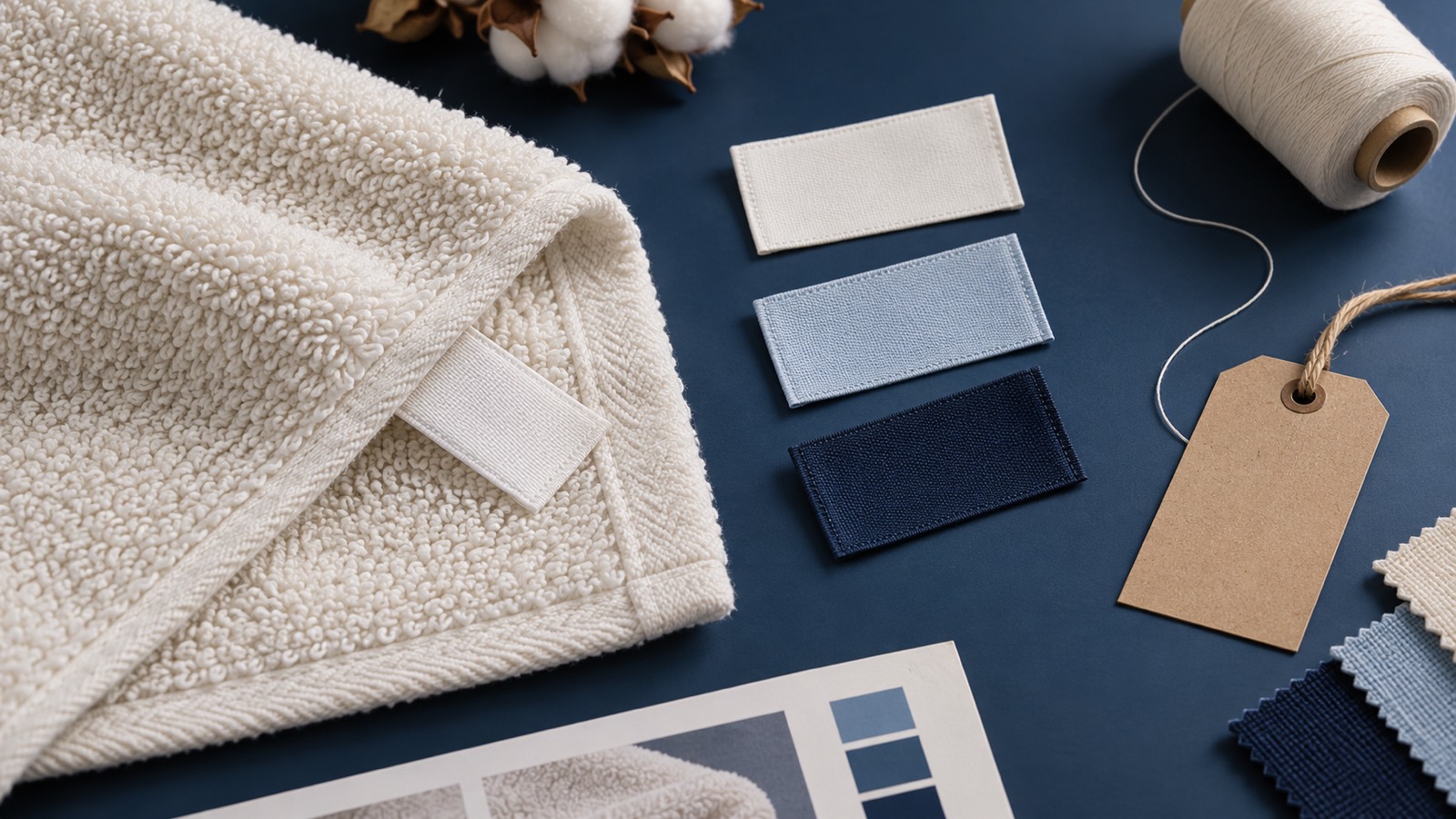
There is no single “global textile label” that makes a towel compliant everywhere. Fibre composition, country of origin, responsible-business identity, care information, language and label placement are governed differently by the destination market and sometimes by the product category or sales channel.
A reliable export brief therefore starts with the exact SKU, destination and route to market. The buyer, importer and qualified compliance adviser should approve the legal content; the factory should manufacture and attach the controlled artwork without silently filling gaps or reusing a label from another market.
Separate four label questions before designing the artwork
Buyers often place fibre, origin and care into one spreadsheet cell called “main label”. That makes omissions more likely because each disclosure answers a different question and may have a different legal source.
| Label field | Decision to confirm | Evidence needed |
|---|---|---|
| Fibre composition | Permitted generic fibre names, percentages, order and treatment of components | Approved bill of materials and market rule |
| Country of origin | Applicable origin rule, wording, language and placement | Manufacturing route reviewed by the importer or adviser |
| Responsible business | Manufacturer, importer, retailer name or authorised identifier | Destination rule and approved commercial identity |
| Care information | Whether required, which symbol or wording system applies, and what treatments the product can tolerate | Market rule, licensed symbol set where applicable and substantiated care instructions |
United States: towels need fibre, origin and business identity
The FTC’s current business guidance lists towels, washcloths and dishcloths among household products covered by the Textile Act and Rules. In general, the label must disclose fibre content, country of origin, and either the company name or the Registered Identification Number (RN) of the manufacturer, importer or another responsible business in the distribution chain. The required information must be legible, conspicuous and readily accessible; FTC guidance also addresses attachment, placement and English-language disclosure. See Threading Your Way Through the Labeling Requirements before approving US artwork.
Fibre wording must represent the whole product, not only its most marketable part. In its towel-specific examples, the FTC explains that if pile and ground use different fibres, the label must account for the fibre weight of both. A claim such as “100% Pima Cotton” is not acceptable when only the loops are Pima cotton and the ground uses another cotton type. The FTC’s cotton guidance gives examples for combined and separately described pile-and-ground constructions.
For origin, the FTC says imported products must identify the country where they were processed or manufactured, with the country determined under laws and regulations enforced by US Customs and Border Protection. Its guidance also warns that Customs requirements are separate. For certain “flat” goods, including towels, processing in the United States using foreign fabric can require wording that identifies both the US processing and the fabric’s country. The importer should determine the final origin statement from the actual production route; “Designed in” or the supplier’s address is not a substitute.
US care rules do not treat every textile product alike
The FTC Care Labeling Rule, 16 CFR Part 423, is scoped to textile wearing apparel and certain piece goods. It requires covered manufacturers and importers to provide care instructions with a reasonable basis, but it is not a blanket federal care-labelling requirement for every finished household textile. A towel programme should not claim that the apparel rule itself mandates its care label without confirming product scope.
Buyers may still require care information for consumer usefulness, retailer policy or another applicable rule. When they do, the instructions should be supported by the product’s fibre, colour, construction, finish and verified laundering behaviour. Copying the warmest wash or strongest bleach symbol from an unrelated towel creates avoidable product risk even when the artwork looks familiar.
European Union: Regulation 1007/2011 centres on fibre composition
Regulation (EU) No 1007/2011 governs textile fibre names and the related labelling and marking of fibre composition. For multi-fibre products, the name and percentage by weight of constituent fibres are generally listed in descending order, subject to the Regulation’s specific provisions. Only the fibre names in Annex I may be used for the formal composition description, and “100%”, “pure” or “all” is reserved for products composed exclusively of one fibre, subject to stated exceptions.
For consumer sale, the composition information must be durable, easily legible, visible and accessible, with a label securely attached. Text must be provided in the official language or languages of the Member State where the product is made available unless that state provides otherwise. Other information, including care, must be clearly separated from the fibre composition. The EU’s official textile-label guide turns these points into a concise business checklist.
The boundary is just as important as the rule. The European Commission’s textile legislation page states that Regulation 1007/2011 does not cover size, country of origin or wash/care labelling. That does not mean those fields can be ignored: national requirements, other product law and rules against misleading information may still apply. It means the buyer must verify them separately rather than citing the fibre-composition regulation as a complete EU label specification.
ISO 3758 supplies a care-symbol system, not market permission
ISO 3758:2023 establishes graphical symbols for textile care and communicates the most severe treatments that do not cause irreversible damage. Its scope covers domestic washing, bleaching, drying and ironing, plus professional dry- and wet-cleaning. It excludes industrial laundering, for which ISO points to ISO 30023, and excludes several products with specialised cleaning processes.
Using ISO 3758 does not by itself prove that a label satisfies the law in every country. The brand should confirm whether the destination accepts or requires the symbol system, whether licences or national implementations apply, and whether words or translations must accompany it. Care instructions also need a technical basis: the symbol sequence should reflect the complete towel—including colour, trims, embroidery, label and finish—not a generic cotton assumption.
A factory-ready export label checklist
- Create a SKU-by-market matrix. Record destination country, consumer or institutional channel, language, product category and importer of record.
- Freeze the construction. Confirm fibre percentages by weight for the whole towel and any separately reportable components; reconcile the label with the approved specification.
- Determine origin from the actual route. Give the adviser every manufacturing country and process. Do not infer origin from the factory address, shipping port or preferential tariff document.
- Substantiate care. Select instructions from the verified wash and drying conditions, then confirm the destination’s wording or symbol convention.
- Approve controlled artwork. Lock wording, translations, type size, colours, label material, dimensions, fold, attachment location and packaging visibility.
- Check the physical sample. Verify content against artwork, legibility, secure attachment, comfort, wash durability and that packaging does not obscure required information.
- Control revisions and records. Link the approved label version to the SKU, purchase order, destination and production lot.
Put these fields into the towel specification sheet and sign off a physical label during sample approval. For the wider order sequence, see the guide to sourcing towels from Vietnam.
Questions buyers often ask
Can one English label be used for both the US and every EU country?
No. US disclosures must meet US rules, while EU fibre information must be in the official language or languages required where the product is offered. Other fields may follow separate national rules.
Is “100% cotton pile” enough for a towel label?
Not if it leaves the total product composition unclear. The US FTC specifically requires the fibre disclosure to account for both pile and ground when they differ.
Does Regulation 1007/2011 require “Made in Vietnam”?
The European Commission states that this Regulation does not cover country-of-origin labelling. Confirm any applicable national or other legal requirement and ensure every voluntary origin statement is accurate and not misleading.
Are ISO care symbols automatically mandatory?
No. ISO 3758 defines a care-symbol system; the destination market determines legal acceptance or obligation. The chosen symbols must also be supported by the product’s tested care limits.
Who should supply the final legal wording?
The buyer or importer, supported by a qualified destination-market adviser, should approve it. The factory needs a controlled artwork file and attachment specification, not an instruction to “make the label compliant”.
Sources
- Threading Your Way Through the Labeling Requirements Under the Textile and Wool Acts — U.S. Federal Trade CommissionAccessed 5 October 2026
- Calling It Cotton: Labeling and Advertising Cotton Products — U.S. Federal Trade CommissionAccessed 5 October 2026
- Care Labeling of Textile Wearing Apparel & Certain Piece Goods — 16 CFR Part 423 — U.S. Federal Trade CommissionAccessed 5 October 2026
- Regulation (EU) No 1007/2011 on textile fibre names and related labelling and marking — EUR-LexAccessed 5 October 2026
- Textiles, leather and fur — The Textile Labelling Regulation (EU) 1007/2011 — European CommissionAccessed 5 October 2026
- Textile label — EU product requirements — Your EuropeAccessed 5 October 2026
- ISO 3758:2023 — Textiles — Care labelling code using symbols — International Organization for StandardizationAccessed 5 October 2026
A note on specifications
Product performance, minimum order quantities, lead times, pricing and compliance requirements depend on the final specification, testing standard, order volume and destination market. This article provides general manufacturing information; confirm requirements with the factory and appropriately qualified testing, compliance and logistics advisers before ordering.