
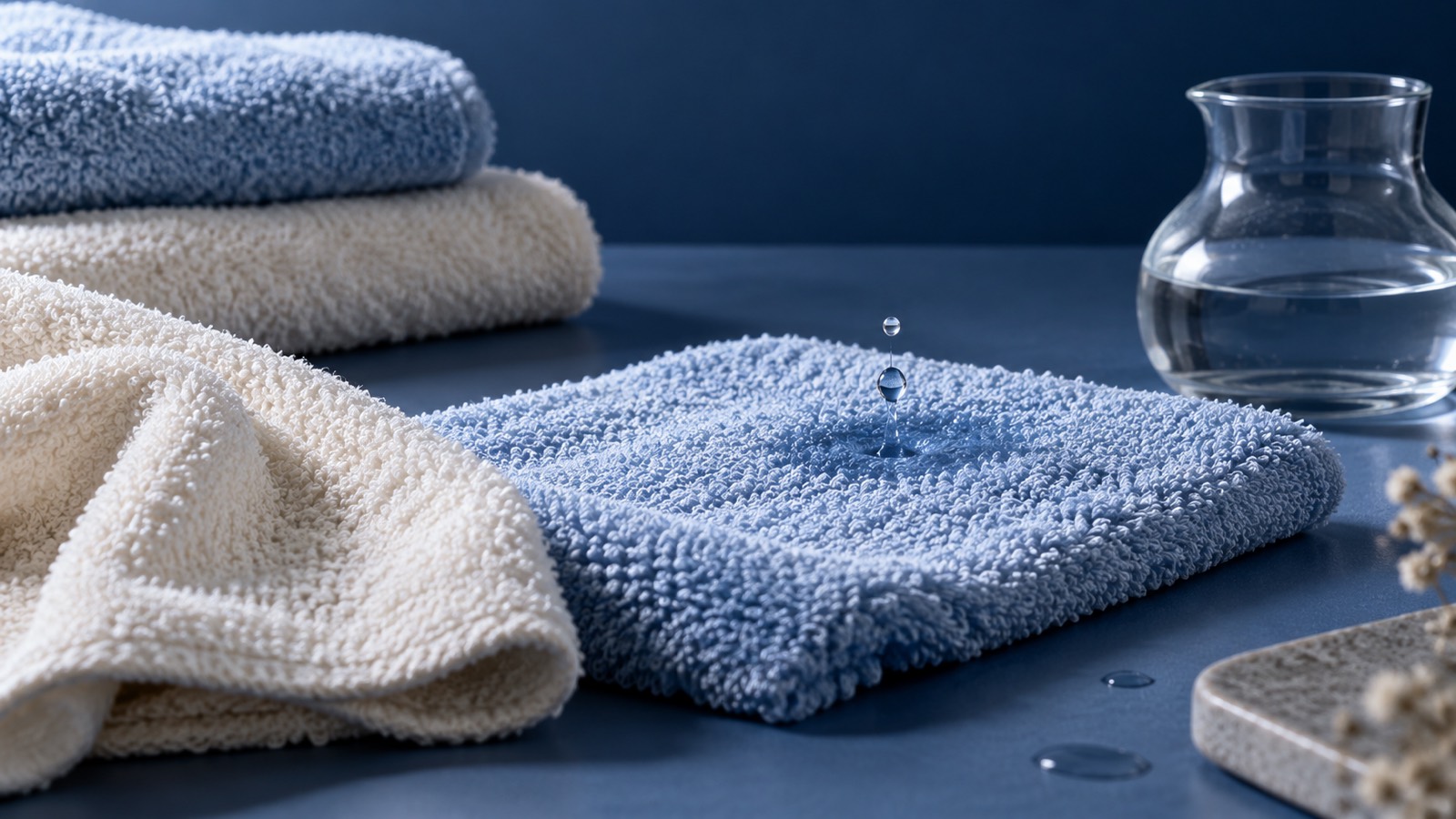
Towel absorbency is not one universal number. A recognised method can ask how effectively terry removes water from a surface, whether a textile wets under defined conditions, how liquid moves through a fabric or how quickly a wet textile dries. Those are related but different performance questions.
GSM answers none of them directly. It records fabric mass per unit area, so a buying specification should state an absorbency method, product condition, sampling plan and acceptance rule separately from its GSM target.
Start with the behaviour you need to measure
The word “absorbency” can hide several decisions. A bath towel must take water from skin; a cloth may need to move liquid away from a contact point; an operational team may care about drying after laundering. Choosing a method by name alone can produce a valid result that does not answer the buyer’s real question.
| Buyer question | Relevant recognised method | What the result addresses |
|---|---|---|
| How effectively does terry take up and retain water from a surface? | ASTM D4772-26 | Rapid surface water absorption and retention by applicable terry fabric |
| What is the water absorbency of this textile under a broad textile method? | AATCC TM79-2025 | Water absorbency of yarns, fabrics or garments across fibre contents and constructions |
| How does liquid spread, transfer or move through the fabric structure? | AATCC TM195, TM197 or TM198, depending on the question | Moisture management or directional wicking behaviour—not a towel’s GSM |
| How quickly does the textile dry under a defined airflow method? | AATCC TM200-2017e2 | Drying rate at absorbent capacity, a separate property from uptake |
These scopes come from the standards owners’ current public summaries: ASTM D4772-26 is terry-specific, while AATCC TM79-2025 applies to yarns, fabrics and garments of any fibre content or construction. The full standards are controlled documents; a laboratory should use the purchased method rather than a web article’s paraphrase.
What ASTM D4772-26 tells a towel buyer
ASTM describes D4772-26 as determining the ability of terry fabric to rapidly absorb and retain liquid water from surfaces such as skin, dishes and furniture. Its listed applications include bath towels, hand towels, washcloths, beachwear and bathrobes. That makes it directly relevant when the commercial question is surface drying by a terry product.
Its boundary matters. ASTM says the method is not applicable to non-terry constructions such as waffle-weave and flour-sack towels, or to decorative terry not intended to absorb water. The standard also notes that surface absorption is only one characteristic in product acceptance and cautions that interlaboratory precision is known to be poor when the method is used for commercial-shipment acceptance. Buyers and suppliers should therefore name the laboratory, edition, sampling and dispute approach before testing—not after two reports disagree. See the official scope and significance statement for ASTM D4772-26.
What the AATCC methods ask instead
AATCC TM79-2025 has a broader scope: determination of water absorbency for yarns, fabrics and garments, including woven, knitted and nonwoven textiles. It can be useful when the agreed question is general textile absorbency rather than the terry-specific surface interaction addressed by ASTM D4772. The buyer still needs the method’s defined result and an agreed limit; “tested to TM79” without a criterion does not decide acceptance.
Moisture movement is different again. AATCC TM195-2011e2(2017)e5 measures, evaluates and classifies liquid moisture management properties in knitted, woven and nonwoven fabrics, considering the fabric structure and the wicking characteristics of fibres and yarns. AATCC TM197-2022 addresses liquid transport in vertically aligned specimens to specified distances; AATCC TM198-2011e3(2020)e addresses transport in horizontally aligned specimens. These may support a development question about liquid spreading, but they should not be presented as interchangeable towel-capacity tests.
Nor does absorbency equal drying. AATCC TM200-2017e2 determines drying rate at a textile’s absorbent capacity under an airflow method. A towel can be evaluated for both uptake and drying, but each result needs its own method, units and limit.
Why GSM cannot be the absorbency result
GSM means grams per square metre. ASTM D3776/D3776M-20(2025) covers measurement of fabric mass per unit area and provides options for different sample forms. It measures how much fabric mass is present over an area—not the time, quantity, retention or movement of water.
More mass may be one construction input, but it does not identify where that mass sits in the ground, pile or border, how the yarn and fibre behave, or whether finishing affects wetting. Two towels at the same GSM can therefore return different water-behaviour results, while two towels at different GSM can still be suitable for different use cases. The related towel GSM guide explains how to specify mass per area without turning it into a quality grade.
Write a test plan that can support acceptance
For a development sample or production lot, record these decisions in the controlled specification:
- Intended use and test question. State whether the priority is surface drying, general wetting, liquid transport, drying rate or a combination.
- Exact method and edition. Write the full designation, not “standard absorbency test”. Confirm the current edition with the laboratory when the order is placed.
- Product state. Define whether testing is on as-received goods, after a specified pre-treatment or after stated laundering cycles. Finishing and laundering can be development variables, so do not leave the state implicit.
- Sampling. Identify the lot, number of pieces, specimen locations and treatment of borders or other distinct zones.
- Report and acceptance rule. State required units, individual readings, averaging, tolerance or pass/fail limit, rounding and what happens if a result is disputed.
- Separate construction controls. Keep fibre composition, yarn, pile, dimensions, GSM and piece weight alongside—but not in place of—the performance criteria.
Retain the report with the approved sample and specification revision. The towel sample approval checklist shows how to keep measurements, visual decisions and test evidence together, while the specification-sheet guide provides the broader factory brief.
Son Ha Textile’s factory team in Phùng Xá, Hanoi can discuss the towel’s intended use, construction and sample plan with buyers. Independent or buyer-nominated laboratory testing should be agreed where a formal standard result is required; an article or informal demonstration is not a substitute for that report.
Questions buyers often ask
Is ASTM D4772 the right test for every towel?
No. Its current scope is for applicable terry fabrics and specifically excludes several non-terry towel constructions. Match the method to the construction and intended use.
Does a 600 GSM towel absorb more than a 450 GSM towel?
GSM alone cannot answer that. It shows mass per area; a named water-behaviour test under the same conditions is needed for a defensible comparison.
Can a simple water-drop demonstration replace laboratory testing?
It can be a useful development screen if the procedure is documented consistently, but it should not be represented as an ASTM or AATCC result. Use the named method and qualified laboratory when formal acceptance depends on it.
Should absorbency be tested before or after washing?
That depends on the use case. The specification should identify the product state and any pre-treatment or laundering cycles. If both initial and after-laundering performance matter, define both checkpoints.
Is drying rate part of an absorbency result?
No. Uptake, retention, liquid transport and drying are distinct behaviours. They may all matter to a towel programme, but they require separately identified methods and criteria.
Sources
- ASTM D4772-26 — Standard Test Method for Surface Water Absorption of Terry Fabrics (Water Flow) — ASTM InternationalAccessed 5 October 2026
- AATCC TM79-2025 — Test Method for Absorbency of Textiles — AATCCAccessed 5 October 2026
- AATCC TM195-2011e2(2017)e5 — Liquid Moisture Management Properties of Textile Fabrics — AATCCAccessed 5 October 2026
- AATCC TM197-2022 — Vertical Wicking Rate of Textiles: to Specified Distances — AATCCAccessed 5 October 2026
- AATCC TM198-2011e3(2020)e — Horizontal Wicking of Textiles — AATCCAccessed 5 October 2026
- AATCC TM200-2017e2 — Drying Rate of Textiles at their Absorbent Capacity: Air Flow Method — AATCCAccessed 5 October 2026
- ASTM D3776/D3776M-20(2025) — Standard Test Methods for Mass Per Unit Area (Weight) of Fabric — ASTM InternationalAccessed 5 October 2026
A note on specifications
Product performance, minimum order quantities, lead times, pricing and compliance requirements depend on the final specification, testing standard, order volume and destination market. This article provides general manufacturing information; confirm requirements with the factory and appropriately qualified testing, compliance and logistics advisers before ordering.