
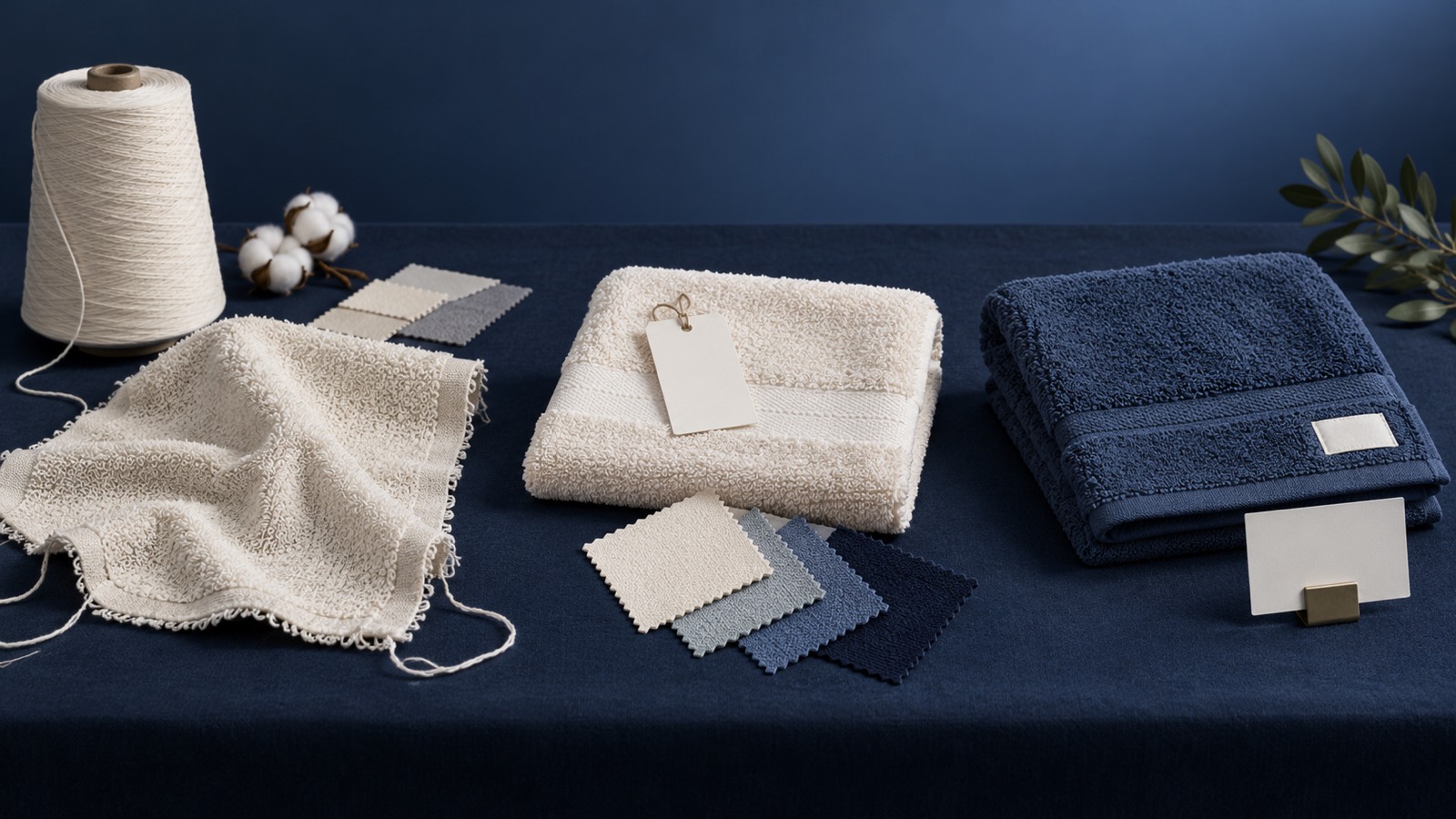
A development sample asks whether the towel concept works. A sales sample asks whether a presentation-ready version can support range review or selling. A pre-production sample asks whether the final controlled specification is ready to release to bulk production.
Those are useful working definitions, not universal trade rules. Sample names and sequences vary between buyers and factories, so both parties should define each stage in writing: its purpose, materials, decision owner, approval evidence, permitted substitutions and the fields that become frozen.
One sample name should lead to one decision
A sample is valuable only when the team knows what it is allowed to prove. A first construction trial may be suitable for discussing pile height but unsuitable for photography. A polished sales sample may look complete while still using a temporary label. A pre-production sample may represent the approved specification but cannot, by itself, prove that every bulk piece will be consistent.
| Stage | Primary approval question | Decision owner | Minimum approval record |
|---|---|---|---|
| Development sample | Does the proposed construction work physically and commercially enough to continue? | Buyer’s product or technical owner; factory confirms feasibility | Sample ID, specification revision, substitutions, measurements, comments and next changes |
| Sales sample | Is this version fit for the stated presentation, showroom or selling purpose? | Buyer’s merchandising or commercial owner, with technical review of any product claims | Approved use, audience, visual sign-off, known deviations and restrictions |
| Pre-production sample | Does this sample represent the controlled standard authorised for bulk manufacture? | Buyer’s authorised product or quality approver; factory production owner acknowledges release | Signed sample, final specification and bill of materials revisions, test status, packaging and release decision |
This stage-gate approach reflects a broader quality principle: customer requirements and controlled processes need to translate into consistent output. ISO 9001:2026 is the current international requirements standard for quality management systems, but citing it here does not mean that Son Ha Textile or a particular supplier is certified.
Development sample: approve the direction, not an imaginary final product
The development sample turns the brief into something physical. For a towel, it can reveal whether the selected yarn, pile arrangement, border, size, weight direction, colour and branding method can work together. It is the right stage to find conflicts, compare alternatives and update costing assumptions before every detail is locked.
The approval should say what is accepted and what remains open. A buyer might approve the dimensions and border layout while requesting a different colour and softer handle direction. If substitute yarn, label or packaging was used, list it prominently. The sample does not demonstrate the final property that the substitute affects.
What becomes frozen? Only the decisions explicitly marked “approved” in the comment sheet or revised specification. What normally remains open? Any recorded substitution, unresolved test, colour correction, artwork revision, packaging detail, tolerance or commercial term. “Proceed to the next sample” should never be interpreted as “approved for bulk”.
Sales sample: approve the stated commercial use
A sales sample supports a line review, distributor meeting, showroom, catalogue decision or another defined commercial use. Its priority is a coherent, presentation-ready expression of the proposed product. Depending on timing, it may be produced before every technical detail, test result or production material is final.
The approval owner is usually the buyer’s merchandising, brand or commercial team. A technical owner should review any statements about fibre content, size, care, performance or production availability. The record should name where the sample may be shown and list every known difference from the intended production article—for example a temporary label, provisional carton, sample yarn lot or unapproved care artwork.
A sales-sample approval freezes the sample for its declared presentation purpose. It does not automatically freeze production tolerances, test limits, final labels, packing or the permission to manufacture bulk. If the same physical sample is later proposed as the production reference, it needs a separate technical review and an explicit change of status.
Pre-production sample: approve the controlled bulk reference
The pre-production sample—often shortened to PP sample or PPS—should represent the confirmed production intent. Before approval, compare it with the final specification for fibre composition, yarn and construction, dimensions and tolerances, GSM or piece weight, colour reference, border and logo, hems and workmanship, labels, care information and packaging.
The authorised buyer approver should issue one of three unambiguous decisions: approved for bulk; approved with clearly listed conditions that must be closed before a named operation; or not approved, with corrections required. The factory’s production owner should acknowledge the same revision and confirm that the approved construction and inputs can be followed in production.
Approval freezes every production-controlled field listed in the signed specification and its attachments. It does not erase agreed manufacturing tolerances, replace a sampling plan, prove lot-wide consistency or waive required testing and inspection. The approved sample is a reference within the quality plan, not a guarantee by itself.
The approval record is more important than the nickname
Terms such as prototype, counter sample, sealing sample, approval sample and “golden sample” can overlap with the three stages above. Avoid resolving the ambiguity in conversation alone. Add a sample plan to the RFQ or purchase order and define each term before sampling starts.
A controlled record should identify the buyer, factory, SKU, sample type and purpose; unique sample number; issue date; specification and artwork revisions; materials and substitutions; measurements and test status; photos; comments; decision; approver; approval date; and location of retained reference samples. The discipline is consistent with ISO 10007:2017, which provides configuration-management guidance across a product or service lifecycle, and ISO 10013:2021, which addresses documented information tailored to an organisation’s needs.
Use the towel specification-sheet guide to establish the controlled product data, then apply the detailed towel sample approval checklist to measurements, appearance, construction, labels, packaging and agreed tests.
Control changes after pre-production approval
If a yarn, dye route, border, label, carton or other approved input changes, do not rely on a message saying it is “similar”. Record the proposed change, reason, affected requirements and risk; decide whether a new sample or targeted test is needed; obtain approval from the same authorised function; and update the specification revision before production continues.
Keep one retained reference with the buyer when practical and one with the factory, both identified to the same approval record. Photographs help with traceability but cannot reproduce handle, colour under controlled lighting, pile structure or physical workmanship. Define how long references and digital records will be kept for reorders and claims.
Questions buyers often ask
Can one towel serve as both a sales sample and a pre-production sample?
Yes, but only after separate commercial and technical reviews confirm that it fulfils both defined purposes. Record the two decisions; do not assume one approval grants the other.
Who should sign the pre-production sample?
The buyer should name an authorised product or quality approver, and the factory production owner should acknowledge the released revision. Sales approval alone may not cover technical or compliance fields.
Does approving a PP sample allow any later changes?
Only through the agreed change-control process. The effect on specification, test status, cost and timing should be reviewed before the changed input or construction is used.
What if the factory uses different sample names?
That is common. Map the factory’s term to a written purpose, inputs, checks, approver and release consequence. The definition controls the decision, not the nickname.
Is the approved sample enough for final inspection?
No. It is an important comparison reference, but inspection also needs the current specification, tolerances, sampling plan, defect criteria, packaging requirements and relevant test records.
Sources
- ISO 9001:2026 — Quality management systems — Requirements — International Organization for StandardizationAccessed 5 October 2026
- ISO 10007:2017 — Quality management — Guidelines for configuration management — International Organization for StandardizationAccessed 5 October 2026
- ISO 10013:2021 — Quality management systems — Guidance for documented information — International Organization for StandardizationAccessed 5 October 2026
A note on specifications
Product performance, minimum order quantities, lead times, pricing and compliance requirements depend on the final specification, testing standard, order volume and destination market. This article provides general manufacturing information; confirm requirements with the factory and appropriately qualified testing, compliance and logistics advisers before ordering.