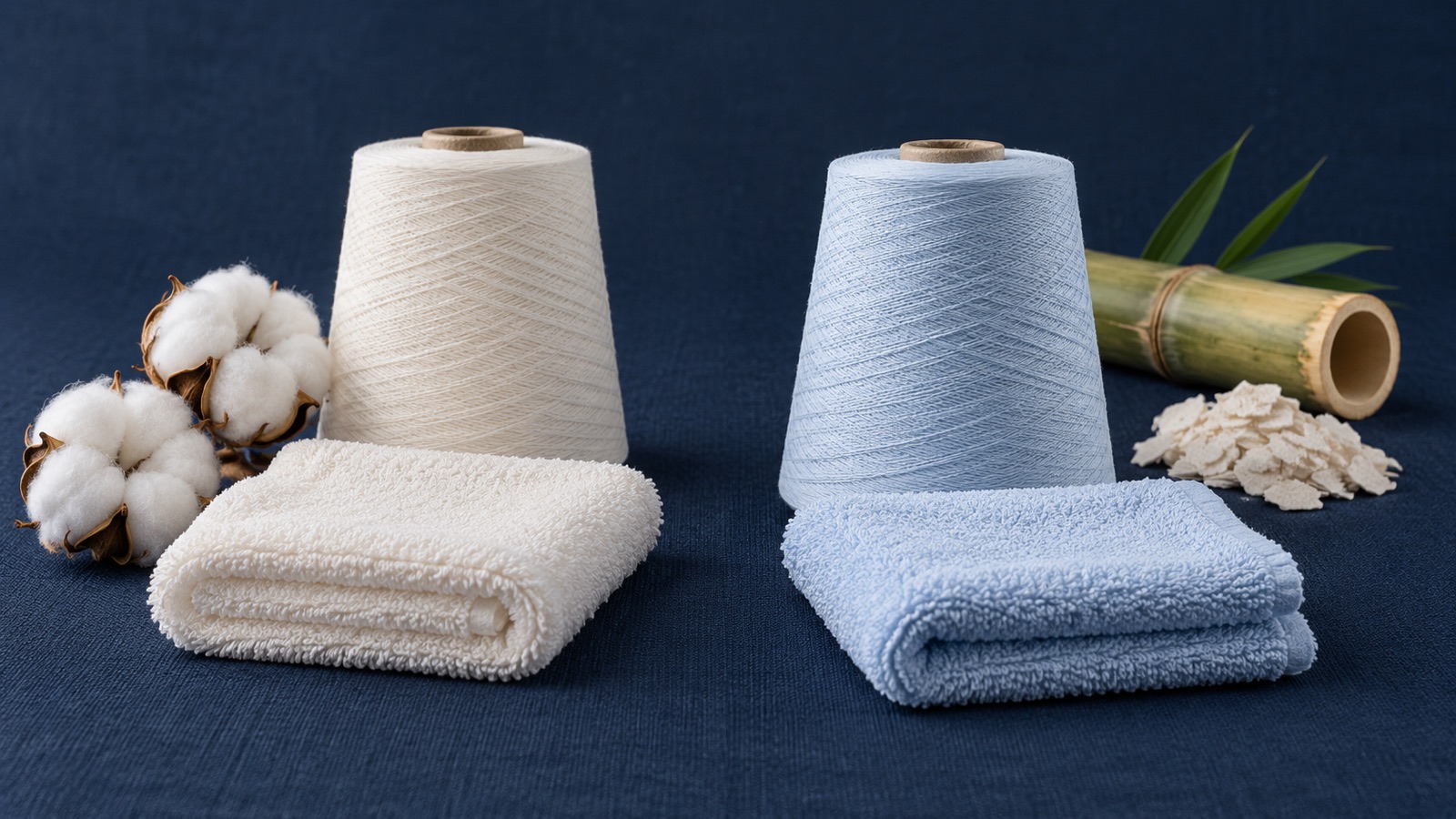
Specify the fibre that exists in the finished towel, not only the plant that supplied its raw cellulose. Cotton is a natural fibre. A soft textile sold as “bamboo” is commonly a manufactured regenerated-cellulose fibre such as viscose or lyocell, with bamboo identified—if substantiated—as the feedstock.
A buyer therefore needs two linked records: a controlled fibre-composition specification using accepted generic names and percentages, and separate evidence for any feedstock or marketing claim. The final consumer wording must then be approved for each destination market; there is no single global “cotton/bamboo” label.
Start with three different descriptions
| Description | Question it answers | Example |
|---|---|---|
| Generic fibre name | What textile fibre is present in the finished towel? | Cotton, viscose or lyocell |
| Feedstock | What raw material supplied the cellulose before fibre manufacture? | Bamboo-derived cellulose pulp |
| Marketing or performance claim | What additional benefit is being promised? | A narrowly defined, substantiated claim—not an automatic result of the feedstock |
These descriptions are not interchangeable. ISO 6938:2012 covers generic names and definitions for important natural fibres, while ISO 2076:2021 defines generic names for categories of man-made fibres based on their polymer and distinguishing attributes. That classification difference matters when a bamboo plant is converted into cellulose pulp and then manufactured into a new fibre.
Why “bamboo towel” is often incomplete
The US Federal Trade Commission’s bamboo-textile guidance draws a direct boundary: a textile may be called bamboo only when it is made directly from actual bamboo fibre. When bamboo is the plant source used to manufacture rayon or viscose, the FTC says the textile should use the manufactured fibre name and may describe it as rayon or viscose made from bamboo. The seller remains responsible for the accuracy of both labels and advertising.
Viscose and lyocell are both regenerated-cellulose fibres, but the names do not describe identical manufacturing routes. EU Regulation 1007/2011 defines viscose by the viscose process and lyocell by a dissolution and organic-solvent spinning process without formation of derivatives. A supplier’s statement that the raw material was bamboo does not establish which generic fibre was produced. Ask for the spinner or fibre producer’s technical declaration before putting either name into the specification.
Write the manufacturing brief in layers
- Finished composition: state each generic fibre and target percentage by mass, with tolerance and the basis on which composition will be verified.
- Towel sections: identify pile, ground, border, sewing thread and decoration where their constructions differ. Do not describe only the soft pile if the ground changes the total composition.
- Regenerated-cellulose type: specify viscose, lyocell or another accepted generic name rather than the unqualified word “bamboo”.
- Feedstock claim: if bamboo origin matters, require a supplier declaration and traceability records that connect pulp, fibre, yarn and the production lot.
- Destination wording: keep a separate approved label and e-commerce copy version for each market and language.
- Claim control: list prohibited or approval-only words, including broad environmental or antibacterial claims that lack product-specific evidence.
For a hypothetical towel made from 70% cotton and 30% regenerated cellulose produced by the viscose route, the technical composition starts with 70% cotton, 30% viscose. “Bamboo-derived” is a separate feedstock statement, not a substitute for viscose. If the manufactured fibre is verified as lyocell, the specification should say lyocell instead. Put these fields into a controlled towel specification sheet and reconcile them with yarn orders, sample records and final artwork.
US and EU wording must be approved separately
In the United States, towels are among the household products covered by the Textile Act and Rules. The FTC’s current business guide says generic fibre names and percentages by weight are generally listed in descending order. It permits viscose as the ISO name for the predominant form of rayon. For pile fabrics, the guide allows whole-product disclosure or separate pile and backing disclosure with their ratios to total fibre weight. Buyers should have the responsible US party confirm the exact approach for the towel and its advertising.
In the European Union, Regulation 1007/2011 allows only the textile fibre names in Annex I for formal composition descriptions. Its list includes cotton, viscose and lyocell but not bamboo. The EU’s official textile-label guide also requires decreasing percentage order, clear separation of composition from other information, and translation into the official language or languages required where the product is offered. A separate bamboo-feedstock statement must not be allowed to confuse the formal fibre composition and should receive market-specific legal review.
These examples do not create a universal label. Requirements and accepted wording can differ elsewhere, and fibre content is only one part of export labelling. Use the wider export textile-labelling guide to coordinate fibre, country of origin, responsible-business identity and care instructions.
Verification answers only the question it was designed for
Documentary review should connect the bill of materials, fibre or yarn declaration, purchase records, lot identification and approved label. Laboratory analysis may then check whether the declared blend is consistent with the finished product. For example, ISO 1833-6:2018 specifies quantitative chemical analysis for mixtures of viscose, certain cupro, modal or lyocell fibres with cotton and certain other fibres, with stated limitations for some finishes, dyes and degraded cotton.
That kind of composition test does not turn the word bamboo into a generic fibre name, and it should not be treated as proof of the original plant source. Feedstock traceability and fibre identification are different evidence questions. Define the method edition, sample conditioning or pre-treatment, reporting basis, acceptance tolerance and laboratory responsibility in the order documents, then record results through sample approval.
Do not turn fibre origin into an environmental promise
The fact that bamboo supplied cellulose does not by itself establish lower water use, safer chemistry, lower emissions, biodegradability or an overall environmental advantage for the finished towel. Those conclusions depend on cultivation, pulp and fibre manufacture, energy, chemicals, yield, transport, dyeing, finishing, product life and end-of-life assumptions.
The FTC’s Green Guides summary warns against broad unqualified claims such as “green” or “eco-friendly” and calls for clear, specific qualifications and substantiation. Keep fibre-content accuracy, feedstock traceability and environmental assessment as separate approval gates. This article does not establish that cotton, bamboo-derived viscose or bamboo-derived lyocell is environmentally superior.
Questions buyers often ask
Can a towel label simply say “70% cotton, 30% bamboo”?
Not as a universal rule. If the second fibre is regenerated cellulose, the formal composition normally needs its accepted generic name, such as viscose or lyocell. Confirm the exact wording for the destination market and keep any verified bamboo-feedstock statement separate.
Are viscose and lyocell the same fibre?
No. Both are regenerated-cellulose categories, but their defined manufacturing routes differ. Require the fibre producer’s declaration and specify the correct generic name.
Does a blend test prove that the cellulose came from bamboo?
Not necessarily. A quantitative composition method can measure relevant fibre classes within its scope; feedstock origin needs its own traceability evidence from the upstream supply chain.
Does bamboo feedstock make a towel sustainable or antibacterial?
No automatic conclusion follows. Any environmental or performance claim needs product-specific, market-appropriate substantiation and must not conflict with the formal fibre disclosure.
Sources
- Bamboo Textiles — United States Federal Trade CommissionAccessed 5 October 2026
- Threading Your Way Through the Labeling Requirements Under the Textile and Wool Acts — United States Federal Trade CommissionAccessed 5 October 2026
- Regulation (EU) No 1007/2011 on textile fibre names and related labelling and marking — consolidated text — EUR-LexAccessed 5 October 2026
- Textile Label — Your Europe — European UnionAccessed 5 October 2026
- ISO 6938:2012 — Textiles — Natural fibres — Generic names and definitions — International Organization for StandardizationAccessed 5 October 2026
- ISO 2076:2021 — Textiles — Man-made fibres — Generic names — International Organization for StandardizationAccessed 5 October 2026
- ISO 1833-6:2018 — Textiles — Quantitative chemical analysis — Part 6: Mixtures of viscose, certain types of cupro, modal or lyocell with certain other fibres — International Organization for StandardizationAccessed 5 October 2026
- Environmental Claims: Summary of the Green Guides — United States Federal Trade CommissionAccessed 5 October 2026
A note on specifications
Product performance, minimum order quantities, lead times, pricing and compliance requirements depend on the final specification, testing standard, order volume and destination market. This article provides general manufacturing information; confirm requirements with the factory and appropriately qualified testing, compliance and logistics advisers before ordering.