
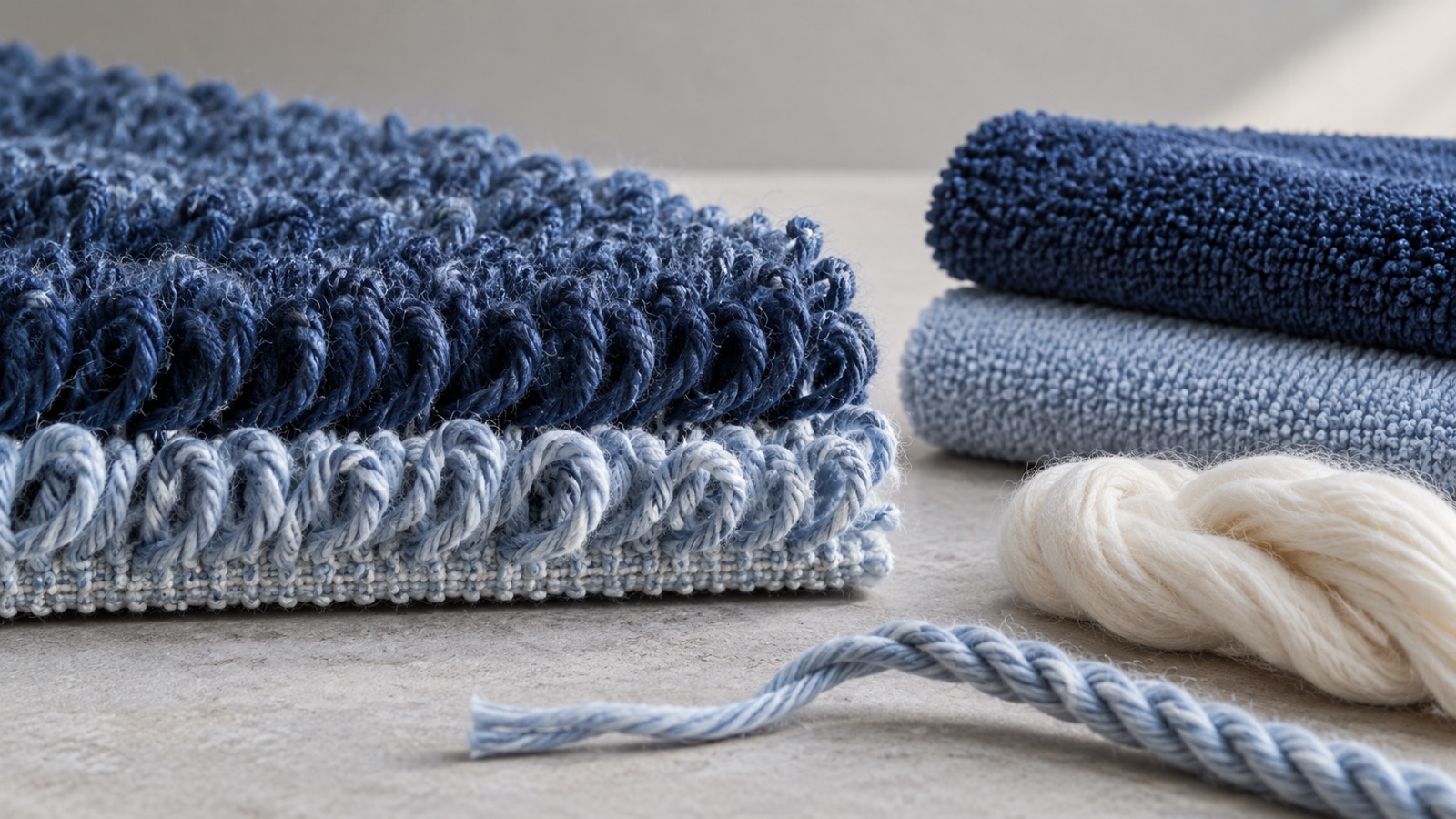
A towel’s feel and performance come from a system: fibre and yarn structure, the height and density of the terry loops, the ground that holds them, and the preparation and finishing applied after weaving. GSM records mass per area; it cannot reveal how that mass is arranged or how the finished towel will wet, absorb, dry or feel in the hand.
For a useful comparison, describe the construction, approve a physical handle reference and measure the performance that matters for the intended use. Keep sensory judgements such as “soft” or “plush” separate from test results such as GSM, surface-water absorption or dimensional change.
Begin with two different questions: hand and performance
Hand is the sensory impression formed when a person touches and manipulates a textile. Words such as soft, smooth, dry, full, springy or firm can be useful, but people may interpret them differently. AATCC EP5-2025 therefore gives guidelines for presenting and handling fabrics under controlled conditions when evaluating components of hand. A buyer can use the same principle without turning every approval into a laboratory exercise: agree the vocabulary, sample condition, comparison sequence and reference sample.
Performance needs a defined property, method and acceptance limit. Mass per unit area can be determined under ISO 3801; water absorbency can be evaluated with methods such as AATCC TM79; and ASTM D4772-26 addresses rapid surface-water absorption and retention for terry fabrics. ASTM explicitly treats surface-water absorption as only one characteristic of an acceptable towel. These results answer different questions and should not be collapsed into one claim of “quality”.
Yarn structure changes the way the pile behaves
A terry towel normally combines structural ground yarns with pile yarns that form the visible loops. The pile yarn’s fibre content, linear density, spinning system, number of plies and twist all affect how compact, open or resilient that yarn is. Those details also interact with the woven construction; a label such as “cotton” or “zero twist” is not a complete specification.
Twist binds fibres together. A more compact twisted pile can produce a different surface and bending response from a bulkier low- or zero-twist pile, but the direction and size of the difference depend on the complete design. In one controlled study, twistless cotton-pile samples had greater water-absorptive capacity and lower flexural rigidity than the twisted constructions tested; pile height and weft density also changed the results. The authors did not test every commercial towel construction, so their findings are decision evidence—not a universal promise attached to a yarn name. See the comparative study for its stated variables and limits.
This is why a buyer should ask what the yarn description means in that supplier’s construction. Record the pile-yarn system, count or linear density, twist category, ply and fibre composition, then compare identifiable samples after the same conditioning and laundering. If durability or lint matters, add relevant acceptance criteria rather than assuming the softest initial sample will remain unchanged in service.
Pile is more than “long” or “short” loops
Pile height, loop density and the amount of pile yarn presented on each face determine how much of the towel’s mass and surface sits above the ground fabric. The ground construction, pick density and loop anchoring also matter because they hold and space the loops. A towel may have pile on both faces, different faces for different functions, or decorative areas with little or no pile.
Peer-reviewed work on cotton terry found that moisture behaviour varied with fabric weight, thickness and pile-yarn twist; the research measured several behaviours rather than treating “absorbency” as one number. In that sample set, a zero-twist construction with longer pile showed higher static absorption, while the broader results demonstrated that absorption time, absorption rate, dynamic absorption and vertical wicking do not necessarily rank fabrics identically. The useful lesson from the study is methodological: specify the behaviour you need, then test it.
More pile is therefore not automatically better. A tall, open pile may support a lofty visual and tactile effect, while another programme may prioritise compactness, fast handling, lower bulk or a stable decorative surface. The buyer should judge the trade-off on a correctly sized, finished and laundered sample—not on an isolated loop-height figure.
Finishing can change the first touch and the first wetting
“Finishing” covers processes after preparation and colouration that adjust appearance, performance, serviceability or hand. CottonWorks describes softeners and hand builders as distinct chemical-finish families and notes that their rewetting behaviour differs. That means “softened” is not enough information for a towel: the chemistry, application level and compatibility with the target wetting performance matter.
Mechanical action, washing, drying and chemical finishing can also change loft, surface smoothness and apparent softness. A new sample may feel impressive because of its finishing state, yet the buyer usually needs to know what remains after the agreed wash procedure. Conversely, a prepared or laundered towel may wet differently from an as-finished sample. Compare like states and state whether approval applies before wash, after wash or to both.
Do not specify a finish only by a marketing adjective. Define the required outcome—for example a particular approved hand reference plus a maximum wetting time or minimum surface-water absorption result—and ask the factory to propose and document the construction and finish used to achieve it.
Why the same GSM can produce a different towel
GSM tells you how many grams of material occupy one square metre. Two 500 GSM towels can allocate that mass differently: one may use more mass in the ground, another in taller or denser pile, and a third in borders or a different yarn system. They can therefore differ in thickness, compressibility, handle, wetting and drying behaviour while meeting the same weight target.
Use the towel GSM guide for measurement and tolerance decisions. Then add the variables and evidence below so the GSM line does not carry claims it cannot support.
| Buyer decision | Specify | Approve or test |
|---|---|---|
| Yarn | Fibre composition; pile and ground yarn systems; count/linear density; twist category and ply | Identified yarn/construction record and representative sample |
| Pile | Face arrangement, loop height or agreed construction reference, density, borders and non-pile zones | Visual consistency, dimensions, GSM and approved tactile reference |
| Finish | Required hand and functional outcome; state before and after the agreed wash | Handle panel/reference plus the named performance method |
| Use performance | Surface drying task, laundry process, drying method and operational priorities | Absorbency, drying, dimensional, colour and appearance criteria selected for the programme |
A practical sample-comparison sequence
- Give each sample a code and record its fibre, yarn, pile, ground, GSM, dimensions and finish.
- Condition and present samples in the same state; keep the evaluator unaware of price where possible.
- Score defined hand attributes separately—such as surface softness, fullness and flexibility—instead of asking only which towel feels “best”.
- Measure the properties relevant to use with named methods, specimen conditions and pass/fail limits.
- Launder samples under the agreed procedure, then repeat the dimensional, appearance, hand and performance comparison.
- Sign and retain the approved reference, test record and tolerance table before bulk production.
Put the decisions into a controlled towel specification sheet and use the sample approval checklist to record results. Son Ha Textile’s factory team in Phùng Xá, Hanoi can discuss yarn, pile and finishing options against an intended use, but the final construction and performance requirements must be confirmed for the specific programme.
Questions buyers often ask
What makes a towel feel soft?
Softness is a sensory result of interacting variables, including fibre and yarn structure, pile geometry, fabric flexibility, surface preparation and finishing. Approve a labelled reference sample under agreed conditions rather than relying on one material or yarn term.
Does zero-twist yarn always make a better towel?
No. Studies can show advantages within the constructions tested, but a yarn label does not establish lint, durability, drying, wash stability or value for every product. Compare complete constructions and verify the properties important to your use.
Can a soft finish reduce absorbency?
Finish chemistry and application can change rewetting, so “softened” alone is not a performance specification. Pair the desired hand with a named absorbency or surface-water test and evaluate it in the agreed product state.
Why do two towels with the same GSM feel different?
GSM records total mass per area, not where the mass sits. Different pile height and density, ground construction, yarn compactness and finishing can produce different thickness, compressibility, surface and wetting behaviour at the same GSM.
Sources
- ISO 3801:1977 — Textiles — Woven fabrics — Determination of mass per unit length and mass per unit area — International Organization for StandardizationAccessed 5 October 2026
- AATCC EP5-2025 — Evaluation Procedure for Fabric Hand Value — AATCCAccessed 5 October 2026
- AATCC TM79-2025 — Test Method for Absorbency of Textiles — AATCCAccessed 5 October 2026
- ASTM D4772-26 — Standard Test Method for Surface Water Absorption of Terry Fabrics (Water Flow) — ASTM InternationalAccessed 5 October 2026
- Study of moisture absorption characteristics of cotton terry towel fabrics — Procedia EngineeringAccessed 5 October 2026
- A Comparative Analysis of Towels Produced from Twisted and Twistless Cotton Pile Yarns in Terms of Absorptive Capacity and Flexural Rigidity — Journal of Engineered Fibers and FabricsAccessed 5 October 2026
- Chemical Finishing — CottonWorks by Cotton IncorporatedAccessed 5 October 2026
A note on specifications
Product performance, minimum order quantities, lead times, pricing and compliance requirements depend on the final specification, testing standard, order volume and destination market. This article provides general manufacturing information; confirm requirements with the factory and appropriately qualified testing, compliance and logistics advisers before ordering.