
EXW, FCA, FOB, CIF and DAP do not describe five levels of shipping service on one simple scale. Each Incoterms® 2020 rule allocates particular transport and customs tasks, costs and the point where risk of loss or damage transfers between seller and buyer. Those three questions must be checked separately.
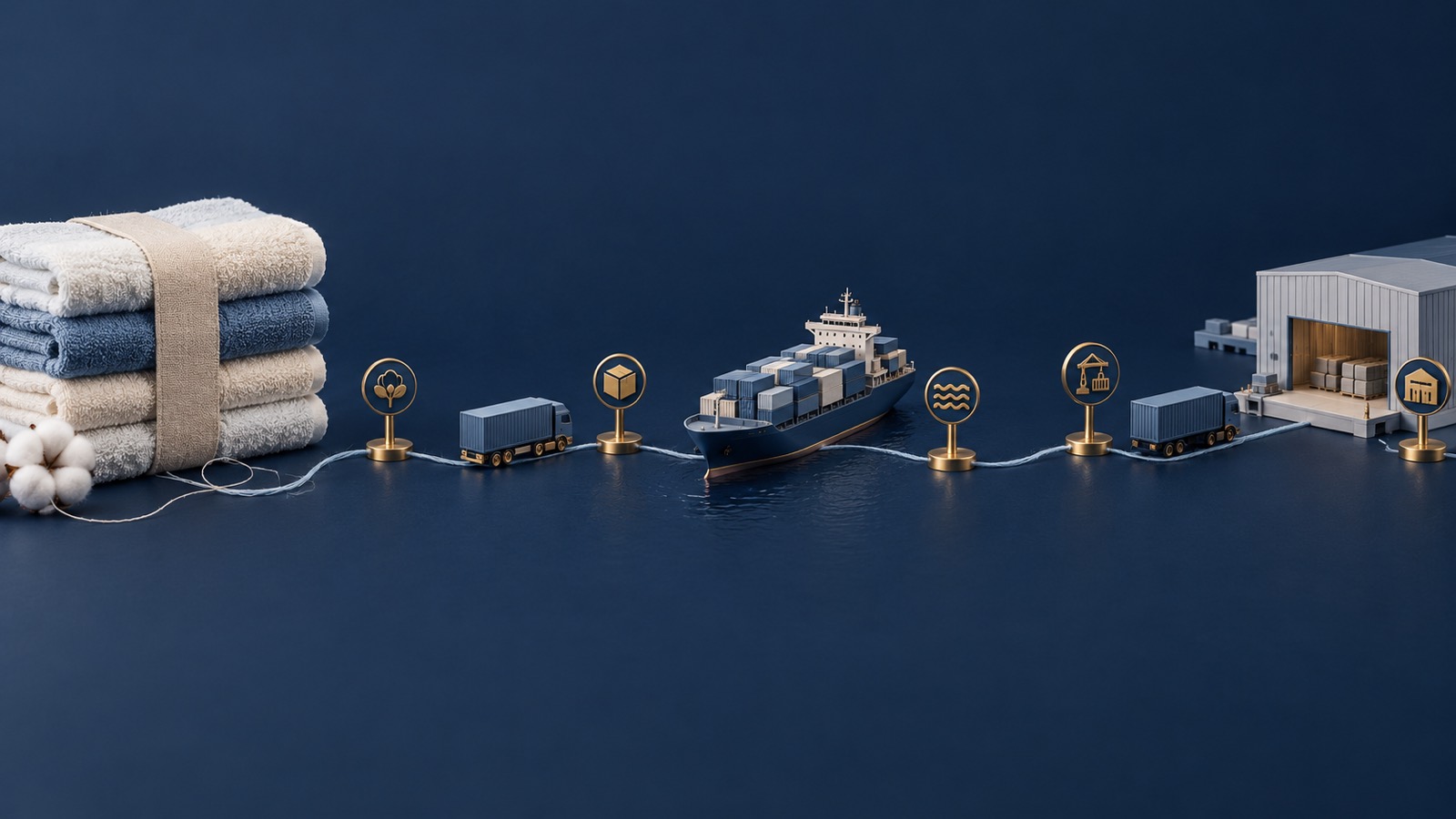
For a towel order, the right comparison starts with the real route: factory collection, inland terminal, export port or airport, main carriage, destination terminal and final warehouse. Then write the chosen three-letter rule with an exact named place, port or point and “Incoterms® 2020”. This article is educational, not legal, customs, insurance or freight advice.
What Incoterms® rules do—and what they leave to the contract
The ICC introduction to Incoterms® 2020 groups the rules around obligations, risk and costs. They help answer who organises carriage or insurance, who handles stated export or import formalities, where delivery and risk transfer occur, and which party bears specified costs. “Delivery” in this system is a defined contractual event; it does not necessarily mean arrival at the buyer’s premises.
The rules are not a complete sale contract. ICC’s commercial-contract guidance says they do not determine matters including product specifications, price or payment method, transfer of title, most consequences of breach, force majeure, intellectual property or dispute law and venue. A towel purchase order still needs to cover the approved specification, quantity, inspection, documents, payment, change control, delay and remedies, with qualified advice where required.
Five rules compared at a practical level
This comparison is deliberately high level and does not reproduce the ICC rule tables. Read it with the official ICC Incoterms® 2020 checklist and authorised rule text before contracting.
| Rule | Transport and delivery pattern | Risk transfer in plain English | Customs and insurance points |
|---|---|---|---|
| EXW — Ex Works | Any mode. Seller places identified goods at the buyer’s disposal at the named place, normally without loading the collecting vehicle. Buyer arranges carriage. | Transfers at that agreed delivery point when the goods are made available as required. | Buyer is responsible for export and import formalities where applicable. Seller has no obligation to arrange insurance. |
| FCA — Free Carrier | Any mode, including container and multimodal moves. Seller delivers to the buyer-nominated carrier or person at the named place; loading treatment depends on whether delivery is at the seller’s premises or another place. | Transfers when FCA delivery to that carrier or person is completed at the stated point. | Seller handles export clearance where applicable; buyer arranges main carriage. Neither party has a rule-based obligation to insure the other’s risk. |
| FOB — Free On Board | Sea or inland waterway only. Seller delivers the goods on board the buyer-nominated vessel at the named port of shipment; buyer arranges main carriage. | Transfers when the goods are on board at the shipment port—not when they reach the destination. | Seller handles export clearance where applicable. No seller obligation to arrange cargo insurance. |
| CIF — Cost Insurance and Freight | Sea or inland waterway only. Seller contracts and pays carriage and specified insurance to the named destination port. | Still transfers when the goods are on board at the shipment port, even though the seller pays freight to the destination port. | Seller handles export clearance and obtains the rule’s insurance cover; ICC warns that CIF requires only minimum cover by default. Buyer handles import clearance. |
| DAP — Delivered at Place | Any mode. Seller arranges carriage to the named destination and presents the goods on the arriving means of transport, ready for unloading. | Transfers at the named destination before unloading. | Buyer unloads and handles import clearance, duties and taxes where applicable. Seller has no rule-based insurance obligation, despite bearing risk to destination. |
EXW and FCA can look similar at pickup—but the handover differs
Under EXW, the seller makes the goods available at the named place without a rule-based obligation to load the collecting vehicle or clear the goods for export. ICC’s checklist says EXW is suitable primarily for domestic trade; a foreign buyer may not be practically positioned to complete export formalities in the seller’s country.
FCA can name the seller’s premises or another place. At the seller’s premises, delivery includes loading on the buyer-nominated vehicle; the condition differs elsewhere. FCA assigns export clearance to the seller where applicable, making it worth comparing for containerised towels. Still confirm the carrier, loading and precise risk point.
FOB and CIF are maritime rules, not synonyms for export price
FOB and CIF are for sea and inland waterway transport, with delivery on board a vessel. ICC directs users towards FCA for containers, multimodal transport or terminal delivery. A sealed container may enter a terminal before vessel loading, so the contractual delivery event should match a point the parties can control and evidence.
CIF also separates cost and risk. The seller pays freight and insurance to the named destination port, yet risk transfers on board at shipment. CIF therefore does not mean warehouse delivery or seller risk through arrival. Review the insurance evidence, value, exclusions, claims procedure and whether the minimum default cover suits the route.
DAP moves the delivery point towards the buyer, but stops before import and unloading
Under DAP, the seller arranges the journey and bears risk to the named destination, with goods ready for unloading. The buyer unloads and handles import clearance, duties and taxes where applicable. DAP is not “all-inclusive delivered” and should not be confused with DDP.
Confirm the receiving gate, hours, vehicle restrictions, appointment, unloading equipment, waiting charges and destination documents. Commercial wording cannot repair a route the seller cannot serve or import formalities the buyer cannot perform.
The named place, port and edition are part of the decision
ICC recommends incorporating the rule in the form “[chosen rule] [named port, place or point] Incoterms® 2020” and being as geographically specific as possible. “FOB Vietnam” does not identify a shipment port; “DAP buyer warehouse” does not identify a delivery address; and “FCA factory” may not identify the gate or loading point. The location can define delivery, destination, or both depending on the rule.
State the full pickup point, terminal, port or delivery address, followed by the edition. Treat examples as hypothetical until the transport parties and advisers confirm the route. Avoid informal variants such as “FOB factory” unless their effect on delivery, costs and risk is made explicit.
Compare quotations on the same logistics basis
A lower quotation may simply stop earlier in the route. Ask each supplier or forwarder to use the same product revision, shipment assumptions, rule, point and edition. Itemise pickup, origin handling, clearance, documents, terminal charges, main carriage, insurance, destination charges, duties and taxes, final transport, unloading and likely waiting or storage.
Keep cost and risk in separate columns. Also record who chooses the carrier, receives transport documents, submits claims and controls shipment changes. Use the Vietnam towel-sourcing process to connect logistics with specification, sampling, inspection and export documents, and put the basis in the custom towel RFQ before comparing prices.
A five-step selection check
- Draw the physical route and mark every handover from factory to final receiving point.
- Confirm whether the shipment is containerised or multimodal, or genuinely delivered on board under a maritime rule.
- Assign export, transit and import formalities to parties that can legally and practically perform them.
- Separate carriage cost, insurance obligation and risk transfer; identify every named point precisely.
- Write the full rule and edition into the quotation and sale contract, then have qualified legal, customs, insurance and logistics advisers review the complete arrangement.
Reconfirm the selected rule if the shipment plan changes. A move from loose cargo to containers, port pickup to warehouse delivery, or one carrier chain to another can change which rule and named point match the transaction. Keep that decision linked to the current order revision and the approved sample-stage record.
Frequently asked questions
Which Incoterms® rule is best for importing towels?
There is no universal best rule. Choose from the actual transport mode, handover points, customs capability, carrier control, insurance needs and commercial leverage, then have the complete contract reviewed.
Does FOB include sea freight?
No. Under FOB, the buyer arranges main carriage. The seller’s delivery and risk obligation reaches the goods being on board the buyer-nominated vessel at the named shipment port.
Under CIF, does risk transfer at the destination port?
No. The seller pays carriage and specified insurance to the named destination port, but risk transfers when the goods are delivered on board at the shipment port.
Does DAP include import duty and unloading?
Not under the standard rule. The buyer handles import clearance, applicable duties and taxes, and unloading from the arriving means of transport. The contract should address operational details and extra charges.
Can an Incoterms® rule replace a purchase contract?
No. It does not settle product specifications, payment, title, most breach consequences or dispute terms. Incorporate the selected rule into a complete, professionally reviewed sale contract.
Sources
- Introduction to Incoterms® 2020 — International Chamber of CommerceAccessed 5 October 2026
- Incoterms® and Commercial Contracts — International Chamber of CommerceAccessed 5 October 2026
- Incoterms® 2020 Checklist and Flowcharts — 2024 update — International Chamber of CommerceAccessed 5 October 2026
- Incoterms® 2020 — ICC Rules for the Use of Domestic and International Trade Terms — International Chamber of CommerceAccessed 5 October 2026
A note on specifications
Product performance, minimum order quantities, lead times, pricing and compliance requirements depend on the final specification, testing standard, order volume and destination market. This article provides general manufacturing information; confirm requirements with the factory and appropriately qualified testing, compliance and logistics advisers before ordering.