
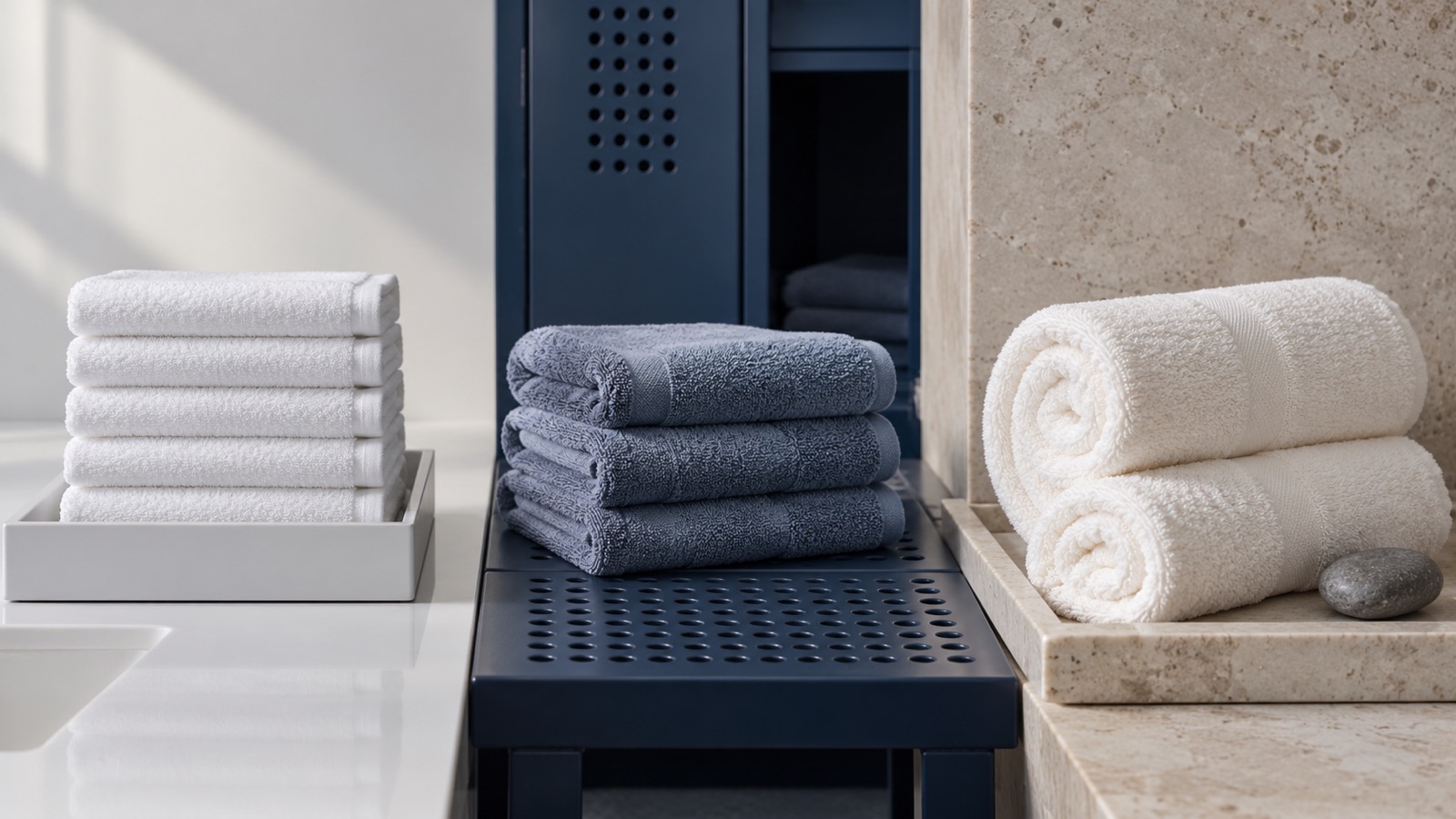
Healthcare, gym and spa towels may all be bought as “institutional” textiles, but they enter different use, soil, handling, laundry, storage and presentation systems. One generic GSM, colour and wash-life brief will not capture those differences.
Write a separate specification for each product role. Begin with the facility’s operating and policy requirements, then define construction, performance methods, sample states and acceptance limits. For healthcare, the textile specification must follow applicable facility policy and regulation; it does not create an infection-prevention or medical-performance claim.
Compare operating systems before comparing towels
| Decision area | Healthcare facility | Gym or fitness club | Spa or treatment setting |
|---|---|---|---|
| Primary role | Defined by facility service, user group and linen policy. | Workout, shower, equipment-contact or pool role. | Guest drying, treatment support or presentation role. |
| Soil and chemistry inputs | Facility-defined soil categories and approved laundry process. | Perspiration, body products and any site-specific cleaning contact. | Oils, creams, colour cosmetics and treatment products identified by the operator. |
| Handling priority | Policy-compliant containment, clean/used flow, transport and storage. | Fast issue, return, sorting and replenishment with limited space. | Controlled presentation, comfort, stain management and room reset. |
| Commercial focus | Process compatibility, traceability and reliable replenishment. | Throughput, compact storage, drying and loss control. | Guest hand, appearance, absorbency and treatment-specific care. |
These are prompts, not universal facts about every facility. Interview operations, laundry, procurement and—in healthcare—the responsible infection-prevention, occupational safety and compliance teams before setting requirements.
Healthcare starts with facility governance
Current CDC guidance on textiles and laundry says methods for handling, transporting and laundering soiled textiles are determined by organisational policy and applicable regulations. Its healthcare environmental guidance covers towels within laundry and bedding operations and addresses containment, handling, processing, transport and clean storage. These are system controls; they should not be replaced by a fibre, GSM, colour or supplier label.
A healthcare buyer should first identify the towel’s approved role and processing route. Ask who owns the textile, where it is issued and returned, how clean and used goods are distinguished, which laundry receives it, how the load is processed, how clean goods are packaged and stored, and what facility rule controls colour coding or labelling. The CDC laundry and bedding guidance distinguishes in-house and off-site services and states that clean textiles supplied by an off-site laundry should be packaged before transport to protect them from dust and soil during loading, delivery and unloading.
Translate only authorised inputs into the product brief: size, dry weight, construction, seams, colour identifier, label information, packaging and compatibility with the approved processing conditions. Do not describe an ordinary towel as sterile, antimicrobial, medical grade or infection preventing unless the exact claim, test, regulatory status and supplied evidence support it. Follow the destination’s responsible health, labour and facility authorities, not one foreign guideline by default.
Gym specifications are driven by flow and repeated handling
A gym may need distinct sweat towels, shower towels and pool towels. Define the user action and size before weight: a compact workout towel may be issued and returned many times through a small counter, while a shower towel needs different coverage and guest feel. Count pieces per shelf, trolley, bag and controlled dry load rather than assuming one towel fits every station.
Document the actual wash, extraction and drying process plus the target fold and replenishment route. Measure dry piece mass, wet mass after extraction, accepted pieces per controlled cycle, drying endpoint, lint, colour appearance, dimensions and edge condition. Dark or saturated colours may support a particular visual identity, but their laundering and colour requirements must be tested under the site’s chemistry rather than inferred from shade alone.
Spa specifications connect sensory approval with soil reality
Spa towels often carry a guest-facing presentation role, but the same programme may include treatment-bed, hand, hair and shower products. Record which items contact identified oils, creams or cosmetics, who sorts them and whether they follow a different reclaim or wash route. The textile supplier should not guess product chemistry compatibility; the operator and laundry or chemical specialist should define representative exposure for development trials.
Approve softness, fullness, drape, colour and fold in a controlled new state and after the agreed care cycles. Avoid solving presentation only by increasing GSM. Higher mass may change folded volume and dry-load piece count, while pile, yarn and finishing shape hand. Absorbency, lint and stain-release acceptance should each have its own method or documented facility trial.
Build a measurable specification for each role
ASTM D5433-24 covers selected performance characteristics for institutional and household towel products. It recognises that purchaser and supplier may modify requirements by mutual agreement and that end-user demands create different parameters by style. That is a useful procurement principle even when a programme uses another standard: name the properties and limits rather than asking for “institutional quality”.
| Specification block | Required record | Evidence |
|---|---|---|
| Identity and construction | Role, size and tolerance, fibre by component, yarn, pile, ground, GSM, piece weight, border, hem, colour and label. | Controlled specification, construction record and signed sample. |
| Laundry process | Operator, sort group, chemistry, temperature, load, extraction, dryer and endpoint. | Approved facility or provider procedure and traceable trial. |
| Physical performance | Dimensions, mass, absorbency behaviour, colour, lint, seams, pile and appearance at stated cycle points. | Named methods, units, limits and identified samples. |
| Operations | Standard fold, pieces per container or load, processing observations, packaging, storage and issue/return route. | Facility trial with acceptance owners present. |
| Change control | Material and process details that require disclosure, resampling or reapproval. | Agreed approval responsibility and retained records. |
Select tests that match the claim
ISO 3801 addresses mass per unit area; it does not certify absorbency or wash life. AATCC TM79-2025 addresses water absorbency across textile constructions, while ASTM D4772-26 addresses rapid surface-water absorption and retention for applicable terry fabrics. ASTM explicitly says surface absorption is only one characteristic of an acceptable towel and advises caution when using the method for acceptance because interlaboratory precision is poor.
For colour under industrial laundering, ISO 105-C12:2024 provides specified procedures; the buyer still needs the relevant procedure and acceptance grade. ISO 5077 determines dimensional change after an appropriate specified wash-and-dry combination. These methods answer defined laboratory questions. They do not replace a trial through the facility’s actual or approved representative system.
Put all selected methods, states, cycles and limits in a factory-ready specification. Use the commercial-laundering brief to capture process inputs and the sample approval checklist to retain new and processed references.
Questions institutional buyers often ask
Is there one best GSM for institutional towels?
No. GSM controls mass per area, while the suitable construction depends on towel role, size, guest or user expectations, handling, laundry, storage and verified performance.
Can one towel serve healthcare, gym and spa programmes?
Only if it independently meets each programme’s approved requirements. A shared appearance or size does not prove compatibility with different policy, soil, processing and presentation systems.
Does a white healthcare towel have infection-prevention properties?
No such conclusion follows from colour. Healthcare hygiene depends on the facility’s authorised handling, laundering, transport and storage system. Any product-specific medical or antimicrobial claim requires separate valid evidence and regulatory review.
Should spa towels always be heavier than gym towels?
No universal hierarchy applies. Approve guest hand and presentation alongside absorbency, identified soil exposure, folded volume, laundry processing and replacement criteria.
What sample should procurement sign?
Retain an identified new reference and a sample processed under the agreed procedure, with the specification, measurements, test reports, photographs and approval status linked to both.
Sources
- II.K. Textiles and Laundry — Fundamental Elements Needed to Prevent Transmission of Infectious Agents in Healthcare Settings — US Centers for Disease Control and PreventionAccessed 5 October 2026
- G. Laundry and Bedding — Guidelines for Environmental Infection Control in Health-Care Facilities — US Centers for Disease Control and PreventionAccessed 5 October 2026
- ASTM D5433-24 — Standard Performance Specification for Towel Products for Institutional and Household Use — ASTM InternationalAccessed 5 October 2026
- ISO 3801:1977 — Textiles — Woven fabrics — Determination of mass per unit length and mass per unit area — International Organization for StandardizationAccessed 5 October 2026
- ASTM D4772-26 — Standard Test Method for Surface Water Absorption of Terry Fabrics (Water Flow) — ASTM InternationalAccessed 5 October 2026
- AATCC TM79-2025 — Test Method for Absorbency of Textiles — AATCCAccessed 5 October 2026
- ISO 105-C12:2024 — Textiles — Tests for colour fastness — Part C12: Colour fastness to industrial laundering — International Organization for StandardizationAccessed 5 October 2026
- ISO 5077:2007 — Textiles — Determination of dimensional change in washing and drying — International Organization for StandardizationAccessed 5 October 2026
A note on specifications
Product performance, minimum order quantities, lead times, pricing and compliance requirements depend on the final specification, testing standard, order volume and destination market. This article provides general manufacturing information; confirm requirements with the factory and appropriately qualified testing, compliance and logistics advisers before ordering.