
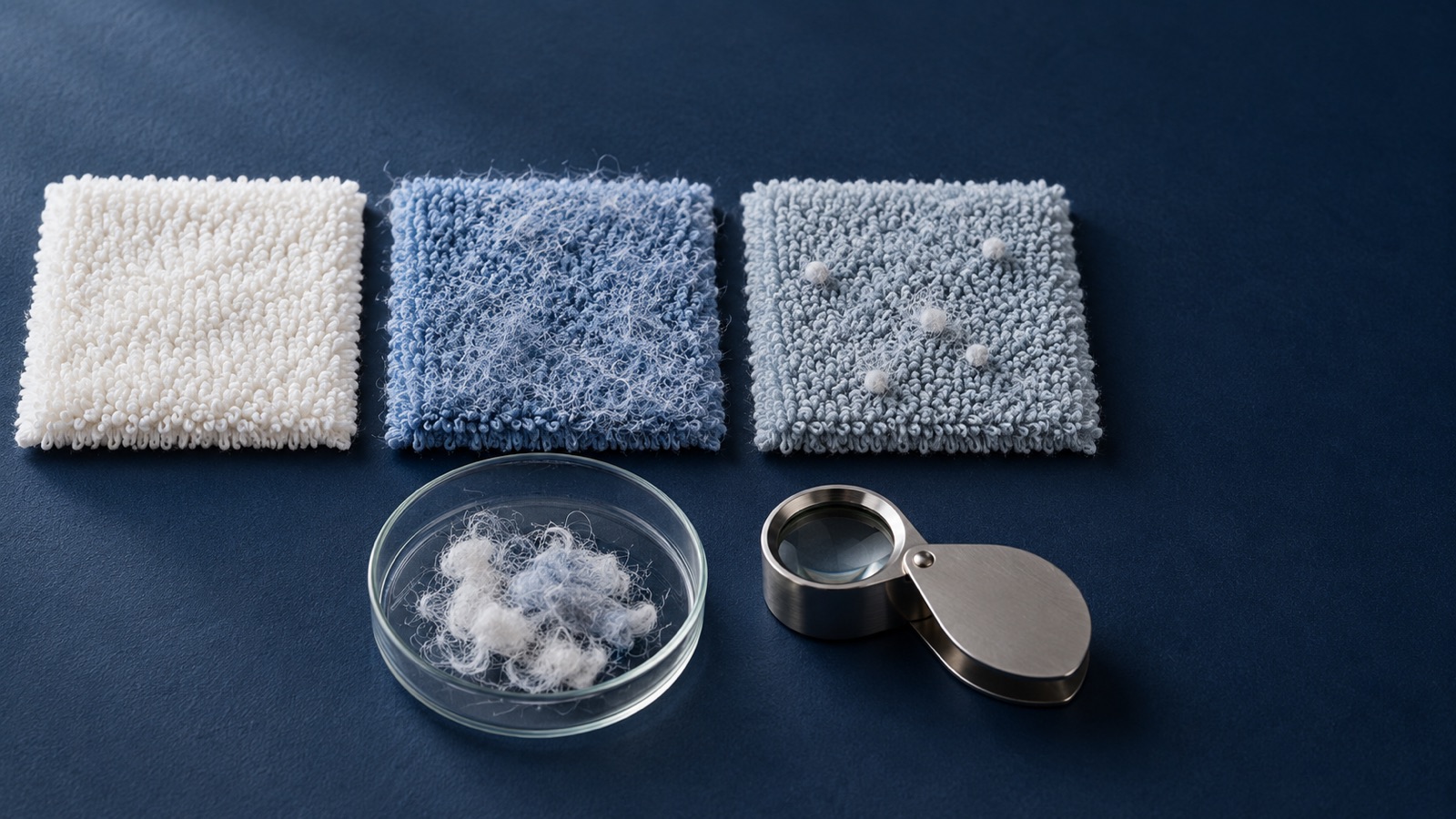
“Low lint” is not a complete towel requirement. A buyer must first say whether the concern is loose fibres visible on a new towel, fibre material released during handling or laundering, a generally fuzzy surface, or discrete pills retained on the fabric. These are related but different observations, and one test result cannot represent all of them.
A workable acceptance standard names the defect, the towel state, the preparation or laundry procedure, the inspection or test method, the reporting unit, the limit, the sample plan and the approved reference. The limit should come from the intended use and validated development samples—not from an unsupported universal number.
Use four separate terms before choosing a method
| Term | Working definition for a towel programme | What the buyer may observe |
|---|---|---|
| Loose fibres | Unattached fibres or tufts present on the towel or in its packaging at the stated inspection point. | Visible pieces, clumps or contamination before use. |
| Shedding or linting | Fibre material released from the towel during a defined action such as washing, drying or controlled handling. | Collected lint, filter residue, transfer to another surface or mass loss. |
| Fuzzing | Fibre ends raised from the fabric, creating a diffuse hairy surface without necessarily forming balls. | A change in clarity, colour appearance or surface texture. |
| Pilling | Small entangled fibre balls retained on the surface. | Discrete pills whose size, number and contrast affect appearance. |
The distinction is reflected in standards. ISO 12945-1:2020 uses a rotating pilling box to assess propensity to pilling, fuzzing or matting, while ISO 12945-4:2020 addresses visual assessment of those surface phenomena. Neither title claims to measure every fibre that leaves a towel in a wash.
A pilling method is not a complete towel-lint test
Pilling tests expose and grade surface change under a prescribed mechanical action. Wash-release methods collect material lost under prescribed laundering conditions. A new-product visual inspection finds remaining loose material. These outputs have different units and answer different buying questions.
Method selection also requires caution. ASTM D3512/D3512M-22 uses a random tumble pilling tester and reports a visual scale from 5 for no pilling to 1 for very severe pilling. Its scope is generally framed around woven and knitted apparel fabrics, and ASTM says the method is not recommended for acceptance testing because between-laboratory precision is poor. ASTM also notes that fibre, yarn, construction, finishing and refurbishment influence pilling. A towel buyer should therefore confirm suitability with the testing laboratory, define the selected procedure exactly and align laboratories before making it contractual.
For released material, AATCC TM212-2021 determines the mass of fibre fragments released in an accelerated laundering machine. AATCC says the result provides a relative approximation of full-scale home laundering and that an exact correlation has not been established. ISO 4484-1:2023 systematically collects material lost from fabrics under laundering test conditions but likewise states there is no direct correlation to domestic or commercial laundry loss. Both can provide comparable method-defined data; neither automatically predicts visible dryer lint, transfer during guest use or a commercial laundry outcome.
Match each risk to evidence
| Buyer concern | Evidence route | Report clearly |
|---|---|---|
| Loose fibres at unpacking | Standardised whole-towel visual inspection against an approved defect library. | Towel state, lighting, viewing distance, zones, count or grade and photographs. |
| Material released in washing | A named mass-release method or a fully documented buyer procedure. | Method edition, wash conditions, specimen basis, collection and result unit. |
| Fuzzing or pills after action | A selected pilling/fuzzing exposure and visual assessment validated for the construction. | Apparatus, cycles or duration, assessment standard, grade and evaluator conditions. |
| Lint in the intended operation | Controlled trial through the buyer’s actual or representative wash, dry and handling process. | Load, chemistry, temperatures, extraction, dryer settings, cycles and collection point. |
| Appearance over repeated care | Signed samples and fixed photography at agreed cycle checkpoints. | Fuzz, pills, loop pulls, bald areas, colour appearance and pass/fail reference. |
If a custom rub, shake, tape or lint-collection check is used, it becomes meaningful only when every detail is controlled: specimen size, conditioning, equipment or action, force, strokes or time, collection surface, cleaning, weighing and calculation. Give it an internal procedure number and do not present it as a standard method.
Build the acceptance standard field by field
- Define the failure mode. Replace “no lint” with the exact observation: visible loose tufts, released mass, surface fuzz grade, retained pills or transfer.
- Define product state. State as-packed, after preparation, after first wash, or after specified repeated cycles. Do not compare towels in different states.
- Name the procedure. Record the method, edition, options, deviations, laboratory and conditioning. ISO 6330:2021, for example, offers multiple domestic wash and dry procedures and notes that machine, detergent and dryer parameters can affect results.
- Choose the unit. A visual grade, count per towel, collected mass per specimen basis and percentage mass loss are not interchangeable. State rounding and treatment of results below measurement capability.
- Set the limit from development evidence. Test representative constructions, compare them with intended use and approve the limit jointly. Record whether each specimen, the mean, or both must pass.
- Control sampling. Define units per lot, selection across cartons and colours, specimen locations, retest rules and what happens when laboratories disagree.
- Keep references. Retain sealed signed samples, dated photographs and tested specimens where practical so words such as “slight fuzz” have a stable meaning.
Place this schedule in the towel specification sheet and carry the records through the sample approval process. The production criterion should match what was actually demonstrated by the approved pre-production sample.
Construction and care still matter
Fibre properties, yarn spinning and twist, pile geometry, loop anchoring, shearing or brushing, washing, softening and drying can all change how fibres remain on or leave a towel. This is why one result should not be attributed to cotton content, GSM or a “zero-twist” label alone. The yarn, pile and finishing guide explains how these variables interact.
The intended laundry can change both release and visible appearance. Hospitality buyers should document their chemistry, mechanical action and drying conditions and use the commercial-laundry specification guide when a domestic method is not representative. A factory sample can establish a controlled benchmark, but only a trial in the intended operation can answer operation-specific transfer and lint-handling questions.
Questions buyers often ask
Is some lint after the first wash automatically a defect?
Not automatically. The contract should define the relevant state, collection method and limit. An observation without a controlled method cannot show whether the towel has passed the agreed requirement.
Can a pilling grade be used as the lint limit?
Not on its own. A pilling grade describes retained surface change under one exposure. It does not quantify loose fibres present at unpacking or fibre fragments released during laundering.
Should released fibre be reported in grams or as a percentage?
Either may be appropriate if the named method permits it, but the specimen basis and calculation must be explicit. Never compare unlike units or results from different wash and collection procedures.
Can the approved sample replace a numerical limit?
A signed sample is useful for subjective appearance, but measurable risks should also have a method, unit and tolerance. Use both when the decision combines visual acceptability with released material.
Does “100% cotton” predict linting?
No. Fibre content alone does not specify fibre characteristics, yarn, pile, finishing, laundering or surface state. Evaluate the complete towel construction in the agreed condition.
Sources
- ISO 12945-1:2020 — Textiles — Determination of fabric propensity to surface pilling, fuzzing or matting — Part 1: Pilling box method — International Organization for StandardizationAccessed 5 October 2026
- ISO 12945-4:2020 — Textiles — Determination of fabric propensity to surface pilling, fuzzing or matting — Part 4: Assessment of pilling, fuzzing and matting by visual analysis — International Organization for StandardizationAccessed 5 October 2026
- ASTM D3512/D3512M-22 — Standard Test Method for Pilling Resistance and Other Related Surface Changes of Textile Fabrics: Random Tumble Pilling Tester — ASTM InternationalAccessed 5 October 2026
- AATCC TM212-2021 — Test Method for Fiber Fragment Release During Home Laundering — AATCCAccessed 5 October 2026
- ISO 4484-1:2023 — Textiles and textile products — Microplastics from textile sources — Part 1: Determination of material loss from fabrics during washing — International Organization for StandardizationAccessed 5 October 2026
- ISO 6330:2021 — Textiles — Domestic washing and drying procedures for textile testing — International Organization for StandardizationAccessed 5 October 2026
A note on specifications
Product performance, minimum order quantities, lead times, pricing and compliance requirements depend on the final specification, testing standard, order volume and destination market. This article provides general manufacturing information; confirm requirements with the factory and appropriately qualified testing, compliance and logistics advisers before ordering.