
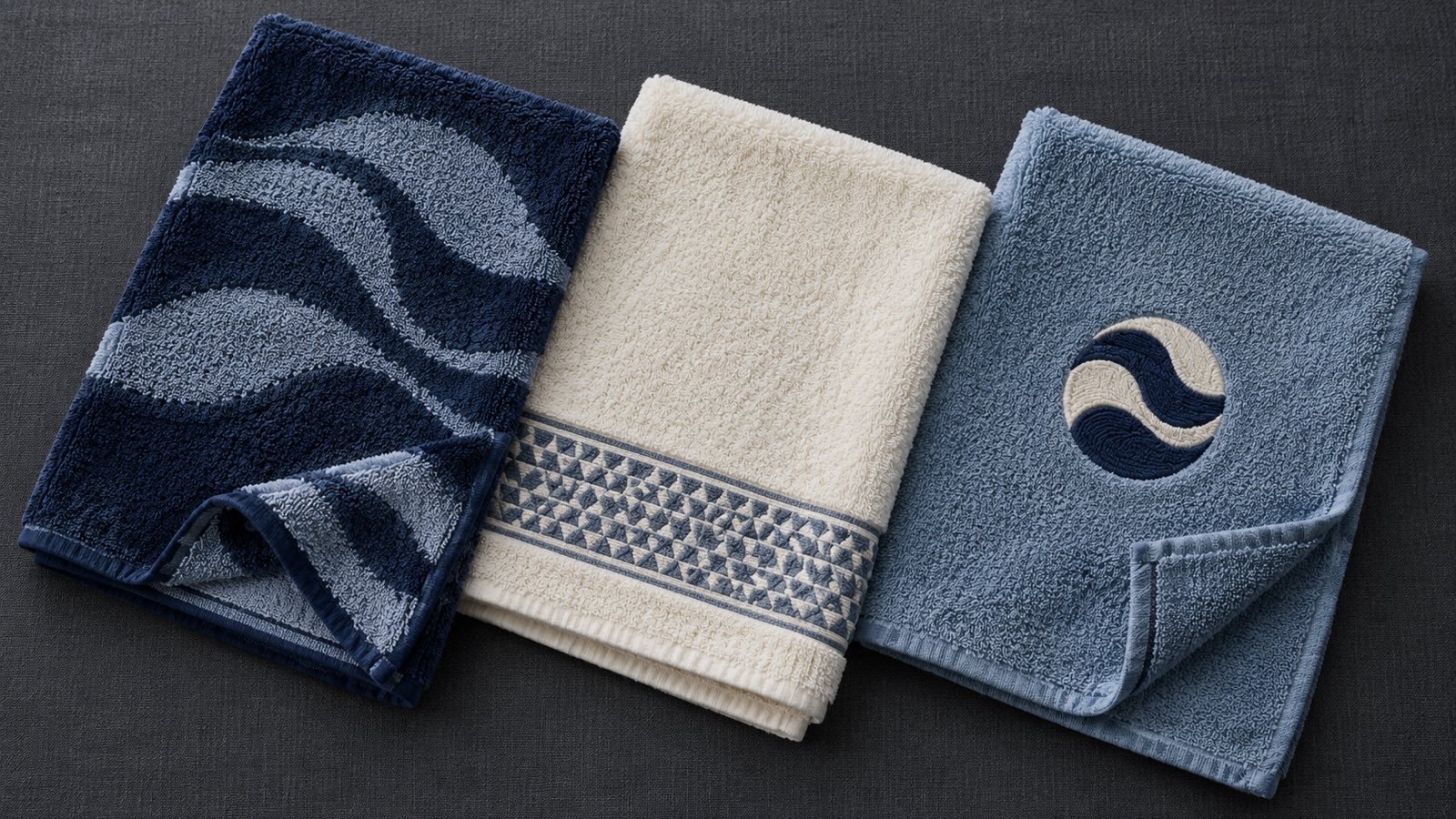
Choose jacquard when the motif should be part of the woven towel and needs more design freedom; choose dobby for restrained geometric borders, stripes or repeated texture; choose embroidery when a compact logo or name should be stitched onto an otherwise defined towel. The right answer depends on the artwork, both-face appearance, desired hand, colour plan, placement and order structure.
These names do not define a universal level of detail, minimum order or price. Loom configuration, yarn systems, towel construction, embroidery equipment and supplier planning all matter. Ask the factory to interpret the artwork in its proposed construction, then approve a physical sample from the front and reverse before confirming production.
First decide whether the brand belongs in the cloth or on the cloth
Dobby and jacquard form a design while the towel is woven. Embroidery adds thread after the base towel has been woven and normally after its size and placement areas are known. That distinction affects more than appearance: it changes artwork preparation, yarn or thread planning, the reverse face, local thickness, sampling sequence and the point at which branded stock becomes committed to one programme.
A brand mark is not automatically suitable for all three methods. Fine lettering that works in embroidery may need simplification as a woven pile motif. A subtle tonal border may look more integrated in dobby than as dense stitching. Begin with the intended use and visual hierarchy, not with a method selected from a catalogue.
Working comparison for towel buyers
| Decision | Jacquard | Dobby | Embroidery |
|---|---|---|---|
| How the mark is made | Woven through controlled warp selection and the specified towel construction | Woven through groups of warp yarns controlled in harness frames | Digitised stitches applied to the completed base fabric |
| Typical design strength | Larger, more intricate repeats and integrated motifs | Small geometry, stripes, checks, borders and repeated texture | Compact logos, initials, names and controlled multicolour marks |
| Reverse | A related woven structure; not necessarily identical to the face | A related woven structure, often visually restrained | Bobbin thread and possibly residual backing or a reverse-side covering |
| Effect on hand | Depends on pile, weave, yarn distribution and motif area | Often flatter or firmer where the decorative structure replaces pile | Adds local stitch mass and may add backing beneath the mark |
| Planning centre | Weave file, loom/harness compatibility, yarn colours and woven quantity | Harness plan, border repeat, yarn plan and woven quantity | Digitising, hooping, placement, stitch count, thread changes and finishing |
Jacquard: woven detail with broader design control
In weaving, shedding raises selected warp yarns so the filling yarn can pass through. CottonWorks explains that jacquard cords connect to individual heddles or small groups, enabling larger repeats and more intricate designs than harness-group control. Equipment configuration still places real limits on resolution: hook count, warp density, pile arrangement, yarn colours, motif scale and the chosen weave must work together.
Jacquard can integrate a wordmark, pictorial motif or all-over identity into the towel rather than adding a separate surface decoration. It is used for terry as well as flat fabrics; Stäubli lists terry cloth among its jacquard applications. That does not mean every artwork can be reproduced unchanged. Thin strokes, tight counters in letters and small colour islands may need enlargement or redrawing for the proposed yarn-and-pile grid.
Ask to see a face-and-reverse simulation or strike-off interpretation, then a physical sample. Depending on the construction, the reverse may show an inverted colour relationship, different pile effect, floats or a less legible version of the motif. If the towel will be displayed from both sides, specify acceptable appearance for each side rather than calling the product simply “reversible”.
Dobby: disciplined geometry and borders
Dobby controls groups of warp yarns through harness frames. CottonWorks notes that dobby shedding commonly supports small geometric figures, spot weaves and more complex pattern stripes. For towels, that logic suits a structured border, tonal texture, repeated geometric device or a quiet brand cue better than a detailed illustration.
A dobby area often changes the surface because loops may be reduced or replaced by a flatter woven structure. The border can therefore feel firmer than the terry body and may interact differently with folding and drying. This is not automatically a defect; it is a construction choice that should be judged against the intended use. Specify border depth, position from the edge, repeat, colour, face and reverse appearance, and how the pattern aligns after hemming.
Do not assume that “simple dobby” means an unrestricted low minimum. The chosen harness plan, warp and weft colours, border repeat, towel width, size mix and production scheduling still determine what is practical. Confirm the factory’s proposed construction and commercial basis for the exact range.
Embroidery: a separate stitched mark with its own engineering
Embroidery begins with digitising artwork into stitch instructions, then controlling size, stitch types and density, underlay, thread colours, sequence, placement and stabilisation. Terry pile can hide fine stitches. Madeira’s technical guidance explains that a water-soluble topping can keep stitches above a high-pile surface and improve definition. The actual combination must be sampled for the towel, artwork and laundering requirement.
The front may reproduce compact lettering or several colours without changing the woven base, but the reverse remains part of the product. It can show bobbin thread, tie-offs and backing. Madeira’s backing overview notes that fabric stability, stitch density and length, design size, speed and expected laundering all influence backing selection; some backing is removed and some remains. State whether the reverse will touch skin, be visible in use or require a covering.
Dense embroidery adds local mass and can create a firmer patch, especially on a light towel or a large filled logo. A lighter open design may feel less intrusive but reproduce differently. Approve edge definition, pile show-through, puckering, local stiffness, reverse finish and placement after laundering—not only the artwork viewed on screen.
Hand and wash appearance need named approval conditions
“Soft” is not a sufficient acceptance criterion. AATCC EP5-2025 provides guidelines for presenting and handling fabrics under standardised conditions when evaluating hand. Buyers can apply that principle by comparing approved samples in the same state, assessing the terry body and decorated area separately, and recording terms such as surface softness, flexibility, thickness and reverse-side comfort.
Evaluate appearance before and after an agreed wash cycle. ISO 6330:2021 specifies domestic washing and drying procedures for textile testing and warns that procedure parameters can affect results. It is not a commercial-laundry method, so hospitality programmes may need a different agreed protocol. Record the cycle, number of repetitions and acceptance points for motif definition, loose threads, distortion, puckering, colour, placement and reverse condition.
Minimums follow the production route, not the method name
Woven branding commits the motif to the weaving plan. Its practical minimum can be influenced by yarn preparation, colour quantities, loom setup, weave file, towel dimensions, size assortment and scheduling. Embroidery can sometimes place different marks onto a shared base towel after weaving, but its economics still depend on digitising, sample approval, frame or hoop setup, stitch count, thread changes, placement and batch handling.
Therefore, ask for programme-specific minimums and setup charges rather than using a universal rule such as “embroidery is always lower MOQ”. A mixed range may use one method for the main identity and another for a secondary cue, but the supplier must confirm compatibility and sequence.
What to put in the RFQ and specification
- vector artwork plus a dimensioned placement drawing for every towel size;
- preferred method, acceptable interpretation changes and priority details;
- front and reverse appearance requirements, including visibility and skin contact;
- motif dimensions, repeat, border depth, edge distance and placement tolerance;
- approved yarn or thread colours under an agreed colour-reference system;
- base towel fibre, size, finished weight or GSM, pile, ground, colour and finish;
- sample stages, wash procedure, number of cycles and visual/hand acceptance criteria;
- quantities by colour, size and artwork, plus packaging and labelling requirements;
- ownership and permitted use of artwork, weave files and embroidery files.
Put these fields into the towel specification sheet and the custom towel RFQ. Son Ha Textile’s factory team in Phùng Xá, Hanoi can review artwork against its published towel-manufacturing capabilities, but the feasible method, construction, minimums, development work and commercial terms must be confirmed for the specific programme.
Questions buyers often ask
Is jacquard always more detailed than embroidery?
No. Jacquard permits intricate woven repeats, while embroidery can be effective for compact lettering and multicolour marks. Actual clarity depends on artwork scale, yarn or thread, pile, density, equipment and the approved construction.
Can the reverse of a branded towel look the same as the front?
Sometimes a woven construction can be designed with a related two-sided effect, but identical faces should never be assumed. Embroidery normally shows a different reverse. Specify and approve both sides.
Does embroidery reduce the towel’s softness?
It adds local thread mass and may include backing, so the decorated area can feel firmer. The effect depends on design area, stitch density, thread, stabilisation and towel construction. Compare physical samples after the agreed wash.
Which branding method has the lowest minimum order?
There is no universal answer. Woven methods depend on yarn and loom planning; embroidery depends on base-towel availability, digitising, setup, stitch count and batch handling. Request a minimum and cost basis for the exact specification.
Sources
- Weaving Basics — CottonWorks by Cotton IncorporatedAccessed 5 October 2026
- Jacquard weaving, harnesses and UNIVAL technology — StäubliAccessed 5 October 2026
- Water-Soluble Toppings and Stabilizers — Madeira USAAccessed 5 October 2026
- Embroidery Backing Options Explained — Madeira USAAccessed 5 October 2026
- AATCC EP5-2025 — Evaluation Procedure for Fabric Hand Value — AATCCAccessed 5 October 2026
- ISO 6330:2021 — Textiles — Domestic washing and drying procedures for textile testing — International Organization for StandardizationAccessed 5 October 2026
A note on specifications
Product performance, minimum order quantities, lead times, pricing and compliance requirements depend on the final specification, testing standard, order volume and destination market. This article provides general manufacturing information; confirm requirements with the factory and appropriately qualified testing, compliance and logistics advisers before ordering.