
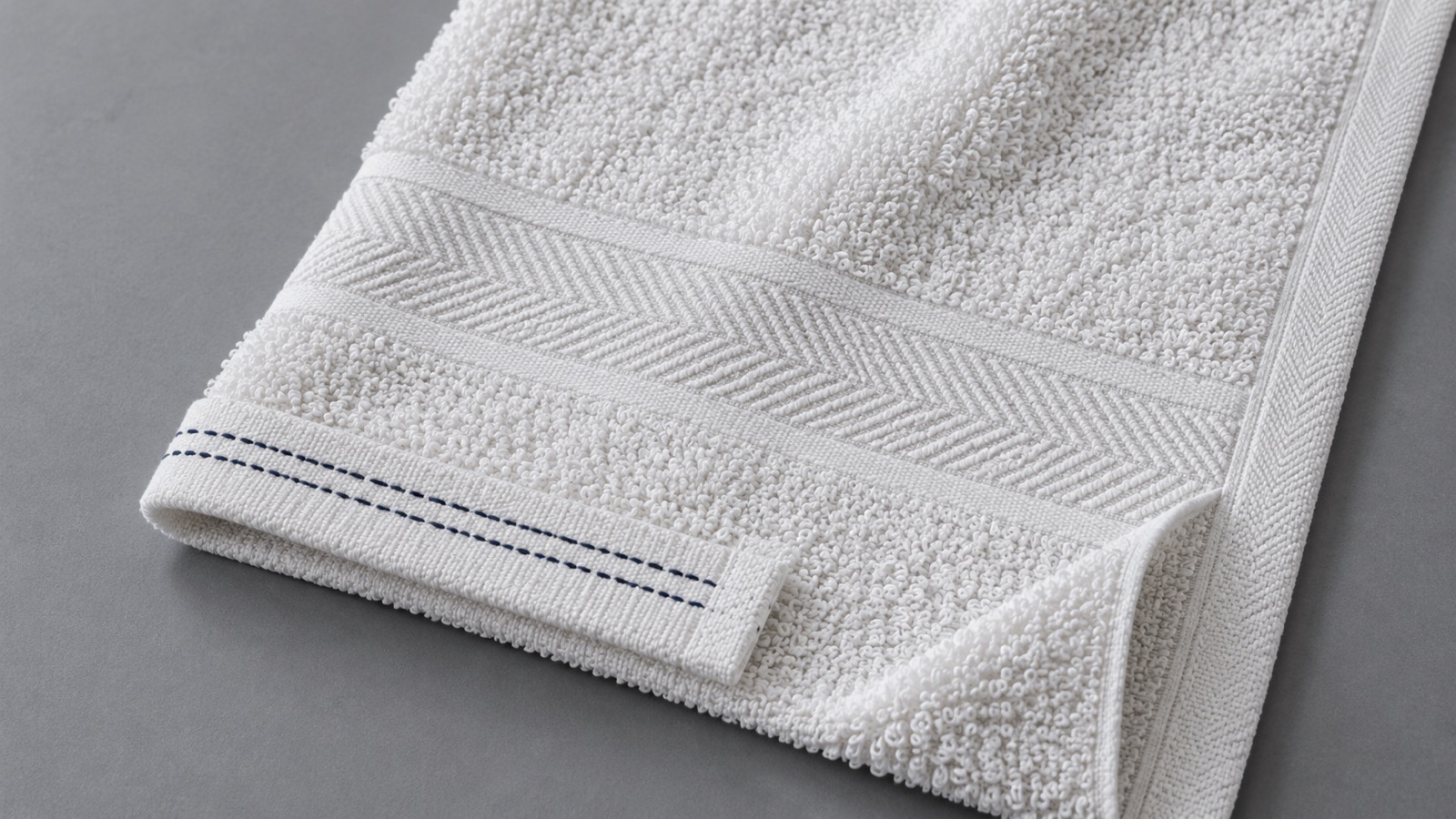
A towel border, hem and selvage are different parts of the product. The border is a woven design or pile-free zone, usually running across the towel. The hem finishes a cut end, often by folding and sewing it. The selvage is the woven lengthwise edge formed as the cloth is made. Each can influence appearance, folding, edge stability, dimensions and laundry behaviour.
No one border width, hem style or selvage construction is universally superior. Buyers should define the intended look and use, describe the construction in measurable terms, and approve the complete towel after the laundering process relevant to the programme.
A practical map of towel anatomy
Terminology can vary between mills and markets. “Border”, “header” and “dobby border” may be used differently, while “hem” is sometimes used loosely for any finished edge. A drawing or annotated sample removes that ambiguity. For a conventional woven terry towel, the working distinctions below are useful.
| Part | Where it is | What to define |
|---|---|---|
| Pile field | The main looped area used for drying or contact. | Face arrangement, pile construction, dimensions and transition to the border. |
| Border or header | A flat or differently woven zone, commonly across one or both short ends. | Number, position, finished width, weave, motif, yarn and colour. |
| End hem | The finish applied to the cut crosswise end. | Fold and turn-in, finished depth, seam and stitch type, rows, thread and securing method. |
| Selvage | The woven edge along each lengthwise side. | Finished width, weave, pile clearance, straightness and acceptable edge appearance. |
| Corner | The junction between end hem and side edge. | Bulk, squareness, loose threads, stitch security and acceptable profile. |
Include front and back photographs, a dimensioned sketch and an approved physical sample in the towel specification sheet. A width alone cannot show how the border transitions into pile or how the corner is assembled.
Borders connect visual design with fabric construction
A border can create a quiet frame, carry a geometric weave, divide colour areas or provide a flatter zone for presentation. It also removes or changes pile over part of the towel. Increasing border depth therefore changes the distribution of pile and flat fabric even when the outside dimensions remain the same. For a drying product, the buyer should assess usable pile area as well as overall size.
Border structure can differ from the terry field in yarn arrangement, weave density and thickness. Those differences may show as a firmer hand, a change in drape or a tendency for the border and pile field to respond differently during wet processing and laundering. This does not make a wide or decorative border inherently problematic; it means the border must be developed as part of the complete construction rather than added as a visual afterthought.
Check whether the design should read from one face or both, whether the two end borders must match, and how the motif aligns after hemming. For folded hospitality presentation, also confirm that the border lands where intended in the specified fold. If a branding technique is added later, reserve sufficient clear area and approve its effect on stiffness, reverse-side appearance and care.
A hem is a seam system, not just a fold measurement
The folded depth is only one variable. Fabric layers, raw-edge turn-in, stitch type, stitch density, sewing thread, thread tension, number of rows and how the stitching is secured work together. ASTM D6193-16(2025) describes seam engineering in the same system terms and states that strength, elasticity, durability, security and appearance must be balanced with the joined material and intended end use. ISO 4915 separately classifies and illustrates stitch types, which is useful when words such as “double stitch” could otherwise be interpreted several ways.
A deeper or multi-layer hem may look substantial but can create more corner bulk. A narrower construction may fold compactly but still needs sufficient edge enclosure and stitch security for its fabric and care process. More stitches are not automatically better: the thread, needle, material and tension must suit one another. Specify the outcome and construction together rather than copying a stitch count from an unrelated towel.
If seam strength is a contractual requirement, name the method and direction. ISO 13935-1:2014 determines maximum force to seam rupture with force applied perpendicular to a sewn seam using a strip method. ASTM D1683/D1683M-22 measures failure in sewn seams of woven fabrics and can distinguish stitching rupture, fabric failure and yarn slippage, but explicitly says it does not predict actual wear performance. Laboratory force and laundered-product inspection answer related but different questions.
Selvages stabilise the sides, but still need specification
The selvage is produced at the lengthwise edge during weaving, so it is not the same as a sewn end hem. It commonly has a compact, pile-free or reduced-pile structure. Its yarns, width and weave influence edge profile, while loom setup, finishing and cutting influence straightness and consistency.
A very firm side edge is not automatically the most suitable: the target is compatibility with the towel body and intended presentation. Inspect for waviness, draw-in, flare, curling, exposed loose ends, unintended pile gaps and unequal left/right appearance. Measure finished width at several points and record whether the side edge is included in the stated towel width.
Corner quality exposes how the systems meet. Look at the front, back and end-on profile. The hem should capture the cut edge consistently; stitches should remain secured through the corner; and excess thickness should not distort the outline beyond the agreed sample and tolerance.
Laundering reveals interactions a new sample can hide
Puckering, twisting, border distortion or edge flare can result from the interaction of components rather than one visibly defective part. That is why an approval record should identify the wash and dry procedure. ISO 6330:2021 provides defined domestic washing and drying procedures for textile testing and notes that machine, detergent and drying parameters can affect results. ISO 5077:2007 provides a method for determining dimensional change after an appropriate specified wash-and-dry combination.
A hospitality or institutional programme may use conditions that a domestic procedure does not reproduce. In that case, document the actual or agreed representative process—load, chemistry, temperature, mechanical action, extraction and drying—and interpret results only for that process. The hotel towel laundering guide explains how to turn operating conditions into a product brief.
Sample checklist for borders and edges
- Confirm finished length and width, noting whether hems and selvages are included.
- Measure each border’s position and width on both faces.
- Compare motif, colour, alignment and transition into the pile field.
- Record hem depth, fold construction, stitch type, row count, thread and stitches per stated unit.
- Check the raw edge is consistently enclosed and stitching is secured.
- Compare left and right selvage width, straightness, pile clearance and surface appearance.
- Inspect all four corners for bulk, squareness, missed stitches and loose threads.
- Perform gentle handling checks for snagging or early unravelling without substituting them for an agreed test.
- Launder and dry under the named procedure, then repeat dimensions and visual grading.
- Retain the signed sample, measurement record and photographs for bulk comparison.
Add these points to the sample approval checklist. Set measurable tolerances where they matter, and use the approved sample for aspects—such as corner profile or border hand—that a number alone cannot describe fully.
Questions buyers often ask
Is a towel border the same as its hem?
No. The border is a woven design or construction zone, while the hem finishes a cut end through folding, sewing or another agreed treatment. They sit near one another on many towels but should be specified separately.
Does a wider border make a towel more durable?
Not by itself. Border width changes design, hand and pile distribution. Durability depends on the full border and ground construction, transitions, edge assembly, finishing and care process.
Are two rows of hem stitching always better than one?
No universal rule applies. Seam type, stitch type, thread, density, tension, fabric and intended use form one system. Approve the specified assembly after the relevant testing and laundering.
Why can a towel border pucker after washing?
The pile field, border yarns, hem layers and sewing thread can respond differently to wet processing and drying. Diagnose the complete construction and process rather than assigning the result to border width alone.
What should be approved if appearance is subjective?
Use measurable limits for position, width and dimensions, supported by a signed physical sample and photographs for alignment, corner profile, hand and acceptable appearance before and after laundering.
Sources
- ASTM D6193-16(2025) — Standard Practice for Stitches and Seams — ASTM InternationalAccessed 5 October 2026
- ISO 4915:1991 — Textiles — Stitch types — Classification and terminology — International Organization for StandardizationAccessed 5 October 2026
- ASTM D1683/D1683M-22 — Standard Test Method for Failure in Sewn Seams of Woven Fabrics — ASTM InternationalAccessed 5 October 2026
- ISO 13935-1:2014 — Textiles — Seam tensile properties of fabrics and made-up textile articles — Part 1: Determination of maximum force to seam rupture using the strip method — International Organization for StandardizationAccessed 5 October 2026
- ISO 6330:2021 — Textiles — Domestic washing and drying procedures for textile testing — International Organization for StandardizationAccessed 5 October 2026
- ISO 5077:2007 — Textiles — Determination of dimensional change in washing and drying — International Organization for StandardizationAccessed 5 October 2026
A note on specifications
Product performance, minimum order quantities, lead times, pricing and compliance requirements depend on the final specification, testing standard, order volume and destination market. This article provides general manufacturing information; confirm requirements with the factory and appropriately qualified testing, compliance and logistics advisers before ordering.