
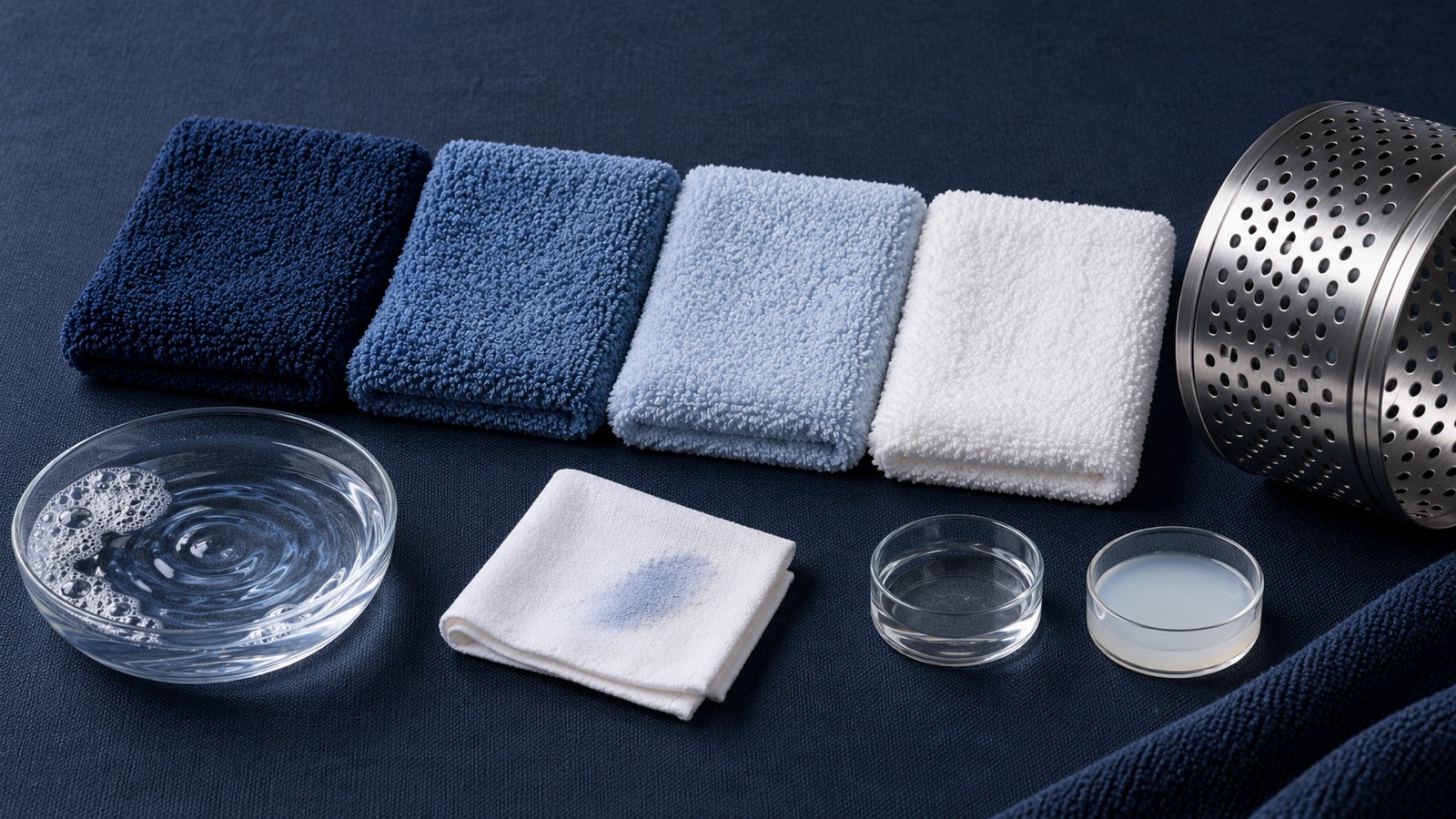
Colourfastness is not one pass-or-fail property. A towel can retain its shade in a domestic wash yet transfer colour when rubbed wet, react to hypochlorite, or change under an industrial laundry process. Each exposure asks a different question and needs its own method, conditions and acceptance limit.
A useful specification therefore names the intended care route, method edition and option, dry or wet state, bleach chemistry, assessment output, minimum grade and approval stage. A report headed only “colourfastness: pass” is not enough to compare suppliers or release production.
Start with an exposure matrix, not one colourfastness number
| Exposure | Buyer question | Relevant ISO starting point |
|---|---|---|
| Domestic or commercial laundering | Will normal household-type washing change the towel or stain other textiles? | ISO 105-C06:2010 |
| Industrial laundering | Will colour resist the separately defined industrial process? | ISO 105-C12:2024 |
| Dry and wet rubbing | Will colour rub off onto another material in dry or damp contact? | ISO 105-X12:2016 |
| Hypochlorite bleach | How does the colour respond to the specified hypochlorite exposure? | ISO 105-N01:1993 |
| Peroxide bleach | How does the colour respond to the specified peroxide bleaching bath? | ISO 105-N02:1993 |
The ISO 105-A01 general principles explain that colourfastness methods have defined uses and limitations. The table is therefore a selection map, not permission to combine results. Buyers should use the full licensed method and a competent laboratory to define and perform each test rather than reconstructing a procedure from a summary.
Domestic or commercial washing is not industrial laundering
ISO 105-C06:2010 addresses resistance to domestic and commercial laundering used for normal household articles with a reference detergent. ISO notes that industrial and hospital articles can face special procedures that are more severe in some respects. It also distinguishes single and multiple test options and warns that its methods represent the specified detergents and bleach systems—not every product used in the market.
For a retail or home-use towel, the brief should identify the selected C06 option, the relevant temperature and detergent or bleach system, the number of test exposures and whether the acceptance applies to colour change, staining, or both. A result from one option must not be presented as proof for every wash temperature or chemistry, nor as a guaranteed number of service washes.
ISO 105-C12:2024 is the separate current standard for determining resistance to industrial laundering. Use it when the destination is a hotel, healthcare, rental-linen or other programme whose actual processing is industrial. “Commercial” in the C06 title does not make C06 interchangeable with C12. The buyer and laundry operator should align the chosen C12 conditions with the intended process and document any important gap between a standard exposure and the real wash formula, drying route or repetition.
Rubbing tests answer a transfer question
ISO 105-X12:2016 determines resistance to colour rubbing off and staining another material. Its scope includes pile fabrics, making it relevant to towels, and provides for separate dry-rubbing and wet-rubbing tests. A dry result does not predict the wet result: moisture can change the transfer behaviour of a deep shade, printed area or contrast border.
The request should state both conditions when both matter, identify the face, reverse, border or decoration to be assessed, and record any directional sampling instruction for the pile. Do not confuse a rubbing grade with shade retention after washing. The rubbing cloth shows transfer under contact; laundering exposes the specimen and adjacent materials to a wash system.
“Bleach-safe” is incomplete without the chemistry
Bleach is not a single exposure. ISO 105-N01:1993 covers colourfastness to hypochlorite bleaching and is mainly applicable to natural and regenerated-cellulose materials. ISO 105-N02:1993 covers peroxide bleaching baths in concentrations commonly used in textile processing; it assesses specimen colour change and staining of adjacent fabric. These methods answer different chemistry questions and cannot substitute for each other.
A procurement brief should name whether chlorine-based hypochlorite, peroxide or another oxidising system is expected, then state the relevant method and agreed condition. If the service laundry uses a proprietary formula, the standard test can be paired with a separately documented use-condition trial. Passing a wash test that includes one specified bleach system does not justify an unlimited “bleach resistant” claim for other agents, concentrations, temperatures or dosing practices.
Define what is graded—and what counts as acceptance
Colour change in the tested towel and staining of another material are separate outputs. ISO 105-A02:1993 defines the grey scale for assessing change in colour, while ISO 105-A03:2019 defines the grey scale for assessing staining. A report may therefore contain more than one grade, and a buyer may need different acceptance limits for each output.
There is no responsible universal grade for every towel, shade and end use. Set limits from the product risk, customer requirement, destination programme and agreed method. Dark navy, contrast jacquard, reactive-dyed pastel and printed decoration should not inherit approval from an untested colourway merely because their GSM and construction match.
Put these fields into the specification and approval record
- End use and care route: home, commercial household-type, or industrial laundry.
- Exact method: standard number, edition, option and any agreed deviation.
- Exposure: wash system, wet and dry rubbing, or named bleach chemistry—kept as separate lines.
- Specimen: colourway, pile face, ground, border, decoration and sample stage.
- Assessment: colour change, staining, or both, with the named scale or instrumental method.
- Acceptance: minimum result for every required output, plus retest and failure action.
- Control: approved sample reference, laboratory report identifier, lot link and responsible approver.
Add the matrix to the towel specification sheet before quotation, then carry the same criteria into the sample approval record. This prevents the development sample being approved by appearance while production is judged later against an unstated wash or bleach expectation.
Questions buyers often ask
Does one wash-fastness pass cover rubbing and bleach?
No. Washing, rubbing and individual bleach chemistries are separate exposures. Specify and accept each condition that matters to the intended use.
Should hotel towels use ISO 105-C06 or ISO 105-C12?
Choose from the actual care route, not the word “hotel”. C12 addresses industrial laundering; C06 addresses domestic and commercial laundering for normal household articles. Confirm the laundry programme and method option in writing.
Is a dry-rubbing result enough?
Only if wet contact is genuinely outside the product risk. Towels routinely meet moisture, so buyers commonly need dry and wet results stated separately.
Can a supplier call a towel bleach-safe after a hypochlorite test?
Only with tightly qualified wording tied to the tested chemistry and conditions. A hypochlorite result does not establish peroxide resistance or every service-laundry formula.
Is there one minimum colourfastness grade for all towels?
No. The buyer must set method-specific limits for colour change and staining according to the shade, construction, end use and customer requirement.
Sources
- ISO 105-A01:2010 — Textiles — Tests for colour fastness — Part A01: General principles of testing — International Organization for StandardizationAccessed 5 October 2026
- ISO 105-A02:1993 — Textiles — Tests for colour fastness — Part A02: Grey scale for assessing change in colour — International Organization for StandardizationAccessed 5 October 2026
- ISO 105-A03:2019 — Textiles — Tests for colour fastness — Part A03: Grey scale for assessing staining — International Organization for StandardizationAccessed 5 October 2026
- ISO 105-C06:2010 — Textiles — Tests for colour fastness — Part C06: Colour fastness to domestic and commercial laundering — International Organization for StandardizationAccessed 5 October 2026
- ISO 105-C12:2024 — Textiles — Tests for colour fastness — Part C12: Colour fastness to industrial laundering — International Organization for StandardizationAccessed 5 October 2026
- ISO 105-X12:2016 — Textiles — Tests for colour fastness — Part X12: Colour fastness to rubbing — International Organization for StandardizationAccessed 5 October 2026
- ISO 105-N01:1993 — Textiles — Tests for colour fastness — Part N01: Colour fastness to bleaching: Hypochlorite — International Organization for StandardizationAccessed 5 October 2026
- ISO 105-N02:1993 — Textiles — Tests for colour fastness — Part N02: Colour fastness to bleaching: Peroxide — International Organization for StandardizationAccessed 5 October 2026
A note on specifications
Product performance, minimum order quantities, lead times, pricing and compliance requirements depend on the final specification, testing standard, order volume and destination market. This article provides general manufacturing information; confirm requirements with the factory and appropriately qualified testing, compliance and logistics advisers before ordering.