
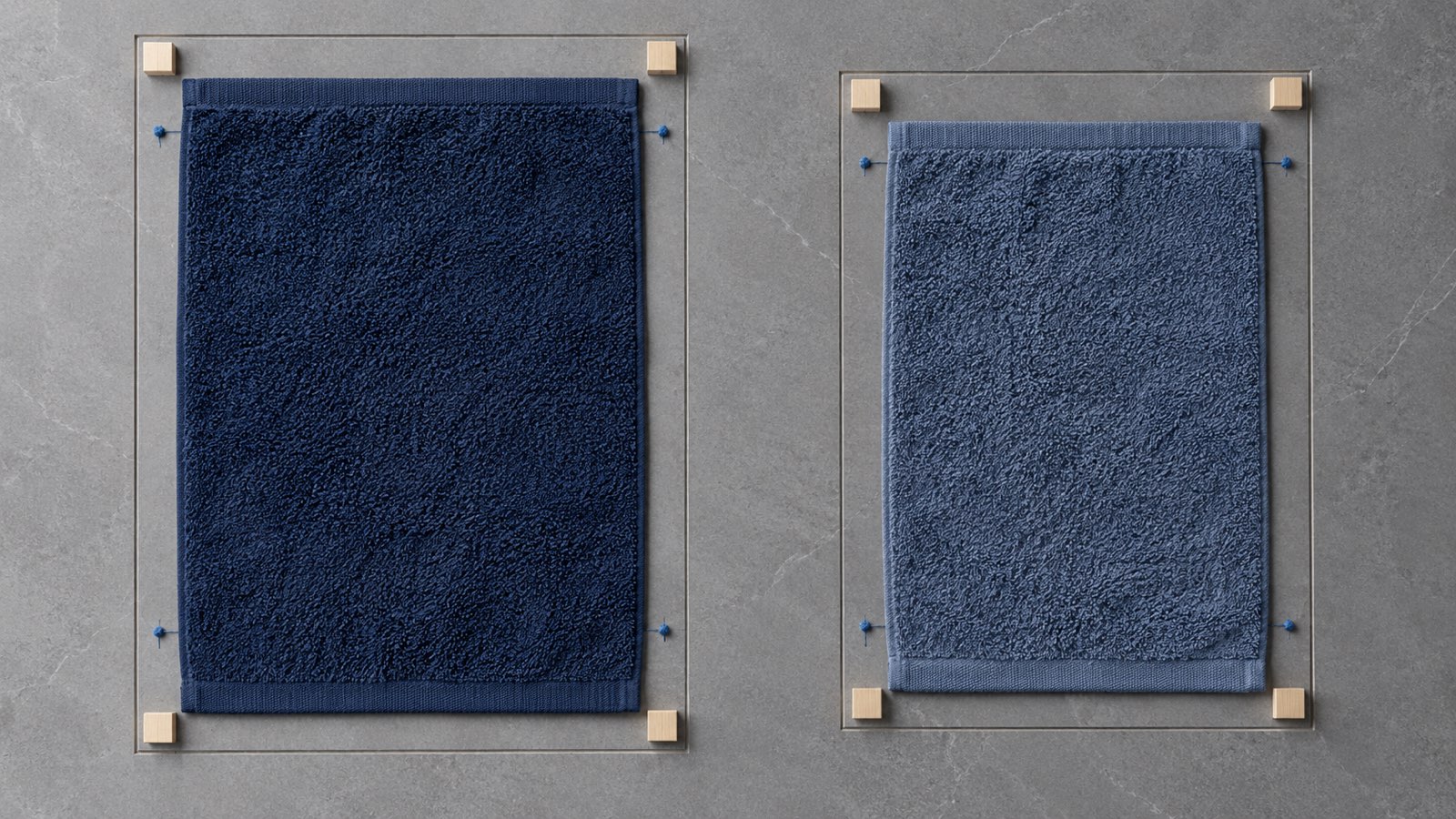
A usable towel shrinkage tolerance must state more than a percentage. Define the measured directions, initial product state, preparation and marking method, washing and drying procedure, number of cycles, post-treatment conditioning, calculation convention, sample size and acceptance rule.
ISO 5077 provides the dimensional-change calculation framework, but it works with specified preparation, measurement and laundering procedures. There is no responsible universal shrinkage promise for every towel: construction, finishing, size, care process and intended use must be represented in the approved test plan.
Use “dimensional change” before assuming every result is shrinkage
Buyers commonly call any after-wash size difference shrinkage. A test report should instead record dimensional change in the length and width directions separately. A dimension can decrease, remain stable or increase. The report must state its sign convention so that a negative result cannot be confused with a positive shrinkage allowance.
For a finished towel, the measurement also needs named endpoints. Overall length and width may be the main commercial dimensions, but borders, hems and decorative zones can respond differently. If border depth or logo placement matters after washing, treat it as a separate measurement rather than expecting the overall percentage to describe every feature.
The ISO method is a chain, not one isolated test number
ISO 5077:2007, confirmed by ISO in 2022, specifies how to determine dimensional change after an appropriate combination of washing and drying procedures. It does not make every washing condition equivalent or set a universal pass limit for towels.
The supporting steps matter. ISO 3759:2011 covers preparing, marking and measuring textile specimens and made-up articles for dimensional-change testing. ISO 6330:2021 provides domestic washing and drying procedures, including different reference machine types and drying options. A complete domestic treatment consists of both the selected wash and dry procedure. The buyer, supplier and laboratory therefore need the whole sequence—not just the phrase “ISO shrinkage test”.
1. Define the product and baseline before it gets wet
Test the product state that the tolerance is intended to govern. A development fabric swatch can help diagnose construction, but it does not automatically represent a hemmed towel with borders, labels and finished edges. Identify the style, size, colour, construction, finishing state, sample source and lot or sample stage on the record.
Condition and prepare specimens as required by the selected method, lay each towel without stretching it, and use repeatable reference points. Follow the purchased version of ISO 3759 or the agreed laboratory method for the actual marking pattern and measuring conditions. Record each initial length and width rather than only the nominal size printed in the specification.
Nominal finished-size tolerance and after-wash dimensional change are different controls. A towel can meet its initial size tolerance yet change too much in laundering; another can show acceptable percentage change but start outside the ordered dimension. The specification should contain both checkpoints.
2. Name the wash and drying procedure completely
Water temperature alone does not define a laundering test. Under ISO 6330, the machine type, selected washing procedure, reference detergent and ballast, and drying method form part of the controlled treatment. ISO notes that different machine, detergent and dryer parameters can affect results. Record the exact procedure designation and method edition in the specification and report.
Drying deserves equal attention. Line drying, flat drying and tumble drying do not apply the same mechanical and thermal history to a towel. A requirement that says “wash at 60 °C and measure shrinkage” is incomplete when the drying route is missing.
An alternative recognised framework may be used when both parties choose it. For example, AATCC TM135-2025 determines length and width changes of fabrics after home laundering and offers defined washing and drying parameters. Do not mix preparation, procedure and reporting fragments from different standards unless a written test plan intentionally defines that modification.
3. State the cycle count and every reporting checkpoint
ISO 6330 treats each selected washing procedure as one wash. The number of repetitions for buyer approval must still be agreed. One cycle can answer an initial-care question; a multi-cycle programme can track whether dimensions continue to change. The appropriate checkpoints depend on the use case, care claim and replacement expectations, so this article does not prescribe a universal count.
If results are needed after more than one checkpoint, measure and report them separately—for example after the first agreed treatment and after the final agreed treatment—without implying that an intermediate value was observed when it was not. Keep the same specimen identity throughout and document any interrupted conditioning or measurement.
4. Recondition, remeasure and calculate consistently
After the final drying step for the checkpoint, allow the towel to reach the condition required by the method. Place it without manually stretching the fabric back towards its original size. Measure between the same reference points, in the same direction and under the same stated conditions used for the baseline.
Under the ISO 5077 dimensional-change framework, the calculation is (after-treatment dimension − original dimension) ÷ original dimension × 100. Under this convention, a negative result indicates contraction and a positive result indicates growth. If a buyer wants “percentage shrinkage” reported as a positive number, that reporting conversion must be stated. Keep raw dimensions and unrounded calculations so another reviewer can reproduce the result.
Report length and width separately for every specimen. An average alone can hide an outlier, while a single piece cannot describe lot variation. Define whether acceptance applies to every result, the mean, a maximum individual value, or a combination—and what happens when a specimen or laboratory result is disputed.
What a complete tolerance line should contain
| Field | What to specify | Why it matters |
|---|---|---|
| Measured article | Finished towel style, size, colour and sample/lot stage | Connects the result to the product being accepted |
| Baseline | Conditioning, reference points, initial length and width | Prevents nominal size from replacing the real starting measurement |
| Treatment | Standard, edition, machine/procedure, detergent, ballast and drying option | Makes the result repeatable and comparable |
| Exposure | Cycle count and measurement checkpoints | Defines when the tolerance applies |
| Acceptance | Separate length/width limits, sign convention, sample count and decision rule | Turns the test into an actionable pass/fail requirement |
| Associated appearance | Hem, border, squareness, distortion and branding observations | Captures changes that one percentage cannot describe |
Domestic care, care labels and industrial laundering are different decisions
A domestic test should align with the intended consumer care route, but a care symbol is not a complete laboratory instruction. ISO 3758:2023 establishes care-labelling symbols for the most severe treatments that do not cause irreversible damage; it excludes industrial laundering. Buyers should have qualified specialists confirm destination-market labelling requirements and keep the chosen test procedure explicit in the product file.
Hospitality and institutional programmes may face processes that ISO 6330 does not represent. ISO 15797:2017 provides industrial washing and finishing test procedures specifically for workwear and notes that actual industrial equipment may sometimes be advisable for compatibility decisions. It is not a universal towel method. Use it as a reminder to define the real laundry context, then agree an applicable towel protocol with the laundry, buyer and qualified laboratory. The related commercial-laundering specification guide explains the operational questions to capture.
Carry the tolerance from sampling into production control
Record the approved method and results with the physical sample. The towel sample approval checklist separates dimensions, construction, workmanship and test evidence, while the towel specification-sheet guide provides fields for initial dimensions, tolerances and performance requirements.
For production, define when dimensional-change testing is repeated, how pieces are sampled across lots or colours, who receives the report and what corrective or confirmation step follows a failure. Son Ha Textile’s factory team in Phùng Xá, Hanoi can review a buyer’s intended dimensions, care route and sample plan, but the tolerance and test protocol for each programme must be agreed before production.
Questions buyers often ask
What shrinkage percentage is acceptable for a towel?
There is no universal value. The limit should reflect the construction, initial-size tolerance, intended care process, cycle count, use case and downstream fit or presentation requirements.
Should towel length and width use the same tolerance?
Not automatically. They are different fabric directions and should be measured and reported separately. Buyers may set different limits when the product and use justify them.
Can I measure shrinkage from the catalogue size?
No. Dimensional change needs an actual before-treatment measurement and an after-treatment measurement between the same reference points. Catalogue or nominal size is a separate commercial requirement.
Is one wash cycle enough?
It depends on the question being answered. State the agreed number of cycles and reporting checkpoints. If ongoing use matters, a single initial result may not be sufficient evidence.
Does a care label define the shrinkage test?
No. A care label communicates permitted care to the user. The test plan must still name the preparation, wash and drying procedure, cycles, conditioning, calculation and acceptance rule.
Sources
- ISO 5077:2007 — Textiles — Determination of dimensional change in washing and drying — International Organization for StandardizationAccessed 5 October 2026
- ISO 3759:2011 — Textiles — Preparation, marking and measuring of fabric specimens and garments in tests for determination of dimensional change — International Organization for StandardizationAccessed 5 October 2026
- ISO 6330:2021 — Textiles — Domestic washing and drying procedures for textile testing — International Organization for StandardizationAccessed 5 October 2026
- ISO 15797:2017 — Textiles — Industrial washing and finishing procedures for testing of workwear — International Organization for StandardizationAccessed 5 October 2026
- AATCC TM135-2025 — Dimensional Changes of Fabrics after Home Laundering — AATCCAccessed 5 October 2026
- ISO 3758:2023 — Textiles — Care labelling code using symbols — International Organization for StandardizationAccessed 5 October 2026
A note on specifications
Product performance, minimum order quantities, lead times, pricing and compliance requirements depend on the final specification, testing standard, order volume and destination market. This article provides general manufacturing information; confirm requirements with the factory and appropriately qualified testing, compliance and logistics advisers before ordering.