
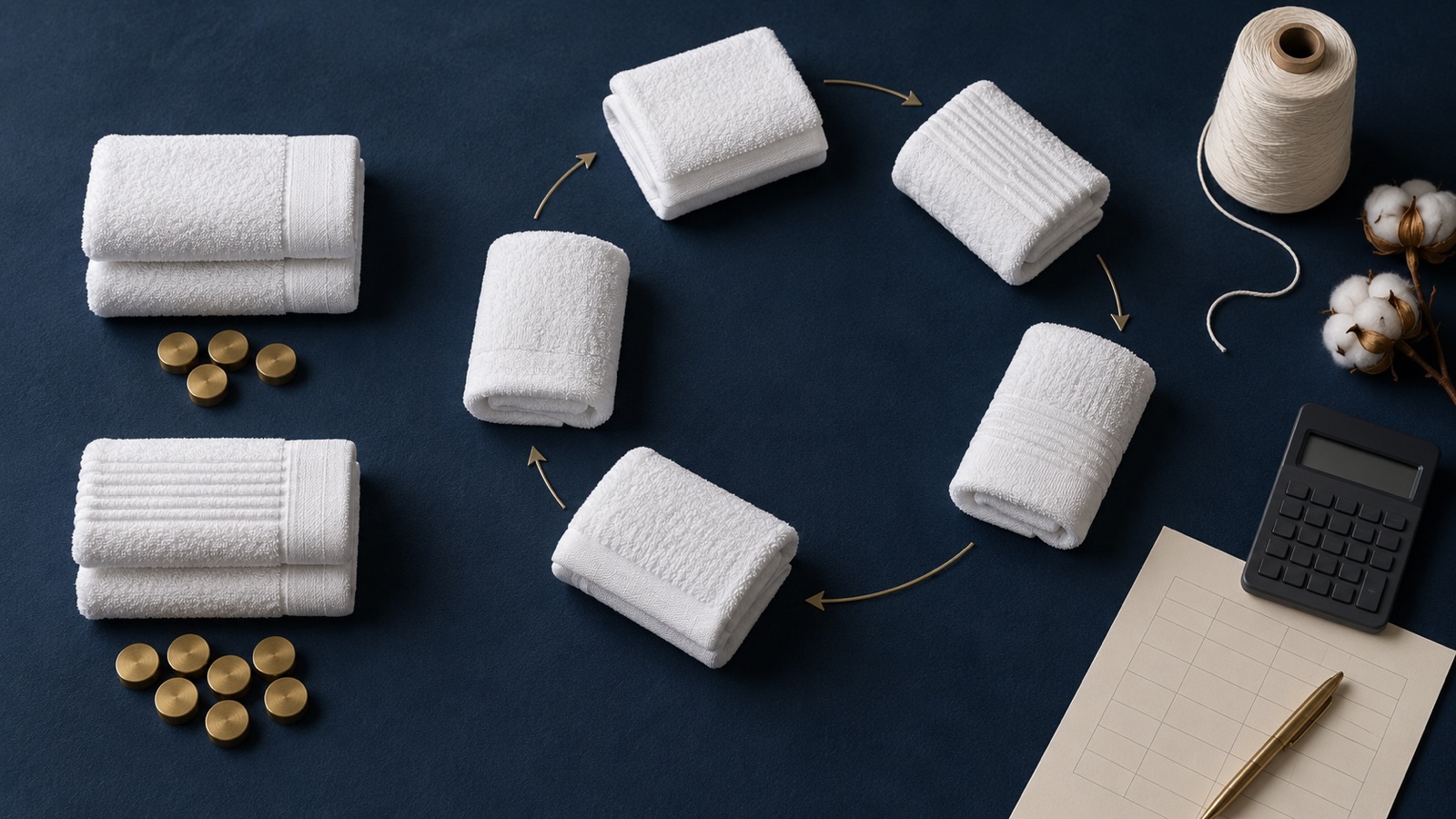
Cost per use compares what an operator spends with the number of acceptable towel uses actually delivered. At its simplest, divide the net acquisition cost of a towel cohort by the completed uses recorded before those towels are lost, damaged or retired. This reveals why the lowest unit price is not automatically the lowest product cost in service.
For an operating view, add laundry processing and internal handling on the same per-use basis. Keep the product-only and expanded figures separate so procurement teams can see whether a difference comes from the towel, the laundry system or the way stock is managed.
Use two cost-per-use measures
Whole-life-cost guidance commonly distinguishes the purchase price from operating and end-of-life costs. For example, current UK government procurement guidance defines whole-life cost as total cost over a deliverable’s life and notes that a reusable item can have a higher initial cost but a lower per-use cost. Its scope is public medical-technology procurement, not hotel towels, but the accounting principle is useful: compare alternatives over the same time or usage basis and disclose the inputs. See the whole-life-cost guidance.
| Measure | Formula | Decision it supports |
|---|---|---|
| Product cost per use | Net towel acquisition cost ÷ completed acceptable uses | Comparison of towel options and replacement performance |
| Service cost per use | (Net towel cost + laundry + handling + other allocated service costs) ÷ completed acceptable uses | Operating-budget and make-or-buy decisions |
Do not merge the two too early. A towel may have a favourable product cost per use while the total programme remains expensive because of laundry, transport or handling. Conversely, a laundry-process improvement should not be presented as evidence that the textile itself lasts longer.
Define a completed use before collecting data
A practical definition is: one towel is issued for its intended service, returned, laundered and accepted back into usable stock. An operator may instead count guest-room turns, spa treatments or another service event. Whatever definition is selected, apply it consistently to every option and record rejected returns separately.
Also define “acceptable”. Replacement criteria may include holes, hem or border failure, permanent staining, unacceptable greying or colour change, dimensions outside the agreed limit, excessive roughness, branding damage or failure of the property’s presentation standard. The threshold belongs to the operator’s brand, use and laundry context; it should not be replaced by a universal wash-count claim.
The data to collect
| Input | Preferred record | Common mistake |
|---|---|---|
| Acquisition | Unit price plus allocated inbound freight, duty and required labels or packing, less any recovery value | Comparing an ex-factory price with a delivered price |
| Uses | Completed uses by tagged cohort, SKU and start date | Treating estimated years in service as measured uses |
| Retirement | Date and reason: wear, stain, damage, loss, guest removal or other defined code | Combining normal wear and unexplained loss |
| Laundry | Invoice allocation or measured water, energy, chemistry, labour and equipment cost | Applying one generic cost to different processes without checking the basis |
| Handling | Sorting, transport, counting, storage, redistribution and stock-control labour | Ignoring a cost because it sits in another department |
Use a cohort rather than isolated pieces. Tag or otherwise identify towels introduced at the same time, record issues and returns, and close the cohort only when the remaining quantity is small enough to manage under a stated rule. If the study stops while many towels are still active, show the result as interim and do not compare it with a fully retired cohort as though both were final.
How loss and damage enter the formula
Loss and early damage reduce the number of completed uses delivered by the purchased cohort. If all cohort acquisition costs and all completed uses are already included, their financial effect is in the denominator; adding a separate “loss cost” would count it twice. Record retirement reasons anyway, because procurement cannot fix guest removal, handling errors and premature textile failure in the same way.
Where replacements are purchased during the study, either add them to the same defined rolling cohort with their uses or report them in a new cohort. State the method. Avoid comparing a supplier’s unit price with an operator’s historical replacement spend unless quantities, timing, delivery basis and active inventory are reconciled.
A hypothetical comparison
The figures below are invented solely to demonstrate the calculation. They are not Son Ha Textile results, hotel benchmarks or expected towel lifespans.
| Hypothetical input | Option A | Option B |
|---|---|---|
| Cohort purchased | 100 towels × $4.80 = $480 | 100 towels × $6.60 = $660 |
| Normal retirements | 80 towels × 45 uses = 3,600 uses | 90 towels × 60 uses = 5,400 uses |
| Early losses | 20 towels × 10 uses = 200 uses | 10 towels × 20 uses = 200 uses |
| Total completed uses | 3,800 | 5,600 |
| Product cost per use | $480 ÷ 3,800 = $0.126 | $660 ÷ 5,600 = $0.118 |
In this fictional dataset, Option B has the higher purchase price but the lower observed product cost per use. That does not make it the better choice automatically. The buyer still needs to compare guest feel, drying and storage implications, laundry cost, availability, cash flow and confidence in the data.
Add laundry and handling without hiding assumptions
For an outsourced laundry, start with the invoice basis—per item, kilogram, load or service period—and allocate any transport, minimum-volume, rewash or special-treatment charges consistently. For an on-premise laundry, consider water and sewer, energy, chemistry, labour, equipment lease or depreciation, maintenance and rewash. Use the operator’s records rather than a global allowance.
The US EPA’s WaterSense at Work laundry guidance shows why site data matters: on-premise and industrial laundries use different equipment, and water demand depends on machine type, wash cycles and settings. A heavier towel does not translate into one fixed laundry-cost penalty across every facility; weigh loads and measure the actual process.
Keep kilograms of laundry per completed use as a separate operating metric. It helps explain water, energy, capacity, transport and drying effects without assuming that purchase price, GSM or service life moves in the same direction. For specification decisions, see how to specify hotel towels for commercial laundering and what towel GSM does—and does not—tell you.
Use testing and pilots to improve the forecast
A laboratory result is not a guaranteed lifetime. It can reveal a relevant failure mode before a large order. ISO 5077 provides a method for determining dimensional change after a specified combination of washing and drying procedures, while ISO 105-C12:2024 addresses resistance of textile colour to industrial laundering. These answer different questions and need agreed procedures and acceptance limits.
Run a controlled pilot through the intended laundry process when the programme justifies it. Approve the starting sample, record cycles or completed uses, assess at planned intervals and document why each piece leaves service. Use the sample approval checklist so the pilot begins from a known construction and condition.
Make uncertainty visible
Before purchase, cost per use is a forecast. Show a low, base and high case using the buyer’s own assumptions for completed uses, early loss and laundry cost. After launch, replace assumptions with observed cohort data. Keep the time window, currency, tax treatment, delivery basis and allocation method consistent across suppliers.
The most useful output is not one precise decimal. It is a range with traceable inputs, retirement reasons and sensitivity: which variable would change the decision? That turns a price comparison into a programme-management tool.
Frequently asked questions
Is cost per wash the same as cost per use?
Not necessarily. One completed use may correspond to one laundering event, but rewashes, unused room changes or pooled loads can break that relationship. Define both measures and reconcile them rather than assuming they are identical.
Should lost towels be given zero uses?
Only if they disappear before completing any recorded use. Otherwise include the uses delivered before loss. Use a consistent cut-off rule and a separate retirement code so loss is visible.
Can a wash test predict the exact service life?
No. A defined test can compare specific performance under stated conditions, but actual life also depends on the laundry process, use, stain treatment, handling, loss and the operator’s replacement threshold.
How long should a towel pilot run?
Long enough to expose the failure modes relevant to the decision and produce a meaningful number of completed uses. Set the cohort size, checkpoints and stop rule before starting; do not invent a universal number of weeks or washes.
Sources
- Value Based Procurement National Standard Guidance for Medical Technology — Whole Life Cost — UK Department of Health and Social CareAccessed 5 October 2026
- WaterSense at Work Section 3.5: Laundry Equipment — United States Environmental Protection AgencyAccessed 5 October 2026
- ISO 5077:2007 — Textiles — Determination of dimensional change in washing and drying — International Organization for StandardizationAccessed 5 October 2026
- ISO 105-C12:2024 — Textiles — Tests for colour fastness — Part C12: Colour fastness to industrial laundering — International Organization for StandardizationAccessed 5 October 2026
A note on specifications
Product performance, minimum order quantities, lead times, pricing and compliance requirements depend on the final specification, testing standard, order volume and destination market. This article provides general manufacturing information; confirm requirements with the factory and appropriately qualified testing, compliance and logistics advisers before ordering.