
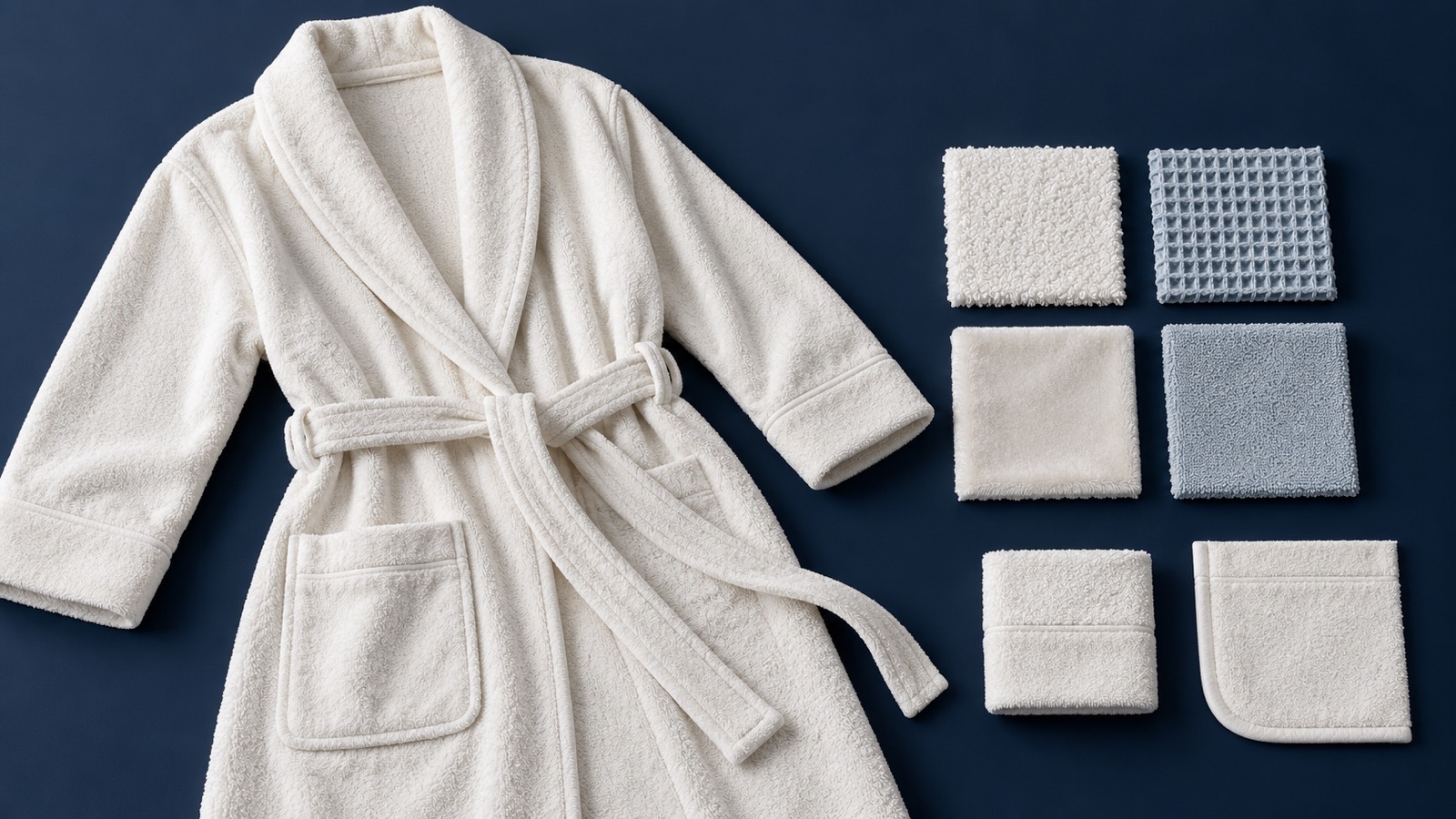
A hotel bathrobe is both a textile and a garment. The fabric must create the intended hand and absorbency, while the cut, overlap, sleeves, pockets, belt and loops must work across the intended wearer range and through the property’s laundry process. A brief that says only “white terry robe, one size, 400 GSM” leaves most of those decisions undefined.
Specify the fabric and the finished garment separately, then approve both new and laundered samples. This prevents fabric GSM from being mistaken for finished robe weight, a size label from being mistaken for fit, or attractive branding from concealing uncomfortable reverse threads and unstable placement.
Start with the robe’s role, not a generic hotel grade
Define where and how the robe will be used: guest room, spa, pool, treatment area or retail. Record the desired coverage, warmth, absorbency, visual volume, fold or hanger presentation, seasonality and laundry route. Different use cases can weight mobility, low bulk or enveloping warmth differently; none creates a universal construction or weight.
Turn descriptive words into approval attributes. “Soft” can become separate scores for surface softness, fullness and flexibility; “generous” can become chest width, sweep, length and overlap; “easy to handle” can become dry piece weight, standard-fold volume and belt retention. AATCC EP5-2025 provides controlled guidance for evaluating components of fabric hand. Use that principle with equally conditioned, coded robe samples, and repeat the comparison after agreed laundering.
Describe construction beyond a fabric nickname
| Construction family | What the buyer should define | What the sample must answer |
|---|---|---|
| Terry | Fibre composition, woven ground, loop pile on one or both faces, yarn and pile character, GSM and finish | Wetting, hand, loop appearance, lint, bulk, drying and dimensional stability in the agreed process |
| Velour-terry | Which face is cut or sheared, which face retains loops, pile direction and intended wearing face | Surface shading, pile appearance, reverse-side function and change after laundering |
| Waffle or piqué | Fibre, woven cellular structure, cell scale, GSM, finish and garment reinforcement | Coverage, drape, seam behaviour, snagging, hand and finished volume—not an assumed drying advantage |
| Knitted, plush, fleece or microfibre | Exact fibre content, knit or pile structure, face and backing, GSM and finish | Warmth, stretch recovery, pilling or pile change, absorbency where required and wash appearance |
Terms such as “waffle”, “plush” and “microfibre” are not complete specifications. Identify every construction zone and state collar, sleeve, cuff, pocket, seam, thread, label and hanging-loop details. The supplier then has a buildable product rather than a mood description.
Keep fabric GSM and finished robe weight separate
ISO 3801 describes methods for determining mass per unit area of woven fabric. GSM therefore controls the fabric before garment geometry is considered. Finished robe weight is the dry mass of the complete article and changes with size, fabric area, front overlap, collar or hood, sleeve volume, pockets, belt, trims, labels and seam construction.
Two robes made from the same nominal GSM can have different finished weights and bulk. Conversely, robes with different GSM can have similar piece weights if their dimensions and details differ. Robe GSM and hotel towel GSM are related mass-per-area measures, but they are not interchangeable product specifications: a robe adds garment shape, ease, overlap and components that a rectangular towel does not.
Record conditioned fabric GSM with its tolerance and test basis, plus dry finished garment weight for every size. Where relevant, add folded dimensions and pieces per carton, shelf or trolley. None of these values substitutes for hand, absorbency, warmth or drying evidence.
Build sizing from bodies, garment measurements and fit
Three records are needed: the intended body-size range, the finished garment measurements and the label shown to the guest or housekeeping team. ISO 8559-1:2017 defines anthropometric points and body measurements, while ISO 8559-2:2025 addresses primary and secondary dimension indicators for size designation. They help make size communication consistent; they do not prescribe a universal hotel-robe chart.
ISO 18890:2018 defines common garment measurement points and allows additional points to be agreed. Add an annotated diagram and state whether the robe is laid flat, closed and tension-free. Typical points include centre-back length from a defined neck seam, half chest at a stated level, shoulder width, sleeve length and its origin, cuff opening, sweep, front overlap, pocket size and position, belt dimensions and belt-loop height. Give a tolerance for each critical point.
“One size” is an inventory choice, not evidence that every guest will be covered comfortably. Use the property’s intended wearer profile to choose a size set, then test coverage, reach, arm movement, sleeve practicality and belt position on representative wearers. Approve the desired ease and overlap rather than simply scaling a towel-like rectangle.
Engineer the belt, loops and pockets as working parts
Specify belt length and width, single- or double-layer construction, stitching, finished weight if relevant, and whether it is detachable or attached. For keeper loops, define quantity, opening or usable length, height from a fixed reference point, seam insertion and reinforcement. If the design uses internal ties, a hanging loop or a second loop height, show each location on the technical drawing.
During sampling, check whether the belt stays in the loops during normal handling, whether different wearers can centre it comfortably, and whether the loops distort the side seam. Load the pockets as they may be used and inspect sagging, seam strain and placement. Repeat those observations after laundering. There is no useful universal belt-loop strength or pocket position; agree a method and acceptance criterion for the product.
Place branding where appearance and comfort both work
Define the branding method, artwork revision, dimensions, position from fixed garment points, colour reference and approved face and reverse appearance. Embroidery can add a crisp logo but may introduce backing, exposed reverse threads or local stiffness. Woven or printed labels add identity at a seam or neck but require their own hand and laundering approval. Jacquard or woven-in detail changes the fabric construction and needs earlier development planning.
Ask the wearer to assess skin contact, not just the buyer to inspect the front. Check puckering, pile crushing, distortion and shade after the agreed wash process. The branding-method comparison gives a broader framework, but terminology and production implications must be confirmed for the selected robe and supplier.
Approve the robe in the actual care conditions
Give the supplier the intended detergent and chemistry, temperature, cycle, extraction, drying and finishing conditions. ISO 6330:2021 provides defined domestic laundering procedures for textile testing and notes that equipment and process parameters affect results; it is not automatically a hotel or industrial-laundry programme. Use it only when that named procedure answers the question, or agree a representative commercial protocol through the commercial-laundering specification guide.
For dimensional change, ISO 3759:2011 covers preparing, marking and measuring garments, and ISO 5077 determines change after a specified wash-and-dry procedure. State the procedure, number of cycles, checkpoints, conditioning and measurement points. Recheck body length and width, sleeves, overlap, belt, loops, pockets, collar, seams, branding, pile or surface, hand and appearance. Do not accept a universal shrinkage or wash-life promise without a defined product, process and limit.
Use a full-garment sample approval sequence
- Identify the sample, pattern and artwork revisions; attach approved fabric and trim references.
- Measure conditioned fabric GSM and the new finished garment’s dimensions, dry weight and folded volume.
- Conduct a fit and movement trial across the intended wearer range, recording coverage, overlap, sleeve and belt position.
- Inspect collar, cuffs, seams, hanging loop, pockets, belt, keeper loops, labels and branding on both faces.
- Launder traceable samples through the agreed procedure and cycle checkpoints.
- Remeasure and score hand, appearance, fit, dimensional change and component function against written limits.
- Run the property’s fold, hanger, shelf, trolley and laundry-handling trial before signing the retained reference.
Record every decision with the sample approval checklist, adapted for garment measurements and fit. Approval should identify what may change in bulk production and what requires written reapproval.
Questions hospitality buyers often ask
What GSM is best for a hotel bathrobe?
There is no universal best figure. Choose candidate constructions for the guest and operating brief, then compare hand, coverage, finished weight, laundry behaviour and presentation under the same conditions.
Is bathrobe GSM the same as towel GSM?
The unit is the same—fabric mass per square metre—but the product specification is not. A robe’s finished weight and performance also depend on garment dimensions, ease, overlap, sleeves, collar, pockets, belt, trims and seams.
Is one-size bathrobe sizing suitable for every hotel?
No. One size may simplify stock but can exclude part of the intended wearer range or create poor sleeve, overlap and belt placement. Define the target body range and validate finished measurements and fit.
Should a hotel choose terry or waffle robes?
Choose by intended hand, coverage, absorbency where required, visual presentation and laundry evidence. Neither construction name guarantees those outcomes; specify and test the complete product.
What should be approved before bulk robe production?
Approve identified materials and artwork, new garment measurements and weight, fit, all components and branding, plus the same checks after the agreed laundering cycles. Retain the signed reference and test record.
Sources
- ISO 8559-1:2017 — Size designation of clothes — Part 1: Anthropometric definitions for body measurement — International Organization for StandardizationAccessed 5 October 2026
- ISO 8559-2:2025 — Size designation of clothes — Part 2: Primary and secondary dimension indicators — International Organization for StandardizationAccessed 5 October 2026
- ISO 18890:2018 — Clothing — Standard method of garment measurement — International Organization for StandardizationAccessed 5 October 2026
- ISO 3801:1977 — Textiles — Woven fabrics — Determination of mass per unit length and mass per unit area — International Organization for StandardizationAccessed 5 October 2026
- ISO 3759:2011 — Textiles — Preparation, marking and measuring of fabric specimens and garments in tests for determination of dimensional change — International Organization for StandardizationAccessed 5 October 2026
- ISO 5077:2007 — Textiles — Determination of dimensional change in washing and drying — International Organization for StandardizationAccessed 5 October 2026
- ISO 6330:2021 — Textiles — Domestic washing and drying procedures for textile testing — International Organization for StandardizationAccessed 5 October 2026
- AATCC EP5-2025 — Evaluation Procedure for Fabric Hand Value — AATCCAccessed 5 October 2026
A note on specifications
Product performance, minimum order quantities, lead times, pricing and compliance requirements depend on the final specification, testing standard, order volume and destination market. This article provides general manufacturing information; confirm requirements with the factory and appropriately qualified testing, compliance and logistics advisers before ordering.