
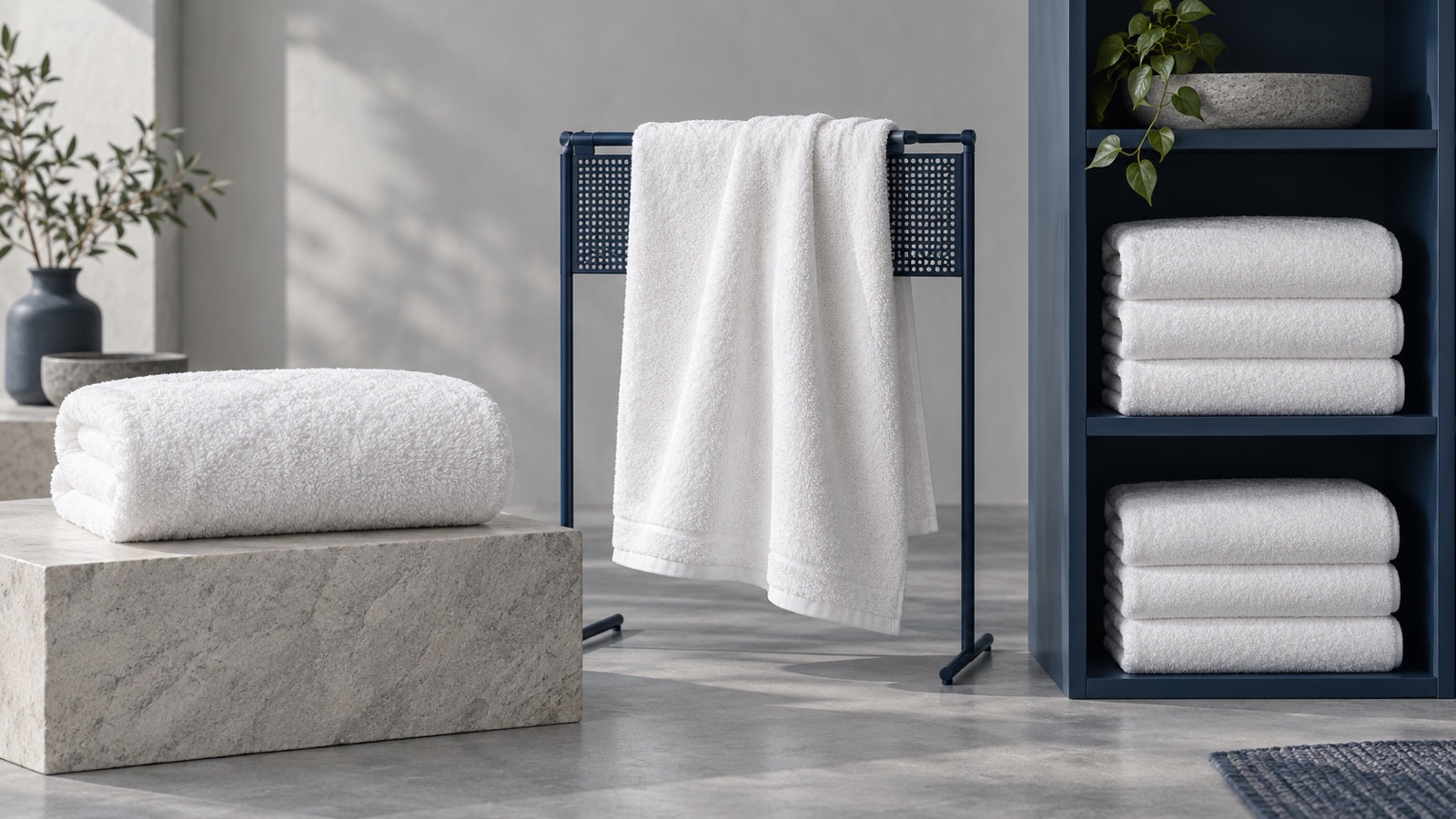
There is no single best GSM for every hotel towel. GSM states fabric mass per square metre; it does not by itself establish guest softness, absorbency, drying time, wash life or operating cost. A useful target balances the intended guest experience with the property’s real wash, dry, handling and storage system.
Start with two or three complete constructions that fit the brand position, then run them through one controlled guest-and-laundry trial. Select the towel that meets the agreed tactile and performance criteria while fitting practical load, drying, folding, shelf and replenishment constraints.
Use GSM as a mass control, not a hotel grade
ISO 3801 provides methods for determining mass per unit length and mass per unit area of woven fabrics. For buying purposes, GSM is useful for controlling how much material is present over a known area. The general towel GSM guide explains measurement, tolerance and why two towels at the same GSM can differ.
Finished piece mass also depends on size: estimated dry mass equals finished area in square metres multiplied by GSM, before allowing for local construction and tolerance. Borders, hems and changes in pile distribution can make a finished towel differ from a simple estimate. Specify both GSM and finished piece-weight tolerance when operations need control at both levels.
GSM does not reveal where the mass sits. Yarn, pile height and density, ground construction, borders and finishing can create different loft, flexibility and wetting behaviour at the same weight. Peer-reviewed work on cotton terry found that fabric weight, thickness and pile-yarn twist all influenced moisture behaviour, and that different absorption measures did not rank constructions identically. The study supports testing the complete towel rather than buying by GSM alone.
Begin with the guest promise
Define what the towel should communicate in the room, spa, pool or gym. “Luxurious”, “substantial” and “quick-drying” are not specifications, but they can be translated into candidate constructions and approval attributes. Record the product role, finished size, desired loft, surface feel, flexibility, visual fullness and the way the towel must fold or hang.
Hand is a sensory decision and should be controlled. AATCC EP5-2025 gives guidelines for presenting and handling fabrics when evaluating components of hand. A hotel can apply that principle by conditioning samples alike, coding them so evaluators are not led by price or GSM, and scoring separate attributes such as surface softness, fullness and flexibility. Repeat the comparison after the agreed laundering because initial finishing can change.
Avoid turning a hotel category or room rate into an automatic GSM band. A property may deliberately choose different constructions for bath, hand, face, pool and spa towels because guest contact, presentation and operating demands differ.
Connect each candidate to laundry throughput
Operations need more than “drying time”. A towel enters the process as dry inventory, picks up water during use and washing, passes through extraction, occupies machine and trolley capacity, then returns to an acceptable dryness and presentation. Higher dry mass may affect how many pieces fit within a weight-limited load, but construction and retained moisture affect what happens after washing. Do not infer the result from GSM; measure the traceable load.
| Operational question | Record during the trial | Useful comparison |
|---|---|---|
| How much enters the washer? | Dry piece mass, number of pieces and total dry load. | Accepted clean pieces produced from the same controlled load basis. |
| How much water remains after extraction? | Load or specimen mass before washing and after extraction. | Water retained relative to the same stated dry basis. |
| When is drying complete? | Dryer, load, settings, elapsed time, endpoint and residual-moisture basis. | Accepted pieces per cycle and per unit of elapsed process time. |
| How much space is required? | Standard fold, stack height, pieces per shelf or trolley and storage layout. | Pieces stored and moved within the property’s fixed space. |
| What reaches the guest? | Dimensions, hand, absorbency, hems, lint and appearance after the trial. | Pass/fail against the signed laundered reference. |
Laboratory drying evidence can answer a narrower comparison. For example, AATCC TM200 determines drying rate at absorbent capacity using an air-flow method. It is not a prediction of pieces per hour in a hotel laundry. Use a named laboratory method for product comparison and a controlled operational trial for the actual process claim.
Test absorbency separately from weight and drying
“Absorbent” can mean how quickly a textile wets, how much water it holds or how effectively it takes water from a surface. AATCC TM79-2025 determines water absorbency of textiles across fibre contents and constructions. ASTM D4772-26 measures rapid surface-water absorption and retention for terry fabrics and explicitly describes surface absorption as only one characteristic of an acceptable towel. It also advises caution for acceptance testing because interlaboratory precision is known to be poor.
Choose the method that matches the hotel’s question, align laboratories if results will be contractual, and state when in the laundering sequence the sample is tested. A heavier towel is not automatically faster to wet, and a towel that holds more water is not automatically faster to dry.
Run one controlled approval plan
- Freeze each candidate’s size, GSM and piece-weight tolerance, fibre, yarn, pile, ground, border, hem and finish.
- Record new-towel dimensions, mass, folded volume, hand scores and selected performance results.
- Use the same representative load basis, wash chemistry, programme, extraction and dryer for every candidate.
- Define the drying endpoint before the trial; record elapsed time and any reprocessing rather than stopping by impression.
- Repeat dimensions, weight, hand, absorbency, lint, edge and appearance checks at the agreed cycle points.
- Ask housekeeping and laundry teams to test the required fold, shelf, trolley and room presentation.
- Approve the construction only when both guest-facing and operational criteria pass.
ISO 6330:2021 provides defined domestic wash-and-dry procedures and notes that machine, detergent and dryer parameters can affect results; ISO 5077 determines dimensional change after an appropriate specified procedure. Hotel conditions may be different, so document the real or agreed representative process through the commercial-laundering guide and retain evidence with the sample approval checklist.
Make the decision with a weighted scorecard
Before seeing results, procurement, housekeeping, laundry and brand teams should agree which criteria are mandatory and which are weighted preferences. A candidate that fails a mandatory absorbency, dimension or processing requirement should not win because it scores highly on initial softness. Likewise, a lighter candidate should not win solely on assumed drying efficiency without measured evidence.
Keep purchase price separate from operating evidence, then bring both into the commercial decision. The related cost-per-use framework shows how to use buyer-observed service, loss and laundry inputs without inventing lifespan figures.
Questions hospitality buyers often ask
What GSM is best for a hotel bath towel?
There is no universal best figure. Select candidate constructions that match the guest proposition, then approve the one that meets both performance and operational criteria in a controlled trial.
Does higher GSM mean better absorbency?
No. GSM is mass per area. Wetting, surface-water pickup and capacity also depend on fibre, yarn, pile, finishing and sample state, so use a method matched to the intended claim.
Will a lower-GSM towel always dry faster?
No guarantee follows from GSM alone. Size, construction, water retained after extraction, load, airflow, heat and endpoint all matter. Compare candidates in the same laboratory method and intended laundry process.
Should every towel in a hotel set use the same GSM?
Not necessarily. Bath, hand, face, pool and spa towels can have different guest-contact, folding, drying and storage requirements. Keep the range visually coordinated while specifying each role separately.
How should a hotel approve GSM?
Specify the target, tolerance, measurement method and product state, then approve the complete construction using both new and laundered samples. GSM should be one line in the approval record, not the whole decision.
Sources
- ISO 3801:1977 — Textiles — Woven fabrics — Determination of mass per unit length and mass per unit area — International Organization for StandardizationAccessed 5 October 2026
- AATCC EP5-2025 — Evaluation Procedure for Fabric Hand Value — AATCCAccessed 5 October 2026
- AATCC TM79-2025 — Test Method for Absorbency of Textiles — AATCCAccessed 5 October 2026
- ASTM D4772-26 — Standard Test Method for Surface Water Absorption of Terry Fabrics (Water Flow) — ASTM InternationalAccessed 5 October 2026
- AATCC TM200-2017e2 — Drying Rate of Textiles at their Absorbent Capacity: Air Flow Method — AATCCAccessed 5 October 2026
- ISO 6330:2021 — Textiles — Domestic washing and drying procedures for textile testing — International Organization for StandardizationAccessed 5 October 2026
- ISO 5077:2007 — Textiles — Determination of dimensional change in washing and drying — International Organization for StandardizationAccessed 5 October 2026
- Study of moisture absorption characteristics of cotton terry towel fabrics — Procedia EngineeringAccessed 5 October 2026
A note on specifications
Product performance, minimum order quantities, lead times, pricing and compliance requirements depend on the final specification, testing standard, order volume and destination market. This article provides general manufacturing information; confirm requirements with the factory and appropriately qualified testing, compliance and logistics advisers before ordering.