
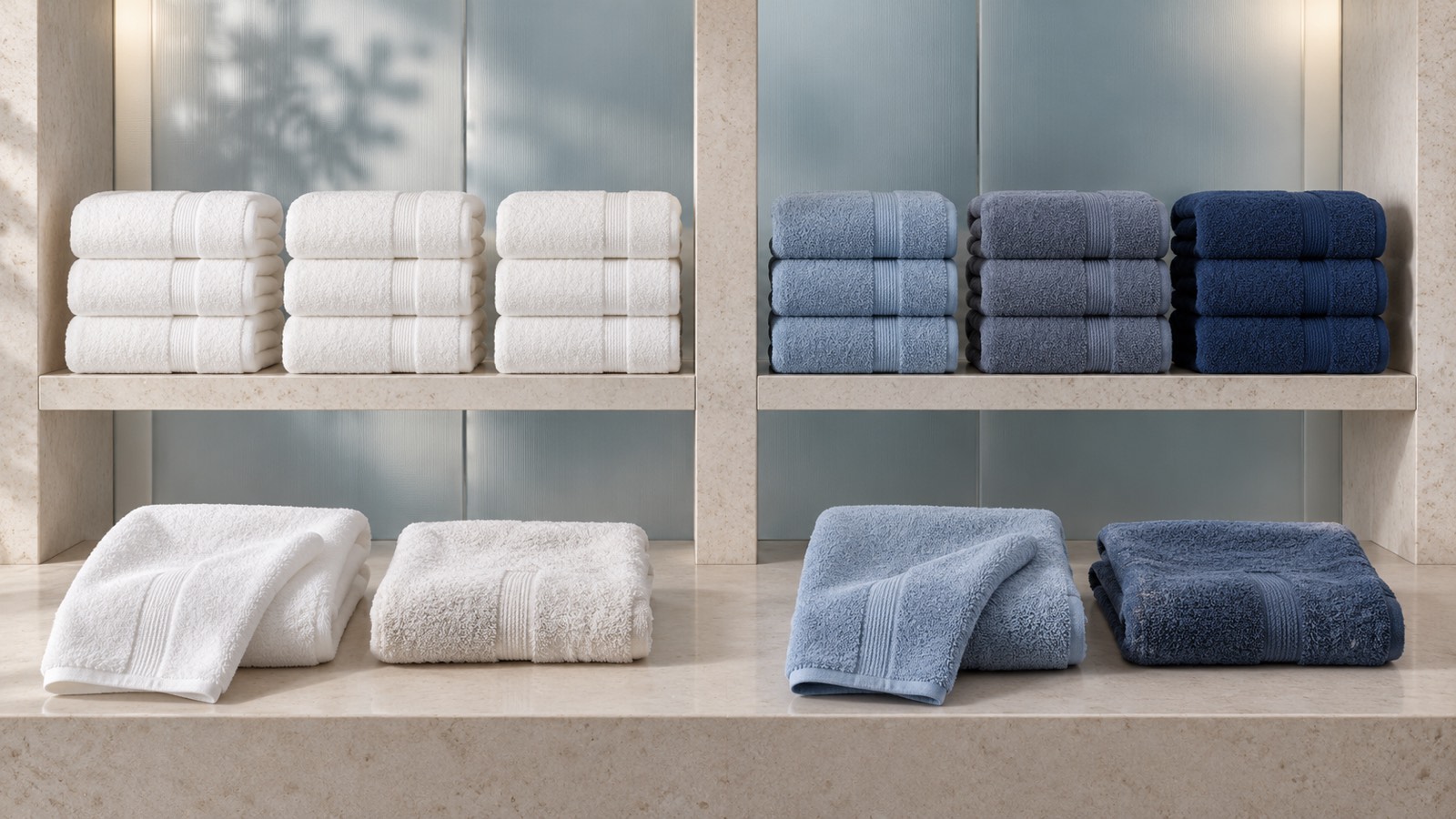
Neither white nor coloured hotel towels are universally better. White can make many stains and visual inconsistencies easier to see and may support a broadly pooled presentation; colour can reinforce a property’s identity, distinguish towel roles and hide some marks. Each choice also creates different chemistry, shade-control and replacement requirements.
Colour alone does not make a towel hygienic. Hygiene depends on the complete handling and laundering process, while the colour decision should be made from the property’s actual soil profile, wash programme, guest presentation, inventory model and replacement evidence.
Separate hygienic cleaning from visible appearance
A white towel may make lipstick, makeup, dye transfer or discolouration conspicuous, but visibility is not a microbiological test. A dark towel may conceal some marks without being clean; a bright white towel can look clean while still having been handled or processed incorrectly. Housekeeping therefore needs both a documented laundry process and a separate visual rejection standard.
The CDC’s healthcare laundry guidance is not a hotel wash specification, but it explains the underlying principle: laundering acts through a combination of mechanical, thermal and chemical factors, followed by handling that protects cleaned textiles from recontamination. It does not identify fabric colour as a hygiene control. Hotels should follow their own applicable regulations, risk assessment, chemical-supplier instructions and validated operating procedures.
Compare the operational trade-offs, not just the room photograph
| Decision area | White programme | Coloured programme |
|---|---|---|
| Visual sorting | Many coloured soils and shade changes are conspicuous; residual marks may trigger reclaim or replacement quickly | Some marks are less conspicuous, while fading, bleach spots, lint or colour transfer can become the dominant appearance issue |
| Laundry chemistry | May allow a wider treatment choice for a compatible product, but “white” never proves that chlorine or another bleach is safe | Detergent, oxidant, dosage, temperature and pH need to be compatible with the dye and trim system |
| Load planning | Can simplify pooling when products share a confirmed process and construction | May require separation by shade, role or transfer risk and stronger control of mixed loads |
| Replacement | Still needs control of whiteness, undertone, construction and finish across suppliers and ages | Needs a retained shade standard, tolerance and plan for dye-lot and service-age variation |
| Brand and wayfinding | Neutral, familiar presentation; branding can be added through weave, border, label or embroidery | Can support identity or distinguish bath, spa, pool and gym inventory, but adds colour-specific SKUs |
These are planning tendencies, not guaranteed outcomes. Fibre, yarn, construction, dye or optical-brightener system, trims, soil type and laundry control can reverse an apparent advantage. Compare actual candidate towels in the intended process.
Stain visibility changes sorting and replacement behaviour
Start by listing the recurring soils for each towel role. Face towels may encounter makeup and skincare products; pool towels may meet sunscreen or pool chemistry; spa towels may encounter oils; food-and-beverage towels may face different coloured soils. White may expose many of these quickly, helping staff route a piece to normal wash, reclaim or retirement. It can also make a small residual mark commercially unacceptable even when the towel remains functional.
Colour can reduce the visual contrast of some soils, but concealment is not removal. It can also reveal other failures more strongly: a local bleach spot, a pale fold line, dye transfer, edge fading or contrasting lint. Define inspection lighting, viewing distance and illustrated reject examples for every colour rather than telling staff to remove anything that “looks old”.
Sorting affects more than appearance. The US EPA’s commercial laundry guidance notes that equipment, cycles and water settings vary and recommends separating laundry according to the number of wash cycles needed. Record normal-wash, rewash, reclaim and discard counts by colour and reason; otherwise an apparent stain advantage may simply move cost into extra processing or early replacement.
Match laundry chemistry to the complete product
Do not write “bleachable” or “colour-safe” as an unsupported blanket claim. Give the laundry and manufacturer the intended detergent, alkali, oxidant or bleach type, dosage range, temperature, cycle sequence, neutralisation and drying conditions. Confirm compatibility with the fibre, dye, sewing thread, label, woven border and embroidery—not only the terry field.
ISO 105-N01:1993, reconfirmed in 2025, addresses colourfastness to hypochlorite bleaching, while ISO 105-N02:1993, also reconfirmed in 2025, addresses peroxide bleaching. They are different exposures. Passing one method does not establish compatibility with every chemical system, concentration or production-laundry programme. Even a white towel requires a trial because chemistry can affect its shade, trims, handle and useful appearance.
Specify colour change, staining and replacement matching separately
For an industrial-laundry programme, ISO 105-C12:2024 provides methods for determining resistance of textile colour to industrial laundering. ISO 105-C06:2010, confirmed current in 2026, covers stated domestic and commercial procedures for normal household articles and warns that industrial or hospital procedures can be more severe. ISO also notes that C06 does not reflect the effect of optical brighteners in commercial products. Select the method and procedure that answer the actual use case; one “wash-fastness pass” is not universal evidence.
Initial shade matching is a separate decision from resistance to laundering. ISO 105-J03:2009, reconfirmed in 2025, provides a method for calculating colour difference between textile specimens measured under the same conditions and permits a maximum tolerance to be specified. Buyers can use a suitable visual or instrumental system to control incoming shade, but the approved standard, instrument conditions, formula and acceptance limit must be written down.
For coloured towels, retain an identified master or approved production standard and compare both new-to-new and replacement-to-in-service appearance. For whites, control undertone and brightness rather than assuming every “hotel white” matches. If a new towel will be visibly different beside an older but serviceable one, decide whether stock is replaced individually, by room set, by floor or by cohort.
Colour can support the brand—but it also creates inventory decisions
Colour can identify pool towels, separate spa inventory from guest-room linen or reinforce an interior palette. That may reduce operational mix-ups, but each colour-size combination becomes a stock item to forecast, inspect and replenish. A small coloured programme can become vulnerable when an exact shade is unavailable or a later order uses a changed construction.
White can simplify cross-room presentation and emergency redistribution, but it is not automatically interchangeable. Different dimensions, borders, weights, undertones and ageing histories can still look inconsistent. Keep style identification and stock records even when all towels appear white.
Run a controlled pilot and compare cost per accepted use
- Document each towel role, recurring soil and guest-facing appearance requirement.
- Record the actual wash and dry programme with the laundry and chemical supplier.
- Approve new white and coloured candidates against measurable construction and shade records.
- Test the relevant wash, bleach and colour-change exposures with named methods and limits.
- Pilot representative pieces through the intended laundry, keeping cohorts identifiable.
- Track rewashes, reclaim treatments, shade mismatch, damage, loss and retirement reason.
- Compare purchasing and processing consequences before standardising the range.
Use the commercial-laundering specification guide to document the process, the towel colourfastness guide to select exposures, and the sample approval checklist to freeze the starting point. Then calculate the programme using observed data with the hospitality towel cost-per-use framework rather than deciding from unit price or colour alone.
Questions hospitality buyers often ask
Are white hotel towels more hygienic than coloured towels?
No. Colour can change how readily some soils are seen, but hygiene depends on correct handling, laundering, drying, transport and storage under the applicable operating requirements.
Can all white cotton towels be washed with chlorine bleach?
No. Compatibility depends on the full product and the exact chemistry and process. Confirm fibre, dye or white finish, sewing thread, labels, borders and branding with the manufacturer, laundry and chemical supplier, then test the agreed exposure.
Will coloured towels always hide stains better?
No. Visibility depends on the soil and shade. Colour may reduce contrast for one mark while making bleach spots, fading, lint or transfer more obvious. Hidden soil is not removed soil.
How should a hotel buy replacement coloured towels?
Keep an identified shade and construction standard, define a visual or instrumental tolerance, retain purchasing records and decide whether replacements enter service individually or as a coordinated cohort.
Should a property use only one towel colour?
Not necessarily. A mixed programme can separate roles or reinforce the brand, but it adds sorting, SKU and replenishment complexity. Validate each colour-role combination in the intended laundry process.
Sources
- ISO 105-C12:2024 — Textiles — Tests for colour fastness — Part C12: Colour fastness to industrial laundering — International Organization for StandardizationAccessed 5 October 2026
- ISO 105-C06:2010 — Textiles — Tests for colour fastness — Part C06: Colour fastness to domestic and commercial laundering — International Organization for StandardizationAccessed 5 October 2026
- ISO 105-N01:1993 — Textiles — Tests for colour fastness — Part N01: Colour fastness to bleaching: Hypochlorite — International Organization for StandardizationAccessed 5 October 2026
- ISO 105-N02:1993 — Textiles — Tests for colour fastness — Part N02: Colour fastness to bleaching: Peroxide — International Organization for StandardizationAccessed 5 October 2026
- ISO 105-J03:2009 — Textiles — Tests for colour fastness — Part J03: Calculation of colour differences — International Organization for StandardizationAccessed 5 October 2026
- Laundry and Bedding — Guidelines for Environmental Infection Control in Health-Care Facilities — US Centers for Disease Control and PreventionAccessed 5 October 2026
- WaterSense at Work — Section 3.5: Laundry Equipment — US Environmental Protection AgencyAccessed 5 October 2026
A note on specifications
Product performance, minimum order quantities, lead times, pricing and compliance requirements depend on the final specification, testing standard, order volume and destination market. This article provides general manufacturing information; confirm requirements with the factory and appropriately qualified testing, compliance and logistics advisers before ordering.