
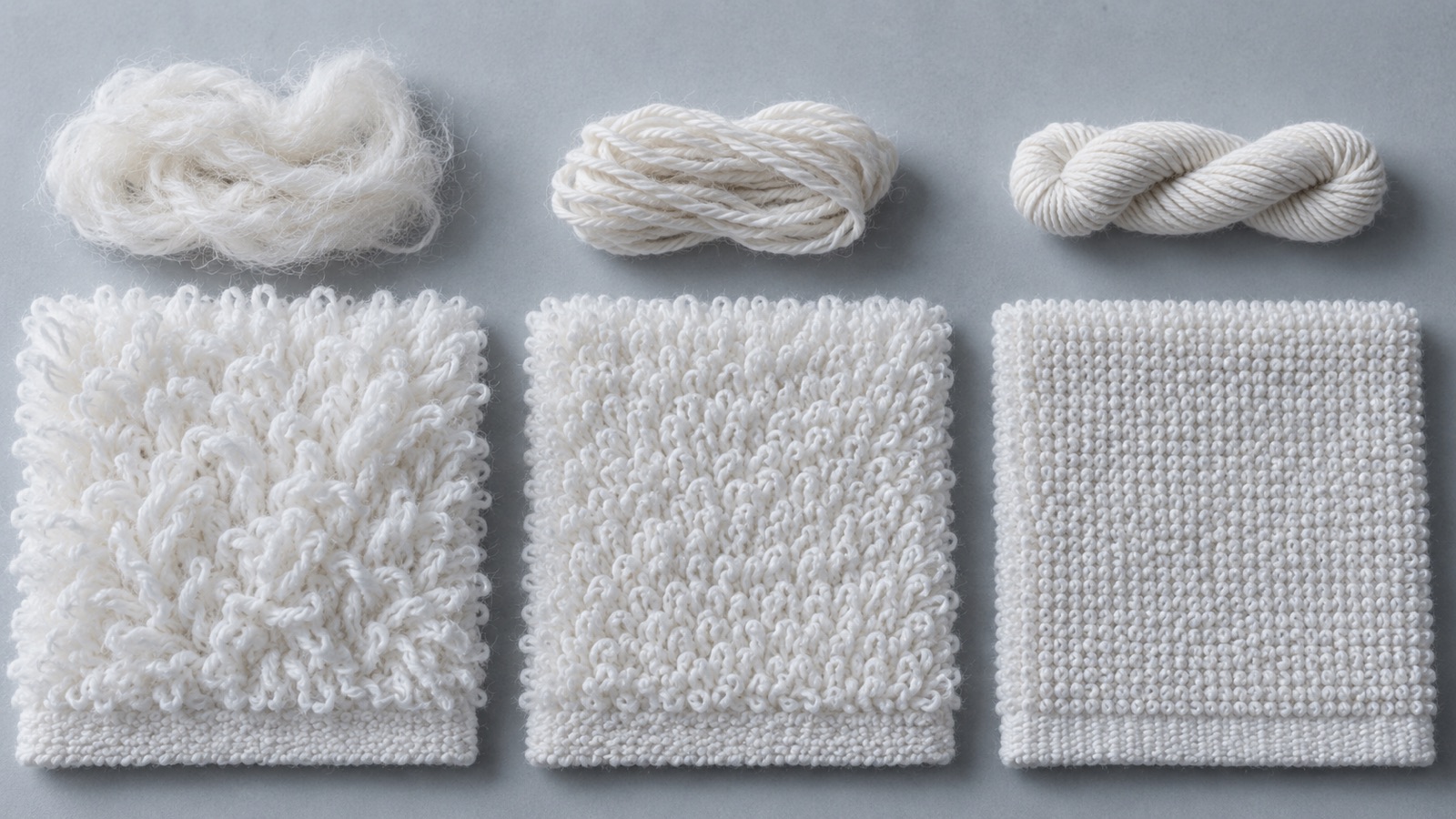
Zero-twist, low-twist and conventional yarn describe ways of constructing yarn; they are not universal quality grades. Reducing pile-yarn twist can create a more open, lofty surface, while a more consolidated yarn can support a neater, firmer pile. Neither description by itself proves softness, absorbency, low lint or service life.
The useful buying question is not “Which label is best?” It is “Which complete towel construction meets this programme’s hand, performance, care and cost requirements after the agreed laundering?” Answer it with a defined yarn and fabric specification, controlled samples and tests on the finished towel.
First, define what the three terms mean
Twist helps bind fibres into a yarn. ISO 2061:2015 provides a direct-counting method for determining twist direction and turns per unit length for applicable yarns. That measurable quantity is more precise than a product name, but even the standard notes limits for some spinning systems. Buyers should therefore ask the supplier to state both the yarn system and how any twist value was determined.
| Commercial term | Working interpretation | Question to put in the brief |
|---|---|---|
| Conventional twist | A spun yarn with enough twist for the intended processing and construction; there is no single universal “conventional” level. | What pile-yarn count, spinning system, ply and twist range are proposed? |
| Low twist | A lower-twist yarn relative to a stated conventional reference—not a fixed international category. | Lower than which reference, by what measure, and in which part of the towel? |
| Zero twist or twistless | A commercial construction intended to present minimally twisted fibres in the pile; the manufacturing route and residual twist can differ. | How is the pile yarn made, and what construction evidence can the supplier disclose? |
In a terry towel, the description normally concerns the pile yarn, not every yarn in the product. Ground warp and weft yarns still form the structure that anchors the loops. Require the specification to identify exactly which component carries the claimed construction.
What lower twist may change—and what it cannot promise
With fewer turns holding fibres into a compact path, a pile yarn may open more readily and create greater bulk or a softer initial hand. A more twisted yarn may be more consolidated and produce a cleaner, firmer surface. Those are useful design tendencies, not purchase guarantees: fibre length and quality, yarn count, pile height, loop density, ground construction, finishing and laundering all influence the finished towel.
A controlled study of twisted and twistless cotton-pile towels reported greater absorptive capacity and lower flexural rigidity for the twistless constructions tested. It also varied pile height and weft density, and did not establish that every twistless towel will outperform every twisted one. Notably, its absorption-time result did not simply mirror capacity. Another cotton terry study found moisture behaviour depended on fabric weight, thickness and pile-yarn twist, with different absorption measures producing different comparisons.
Recent research likewise treats terry performance as a multi-variable problem. A 2025 woven-terry optimization study evaluated interacting yarn and construction factors rather than assigning performance to one marketing term. The purchasing implication is clear: compare complete, traceable constructions under one test plan.
Use a trade-off table, not a ranking
| Buyer priority | Possible direction as pile twist reduces | Evidence to request |
|---|---|---|
| Initial softness and loft | A more open, flexible pile may feel fuller or softer. | Blind handle comparison against an approved reference, before and after agreed washes. |
| Absorbency | Greater exposed fibre surface may help some absorption behaviours, but wetting speed, capacity and surface-water pickup are different questions. | Named method, specimen state and limit; use the same method for every candidate. |
| Lint and surface appearance | A more open structure may release or disturb fibres differently; fibre quality and finishing remain important. | Agreed wash/dry cycles followed by measured lint loss and visual grading. |
| Abrasion and service stability | Yarn consolidation may affect resistance, but the loop anchors, ground and laundry process also carry load. | Programme-relevant laundering and abrasion or appearance criteria; record loop pulls and edge condition. |
| Drying and handling | Bulk, retained water, dimensions and equipment conditions can outweigh the yarn label. | Comparable dry mass, water retention and drying observations under the intended process. |
Avoid turning this table into a scorecard that automatically rewards one yarn. A retail spa towel, a hotel bath towel and a high-cycle institutional towel can weight the same evidence differently.
Specify the construction before comparing quotations
Put the following fields into the towel specification sheet: fibre composition by component; pile-yarn spinning system, count or linear density, ply and twist description; ground-yarn details; pile face, height and density; finished dimensions; target piece weight and GSM with tolerances; borders; dyeing and finishing; and the required care process. If “low twist” is permitted, state the approved reference or measurable range instead of leaving the term open to interpretation.
Keep GSM in its proper role. It records mass per area, not fibre arrangement or yarn consolidation. Two towels at the same GSM can distribute mass differently between pile, ground and borders and therefore feel and perform differently. The GSM guide explains how to set weight and tolerance without using GSM as a quality grade.
Approve performance in the finished state
- Code each candidate and document its pile and ground construction so results remain traceable.
- Condition samples consistently and compare hand without price or yarn-label cues where practical.
- Choose the absorbency question. AATCC TM79 addresses textile absorbency, while ASTM D4772-26 addresses surface-water absorption of terry fabrics; they are not interchangeable claims.
- Launder and dry samples using the intended or agreed accelerated procedure, then reassess dimensions, weight, absorbency, hand, lint and appearance.
- Sign a physical approval sample and record the construction, method, result, tolerance and approval state.
Use the sample approval checklist to distinguish development, sales and pre-production decisions. If the bulk order depends on a particular pile-yarn system, make that identity part of the approval record rather than relying on an unqualified “zero-twist” label.
Questions buyers often ask
Is a zero-twist towel always softer than a conventional towel?
No. A more open pile can support a softer initial hand, but fibre selection, yarn count, pile geometry, finishing and laundering also shape softness. Approve a conditioned reference and compare it after the agreed wash procedure.
Does zero twist mean there is literally no twist anywhere in the towel?
Not necessarily. It is commonly a description of the pile-yarn construction, while the ground uses structural yarns. Manufacturing routes and residual twist can differ, so ask the supplier to define the term and the component it covers.
Which construction is most absorbent?
There is no reliable answer from the yarn label alone. Define whether you mean wetting time, absorption capacity, surface-water pickup or another behaviour, then compare finished towels using the same method and condition.
Should hospitality buyers avoid low- or zero-twist towels?
No blanket rule is justified. Hospitality buyers should test the candidate construction under their laundry and handling conditions and balance guest hand, absorbency, lint, appearance, processing and replacement outcomes.
Can two suppliers quote different products under the same yarn term?
Yes. Commercial labels may hide differences in fibre, yarn count, actual twist, pile geometry, GSM and finishing. A field-by-field specification and approved sample make quotations more comparable.
Sources
- ISO 2061:2015 — Textiles — Determination of twist in yarns — Direct counting method — International Organization for StandardizationAccessed 5 October 2026
- A Comparative Analysis of Towels Produced from Twisted and Twistless Cotton Pile Yarns in Terms of Absorptive Capacity and Flexural Rigidity — Journal of Engineered Fibers and FabricsAccessed 5 October 2026
- Study of moisture absorption characteristics of cotton terry towel fabrics — Procedia EngineeringAccessed 5 October 2026
- Evaluation of performance properties in woven Terry towel by multi response optimization — Scientific ReportsAccessed 5 October 2026
- AATCC TM79-2025 — Test Method for Absorbency of Textiles — AATCCAccessed 5 October 2026
- ASTM D4772-26 — Standard Test Method for Surface Water Absorption of Terry Fabrics (Water Flow) — ASTM InternationalAccessed 5 October 2026
A note on specifications
Product performance, minimum order quantities, lead times, pricing and compliance requirements depend on the final specification, testing standard, order volume and destination market. This article provides general manufacturing information; confirm requirements with the factory and appropriately qualified testing, compliance and logistics advisers before ordering.