
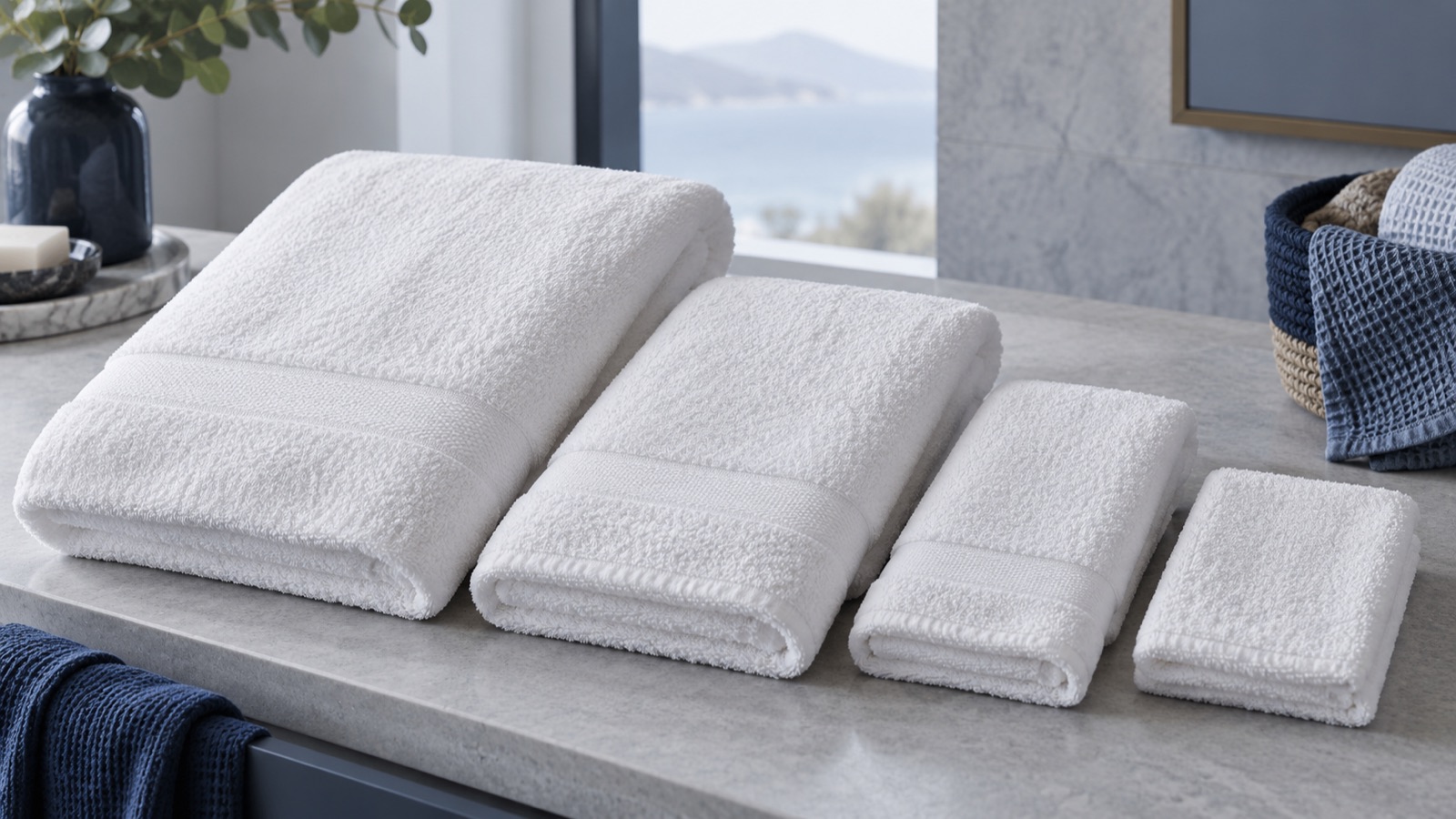
A coordinated hotel towel set begins with roles, not names. Define what each item must do, then state its exact finished width and length, acceptable tolerance, measurement condition and laundering requirement. “Bath towel”, “bath sheet”, “hand towel” and “face towel” are useful commercial labels, but they do not create one universal size specification.
The set should work as a system: the bath sheet is the oversized body towel, the bath towel is the main everyday body towel, the hand towel serves the basin area, and the face towel is the smallest personal-use piece. Their dimensions, weight, borders, colour and presentation should remain distinguishable without making laundry, storage or replacement unnecessarily complex.
Give every towel a role and a product code
Start with the guest and housekeeping task. A name alone can be interpreted differently by a buyer, manufacturer, laundry or destination market. ASTM International’s D5433-24 towel performance specification recognises washcloth, hand towel, bath towel and bath sheet products for institutional and household use, while also emphasising purchaser–supplier agreement. That makes the terms useful categories—not substitutes for an agreed dimension table.
| Set item | Primary role | What to make explicit |
|---|---|---|
| Face towel or washcloth | Small personal-use towel, commonly placed at the basin or bath | Square or rectangular format, intended use, quantity per guest and whether “face towel” and “washcloth” are the same SKU |
| Hand towel | Drying hands at the basin or washroom | Rail or ring fit, folded presentation, border orientation and replacement quantity |
| Bath towel | Main full-body drying towel for routine guest use | Body coverage, handling weight, fold size, storage depth and laundry throughput |
| Bath sheet | Oversized full-body towel offering more wrap and surface area | Meaningful size difference from the bath towel, hanging clearance, shelf volume and whether it is standard or optional |
Assign each item a stable product code such as HT-FACE-01 or HT-BATH-01. The code prevents a later email, purchase order or carton mark from relying on a label that could change meaning between teams.
Use dimensions as a planning ladder, not a global standard
The ranges below are an illustrative briefing tool only. They are not a hotel classification, regional standard or Son Ha stock specification. Actual ranges in the market overlap, especially between a large bath towel and a small bath sheet. Choose one exact finished dimension for each SKU after checking the property’s rooms and operating process.
| Item | Illustrative planning band (width × length) | Relationship to preserve |
|---|---|---|
| Face towel / washcloth | About 30–35 × 30–35 cm when square | Clearly the smallest piece; easy to distinguish by touch and fold |
| Hand towel | About 40–50 × 70–100 cm | Long enough for the chosen rail or fold, but clearly smaller than the body towels |
| Bath towel | About 65–80 × 130–150 cm | The core body towel and reference point for the programme |
| Bath sheet | About 85–100 × 150–180 cm | Visibly and functionally larger than the bath towel |
Do not turn the top or bottom of these bands into an automatic quality hierarchy. A larger towel uses more shelf, trolley, washer and dryer capacity. A compact towel may suit a particular room, climate or service model better. Record the selected metric dimensions; add inch conversions for communication if needed, but designate one unit system as controlling so rounding cannot create two specifications.
Specify whether dimensions are new, conditioned or after laundering
“70 × 140 cm” remains ambiguous unless the measurement state is stated. Is it the target as manufactured, the finished product after conditioning, or the minimum acceptable size after an agreed number of wash-and-dry cycles? Also define whether fringe is excluded, where measurement starts at the hem, and how distortion is handled.
ISO 3759:2011 provides a method for preparing, marking and measuring textile articles in dimensional-change tests. ISO 5077:2007 covers determination of dimensional change after an appropriate specified washing and drying procedure. These standards help make before-and-after comparison repeatable; they do not choose the hotel’s size or wash process. The buyer, factory, laboratory and laundry still need to agree the treatment, number of cycles, measurement points and acceptance tolerance.
Review width and length change separately. Terry construction, borders and hems can respond differently along the two directions, and an item may remain within an overall area expectation while becoming too narrow for its intended presentation. Use the towel shrinkage and tolerance guide to build this into approval records.
Coordinate the set without making every item identical
A set can share fibre composition, colour family, pile character, border design, label system and sewing standard while using different constructions or weights by role. A face towel may need a compact fold and frequent replenishment; a bath sheet may need controlled mass so its extra area does not overwhelm drying and storage. GSM is mass per unit area, so increasing both dimensions at the same GSM increases the piece weight.
Keep the visual hierarchy deliberate. Borders should stay proportionate to each towel rather than being copied at one width across the range. Confirm where embroidery or a woven motif sits after folding. If face and hand towels are close in dimension, vary the fold, border or product coding so housekeeping can identify them without opening every stack.
Colour decisions also operate at set level. A single shade can simplify presentation, while role-specific shades can support wayfinding but create more sorting and replacement SKUs. Compare these options with the white-versus-coloured hotel towel framework before approving the palette.
Test the set inside the hotel operation
- Map the number of each item placed per room, expected occupancy and replenishment policy.
- Check the exact rail, hook, shelf, basket, trolley and linen-chute dimensions.
- Calculate new piece weight from the approved sample rather than GSM alone.
- Fold and stage each item as housekeeping will present it, including branding orientation.
- Run representative samples through the intended wash and dry programme.
- Measure again using the agreed method and assess hand feel, distortion, border behaviour and appearance.
- Record processing time, load constraints, folding effort and replacement reasons by SKU.
Use the commercial-laundering specification guide to document chemistry and drying conditions, and compare alternatives with the cost-per-use framework. The largest towel is not automatically the best guest or procurement choice if it creates avoidable handling and processing costs.
Put a set schedule into the RFQ and purchase order
For each product code, record:
- agreed name, primary role and quantity per room or user;
- finished width × length, controlling unit and dimensional tolerance;
- measurement state, conditioning and wash/dry procedure where applicable;
- finished piece weight and GSM, each with its own tolerance;
- fibre content, yarn, pile, ground, border, hem and sewing requirements;
- colour or whiteness standard, branding position and folded presentation;
- care information, labels, packing ratio, carton identification and replenishment reference;
- sample stage, test method, acceptance criteria and retained approval sample.
Put the four SKUs in one controlled schedule so a dimension or border revision cannot be made to one item without checking its effect on the set. A signed sample should support the written specification, not replace it.
Questions hospitality buyers often ask
Is there one standard hotel bath towel size?
No single dimension should be assumed from the name alone. Properties, suppliers and markets use overlapping size conventions. State the exact finished width and length, tolerance and measurement condition in the specification.
What is the practical difference between a bath towel and a bath sheet?
A bath sheet is intended to provide more wrap and surface area. Define a meaningful dimensional difference in the actual set; otherwise two differently named products can become operationally indistinguishable.
Should all four towels use the same GSM?
Not automatically. Coordinate the desired appearance and feel, then evaluate piece weight, drying, storage and use by role. The same GSM produces a heavier item when its area increases.
Should hotel towel dimensions be specified before or after washing?
Specify both the initial measurement state and the acceptable result after the agreed laundering exposure when service dimensions matter. Name the test or operating procedure, number of cycles and tolerance.
How can housekeeping tell similar towels apart?
Use clearly separated dimensions, stable product codes and, where helpful, controlled differences in border, fold or shade. Confirm that identifiers remain practical after repeated laundering and do not confuse the guest presentation.
Sources
- ASTM D5433-24 — Standard Performance Specification for Towel Products for Institutional and Household Use — ASTM InternationalAccessed 5 October 2026
- ISO 3759:2011 — Textiles — Preparation, marking and measuring of fabric specimens and garments in tests for determination of dimensional change — International Organization for StandardizationAccessed 5 October 2026
- ISO 5077:2007 — Textiles — Determination of dimensional change in washing and drying — International Organization for StandardizationAccessed 5 October 2026
A note on specifications
Product performance, minimum order quantities, lead times, pricing and compliance requirements depend on the final specification, testing standard, order volume and destination market. This article provides general manufacturing information; confirm requirements with the factory and appropriately qualified testing, compliance and logistics advisers before ordering.